


Key Takeaways
- Owaisi’s ‘Jai Palestine’ statement sparks controversy in Indian Parliament.
- The statement raises questions about Muslim appeasement and parliamentary decorum.
- Owaisi’s actions may undermine the sanctity of parliamentary procedures and challenge India’s foreign policy.
- The incident highlights the deep divisions within Indian politics regarding international solidarity and the treatment of Muslims both domestically and globally.
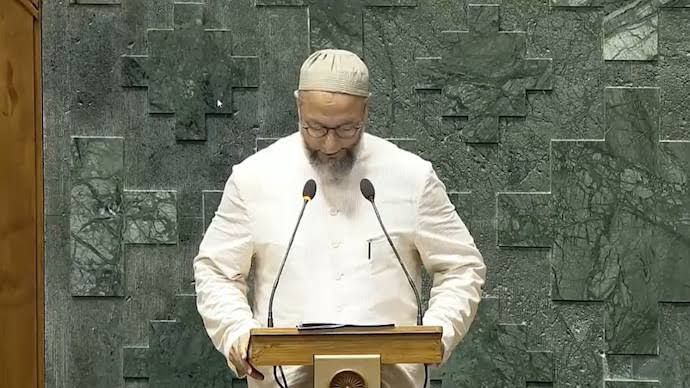
In a surprising and unprecedented move, Member of Parliament (MP) Asaduddin Owaisi of the All India Majlis-e-Ittehadul Muslimeen (AIMIM) concluded his oath-taking ceremony in the Indian Parliament by proclaiming ‘Jai Palestine’. This gesture has sparked significant controversy, highlighting the sensitive intersection of domestic politics, international relations, and parliamentary decorum in India.
Asaduddin Owaisi, the president of the All India Majlis-e-Ittehadul Muslimeen (AIMIM), is known for his outspoken stance on various issues concerning Indian Muslims and international Muslim solidarity. During the parliamentary oath-taking ceremony, instead of the conventional conclusion to the oath, Owaisi chose to end with “Jai Palestine,” a phrase expressing solidarity with the Palestinian cause against Israeli policies.
The Indian Constitution requires MPs to take an oath of office in a prescribed manner. Deviations from this script, like Owaisi’s ‘Jai Palestine’ statement, may be viewed as inappropriate or even unlawful.
The Parliament’s rulebook and conventions mandate that the oath be taken in a manner that reflects respect for the nation’s democratic and secular ethos. By inserting “Jai Palestine,” Owaisi potentially violated these norms, raising questions about the permissible limits of political expression within the framework of parliamentary procedures, especially when seen with Article 102 (1) (d) of The Constitution of India.
Such a statement undermines the solemnity of the occasion and diverts attention from domestic issues that require urgent attention. Owaisi has attempted to internationalize India’s parliamentary proceedings for political gain, thereby detracting from the country’s sovereignty and focus. Owaisi’s addition of “Jai Palestine” could set a precedent for other MPs to introduce personal or political causes into official proceedings, potentially leading to a fragmented and politically charged atmosphere in the Parliament.

India has a long history of supporting the Palestinian cause, dating back to its non-aligned movement stance during the Cold War. However, in recent years, India’s diplomatic relations with Israel have strengthened, leading to a more balanced approach to the Israeli-Palestinian conflict. Owaisi’s statement thus reintroduces a traditional stance that resonates with a section of the Indian populace, particularly among those who view the Palestinian struggle as analogous to other anti-colonial and human rights movements.
The incident underscores the deep divisions within Indian politics regarding international solidarity and the treatment of Muslims both domestically and globally. Owaisi’s gesture can be seen as an attempt to galvanize support from Indian Muslims by aligning their struggles with global Muslim issues, thereby strengthening his political base but also further polarising the Muslim community in India and creating an air of communally divisive politics.
The controversy reignites the debate on the limits of freedom of expression within parliamentary settings. While MPs have the right to express their views, the manner and context in which they do so are bound by rules intended to maintain the dignity and focus of parliamentary proceedings.
Asaduddin Owaisi’s decision to end his oath-taking with “Jai Palestine” has opened up a Pandora’s box of legal, political, and diplomatic questions. While his supporters would laud his courage and commitment to international Muslim solidarity, it should be argued that his actions undermine the sanctity of parliamentary procedures and could have broader implications for India’s foreign policy and domestic unity. This incident is a reminder of the complex interplay between national responsibilities and global solidarities, and the challenges faced by democracies in balancing individual expression with institutional integrity.