



Key Takeaways
- 2.2 million people across eastern Africa are battling floods and landslides, compounding years of drought.
- The UN’s OCHA highlights severe impacts in Somalia (468,000 affected) and South Sudan (over 1 million affected).
- Projected climate patterns like El Niño and a positive Indian Ocean Dipole may worsen conditions through September.
- Displacement, damaged WASH infrastructure, and heightened disease risk are driving urgent humanitarian needs.
Nairobi: More than 2.2 million people are facing destructive floods and landslides in eastern Africa since mid‑2022.
Many have already endured five consecutive seasons of drought, the UN humanitarian agency reported on Thursday.
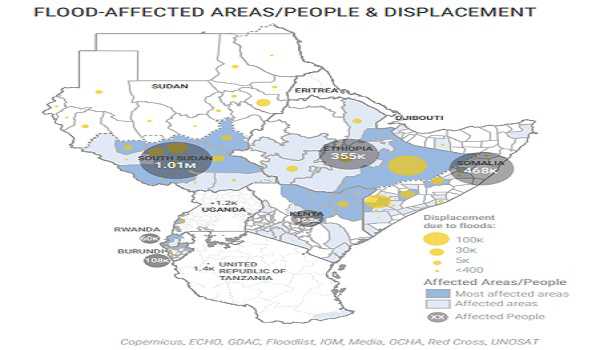
“In Somalia, over 468,000 people have been impacted by flooding, with at least 247,000 people displaced,” the UN Office for the Coordination of Humanitarian Affairs (OCHA) said in its latest regional floods Update.
The agency warned that widespread floodwaters, damage to water, sanitation and hygiene (WASH) infrastructure and facilities, and large-scale displacement have all increased the risks of water-borne diseases.
OCHA said persistent flooding in South Sudan from July 2022 to 2023 has affected at least one million people, many of whom are facing urgent needs due to conflict and violence.
According to OCHA, flooding in Sudan last year displaced at least 90,000 people, and the 2023 season is set to intensify in the coming months, June to September, including in areas impacted by the conflict which began on April 15, raising concerns about a cycle of displacement and escalating needs.

Ethiopia has also been affected, with more than 355,000 individuals hit by floods, it said.
The UN agency said intense seasonal flooding and landslides have also struck at least 60,000 people in Rwanda and 108,000 in Burundi, while in Kenya, riverine and flash floods have affected at least 163,000 people during the long rains (March-April-May 2023).
Uganda and Tanzania have also reported incidents related to heavy rains, it said.
The Intergovernmental Authority on Development (IGAD), the East African bloc, has forecast that coastal Somalia, southeastern Ethiopia and coastal Kenya are expected to see increased rainfall from June to September.
According to the latest forecast from the IGAD Climate Prediction and Applications Center, a likely combination of El Nino and a positive Indian Ocean Dipole (IOD) is predicted for the rest of the year, possibly causing wetter conditions in eastern Africa, although forecasts remain uncertain.
The last positive IOD in eastern Africa, in 2019, caused widespread flooding affecting at least 3.4 million people and contributed to a serious and widespread desert locust outbreak, the UN said.