

Key Takeaways
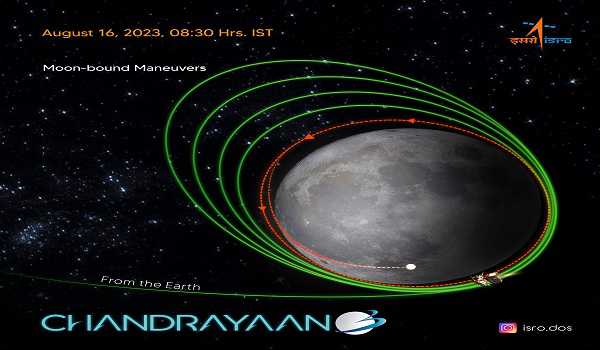
- The lunar bound maneuvres have been completed, bringing Chandrayaan-3 to a 153 km × 163 km orbit.
- Separation of the Lander Module from the Propulsion Module is scheduled for August 17, 2023.
- The mission aims for a soft landing in the Moon’s South Polar region on August 23.
Chennai: The Lunar bound maneuvres of India’s third moon Mission Chandrayaan-3 were completed on Wednesday.
By reducing its orbit for the fourth time, ISRO set the stage for the separation of the Lander Module (LM) from the Propulsion Module (PM) and from the spacecraft tomorrow.
The firing was done for a short duration and the Chandrayaan spacecraft is now just 163 km from the moon’s surface.
ISRO said it’s time for preparations as the Propulsion Module and the Lander Module gear up for their separate journeys”.
The Indian Space Agency tweeted “Today’s successful firing, needed for a short duration, has put Chandrayaan-3 into an orbit of 153km x 163km, as intended.”
“With this, the lunar bound maneuvres are completed”, it said. “It’s time for preparations as the Propulsion Module and the Lander Module gear up for their separate journeys” ISRO said.

“Separation of the Lander Module from the Propulsion Module is planned for August 17, 2023 (tomorrow)”, ISRO added.
After entering the Lunar Orbit on August five, the Chandrayaan-3 spacecraft underwent four orbit reduction maneuvres till date and moved very closer to the moon’s surface.
The earlier three orbit reduction maneuvres were performed on August 6, 9 and 14, gradually moving the 3 spacecraft closest to the moon’s surface ahead of soft landing on August 23.
After the separation of the Lander Module, a series of complex braking maneuvers will be executed to facilitate a soft landing in the hitherto unexplored South Polar region of the Moon on August 23.
The Space Agency said the health of Chandrayaan-3 is normal. “Throughout the mission, the health of the spacecraft is being continuously monitored from the Mission Operations Complex (MOX) at ISRO Telemetry, Tracking, and Command Network (ISTRAC), the Indian Deep Space Network (IDSN) antenna at Byalalu, near Bengaluru, with the support from European Space Agency (ESA) and JPL Deep space antenna.