

Key Takeaways
- The Chang’e-6 mission marks a major breakthrough in human spaceflight, paving the way for a deeper understanding of the moon’s evolution.
- The mission represents a significant milestone in the history of human lunar exploration and will contribute to a more comprehensive understanding of lunar evolution.
- The China National Space Administration has successfully landed the return capsule of the Chang’e-6 probe on Earth, bringing back the world’s first samples collected from the moon’s far side.
Beijing: The returner of the Chang’e-6 probe touched down on Earth on Tuesday, bringing back the world’s first samples collected from the moon’s far side.
The return capsule landed precisely in the designated area in Siziwang Banner, north China’s Inner Mongolia Autonomous Region, and the mission is a complete success, according to the China National Space Administration (CNSA).
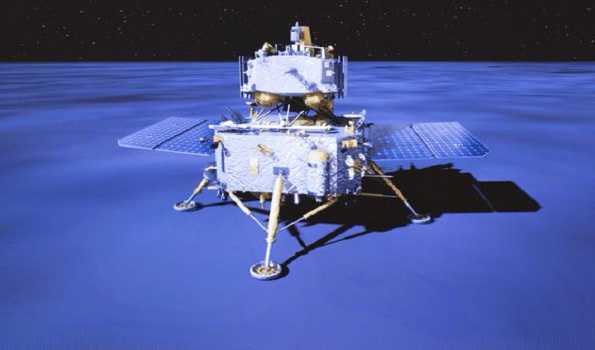
Chang’e-6 is one of the most complex and challenging missions in China’s space exploration efforts to date. Consisting of an orbiter, a returner, a lander and an ascender, it was launched on May 3 this year, and has gone through various stages such as Earth-moon transfer, near-moon braking, lunar orbiting and separation of the lander-ascender combination and the orbiter-returner combination.
Supported by the Queqiao-2 relay satellite, the lander-ascender combination landed at the designated landing area in the South Pole-Aitken (SPA) Basin on the far side of the moon on June 2 and carried out sampling work.

On June 4, the ascender took off from the moon with samples and entered the lunar orbit. On June 6, it completed rendezvous and docking with the orbiter-returner combination and transferred samples to the returner. The ascender then separated from the combination and landed on the moon under ground control to avoid becoming space junk.
The orbiter-returner combination spent 13 days in lunar orbit, awaiting the right opportunity to return to Earth. After completing two moon-Earth transfer maneuvers and one orbital correction, the returner separated from the orbiter and delivered the samples to Earth.
“The Chang’e-6 mission represents a significant milestone in the history of human lunar exploration, and it will contribute to a more comprehensive understanding of lunar evolution,” said Yang Wei, a researcher at the Institute of Geology and Geophysics of the Chinese Academy of Sciences.
“New samples will inevitably lead to new discoveries. Fascination with the moon is rooted in Chinese culture down the ages, as evidenced by the mythological narrative of Chang’e, a lady who journeyed to and resided on the moon. Now, Chinese scientists are eagerly anticipating the opportunity to contribute to lunar science,” Yang added.