


Key Takeaways
- Budget 2026–27 allocates a record ₹1,05,530.42 crore for the Ministry of Health & Family Welfare, making healthcare a pillar of national development.
- The Budget 2026–27 marks a significant shift in India’s healthcare story, moving from shortages to scale, systems, and strategic ambition.
- The key initiatives in Budget 2026–27 for healthcare transformation in India include the Pradhan Mantri Ayushman Bharat Health Infrastructure Mission (PM-ABHIM), the expansion of AIIMS, and the strengthening of hospital networks and service quality.
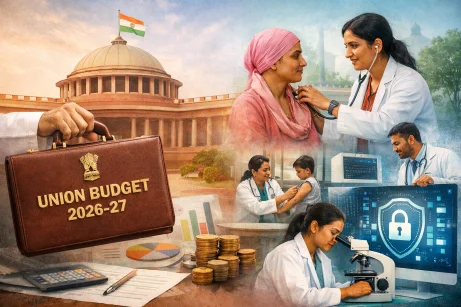
India’s healthcare story is no longer about shortages and struggle – it is steadily becoming a story of scale, systems, and strategic ambition. The Union Budget 2026–27 makes that shift unmistakably clear. With a record allocation of ₹1,05,530.42 crore for the Ministry of Health & Family Welfare, the message is direct: healthcare is no longer a welfare afterthought; it is now a pillar of national development.
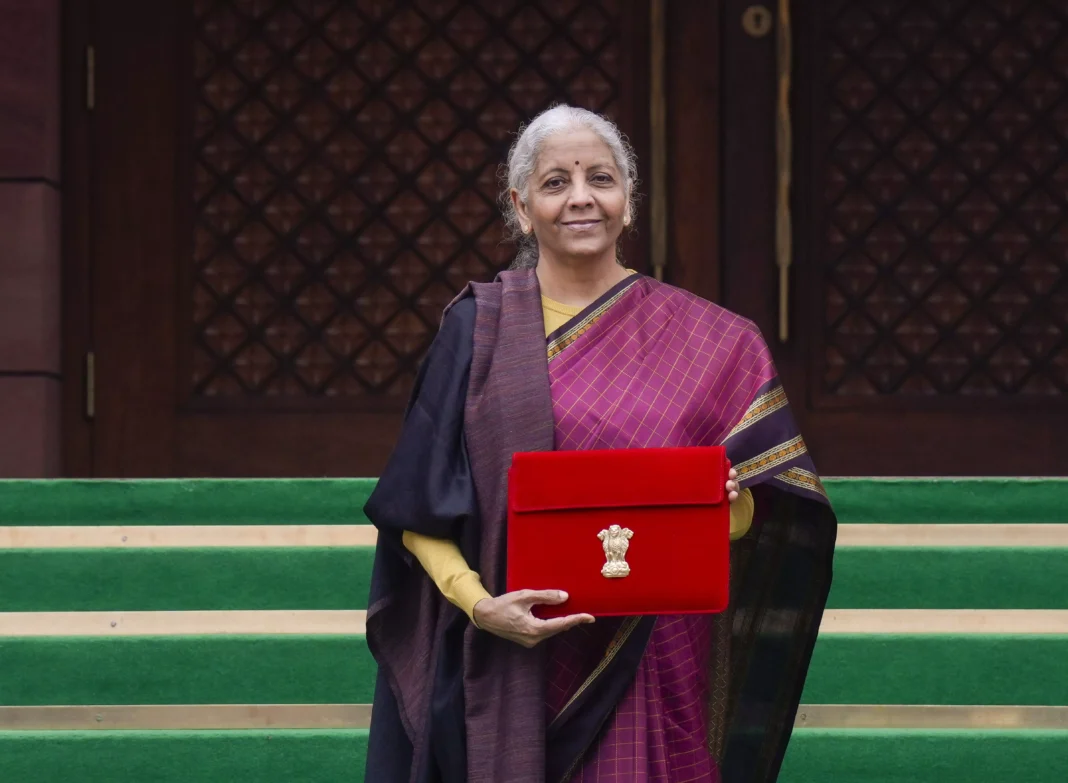
When Finance Minister Nirmala Sithraman laid out the numbers in Parliament, what emerged was not just a balance sheet but a blueprint. Under the leadership of Prime Minister Narendra Modi, India’s healthcare vision is clearly moving toward universal access, modern infrastructure, and global competitiveness. An 8.96% rise over last year’s revised estimates might sound incremental to the untrained ear, but in public health economics, sustained annual increases are what build resilient systems.
Consider the long arc of change: since 2014–15, health allocations have risen by over 176%, translating into an additional ₹63,677.89 crore. That’s not a token bump – that’s structural commitment. It signals that healthcare is now seen as both social protection and economic investment.
At the heart of this expansion is insurance-led access. The Pradhan Mantri Jan Arogya Yojana (PM-JAY) – the world’s largest government-funded health assurance scheme – now receives ₹9,500 crore. This strengthens hospital networks and improves service quality for millions of vulnerable families. More importantly, it deepens the financial protection shield that prevents illness from turning into poverty.
Parallel to this, the National Health Mission (NHM) allocation rises to ₹39,390 crore. NHM remains the backbone of primary healthcare – from maternal services to disease control – and its strengthening ensures that healthcare delivery is not just urban and elite, but rural and grassroots.
Infrastructure, long India’s Achilles’ heel, gets a powerful boost under the Pradhan Mantri Ayushman Bharat Health Infrastructure Mission (PM-ABHIM), with a 67.66% jump in allocation. Critical care blocks, district labs, and upgraded hospitals will now move from plan to reality. If COVID taught India anything, it was this: beds, oxygen, and labs save lives. This budget ensures we are better prepared next time.
Medical education is another silent revolution underway. Under PMSSY and the expanding AIIMS network, new institutions are rising in regions that once had none. Today, 18 AIIMS are functional, with more coming up. MBBS, postgraduate, and super-specialty seats have surged since 2014. This is not just about doctors; it is about decentralising excellence.
Disease control also gets sharper focus. Funding for the National AIDS and STD Control Programme jumps by over 30%, while blood transfusion services see a major boost. This shows a government willing to invest in preventive and public health – areas that rarely make headlines but quietly save millions of lives.

One of the most forward-looking moves in this budget is the ₹980 crore plan to expand allied health education. India is preparing nearly one lakh skilled professionals and training 1.5 lakh geriatric caregivers. With an ageing population and rising non-communicable diseases, this is strategic foresight. Healthcare is not just about surgeons – it is about technicians, therapists, and caregivers who form the system’s foundation.
Digital health, too, advances with higher funding for the Ayushman Bharat Digital Mission. Interoperable records and telemedicine are no longer futuristic ideas; they are becoming everyday tools. In a country where geography often dictates access, digital bridges can be transformative.
Research and innovation receive a major shot in the arm. The Indian Council of Medical Research (ICMR) sees a 26.98% rise in allocation. That means more indigenous research, faster trials, and stronger pandemic preparedness. Simultaneously, regulatory strengthening of the CDSCO promises better drug oversight while easing pathways for innovation.
The proposed Bio Pharma Shakti initiative, with ₹10,000 crore over five years, could be a game changer. By building capacity in biologics and biosimilars, India aims to move up the pharmaceutical value chain – from generics powerhouse to innovation leader. New and upgraded NIPER institutions and a network of 1,000 clinical trial sites will help anchor this ambition.
Patients, too, get direct relief. Customs duty exemptions on life-saving drugs and expanded support for rare diseases will lower treatment costs. Meanwhile, mental health receives overdue attention with upgrades to key institutions and plans for a new NIMHANS in North India. Emergency and trauma centres in every district hospital promise faster critical care – where minutes often decide survival.
Taken together, this budget does not treat healthcare as a single scheme or slogan. It approaches it as an ecosystem – financing, infrastructure, human resources, research, digital systems, and regulation moving in sync.
India’s healthcare journey is far from complete. Gaps remain, especially in rural quality, specialist access, and preventive health behaviour. But what this budget signals is intent backed by investment. And in governance, sustained intent is what ultimately changes outcomes.
The 2026–27 health outlay is not just an expenditure line. It is a declaration that a healthier India is central to a stronger India – economically, socially, and strategically.