


New Delhi: In a virtually please-all Budget ahead of general elections early next year, Finance Minister Nirmala Sitharaman on Wednesday proposed to provide tax reliefs to the middle class while raising capex by a whopping 33 pc to Rs 10 lakh in FY24 to spur economic growth.
The Minister proposed to increase the rebate limit to Rs 7 lakh in the new personal income tax regime. She also announced changes in the tax structure in this regime by reducing the number of slabs to five and increasing the tax exemption limit to Rs 3 lakh.
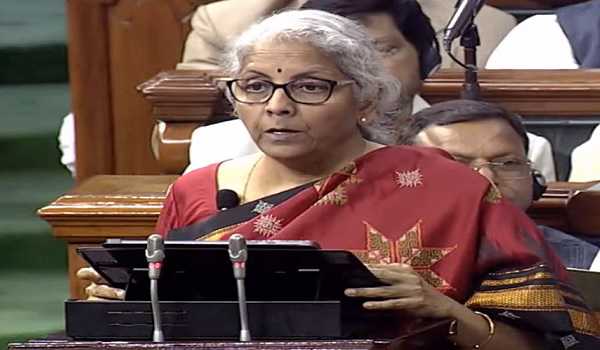
“Currently, those with income up to Rs 5 lakh do not pay any income tax in both old and new tax regimes. I propose to increase the rebate limit to Rs 7 lakh in the new tax regime. Thus, persons in the new tax regime, with income up to Rs 7 lakh will not have to pay any tax,” Sitharaman said amid loud thumping by lawmakers in the Lower House of the Parliament.
“I had introduced, in the year 2020, the new personal income tax regime with six income slabs starting from Rs 2.5 lakh. I propose to change the tax structure in this regime by reducing the number of slabs to five and increasing the tax exemption limit to Rs 3 lakh,” the Minister further said.
Accordingly, the FM said, the proposal will provide major relief to all taxpayers in the new regime.
“An individual with an annual income of Rs 9 lakh will be required to pay only Rs 45,000. This is only 5 per cent of his or her income. It is a reduction of 25 per cent on what he or she is required to pay now, i.e., Rs 60,000. Similarly, an individual with an income of Rs 15 lakh would be required to pay only Rs 1.5 lakh or 10 per cent of his or her income, a reduction of 20 per cent from the existing liability of Rs 1,87,500,” she said.
For salaried class and pensioners, the Minister proposed to extend the benefit of standard deduction to the new tax regime. As a result, each salaried person with an income of Rs 15.5 lakh or more will stand to benefit by Rs 52,500.
The Minister also proposed to reduce the highest surcharge rate from 37 per cent to 25 per cent in the new tax regime. This would result in reduction of the maximum tax rate to 39 per cent.

The limit of Rs 3 lakh for tax exemption on leave encashment on retirement of non-government salaried employees has also been increased to Rs 25 lakh.
Betting big on infrastructure development to spur growth in the economy, Finance Minister Nirmala Sitharaman proposed to raise capital expenditure by 33% to Rs 10 lakh crore.
Presenting the last full Budget of the Modi 2.0 government in Lok Sabha, Sitharaman said that investment in infrastructure and productive capacity have a large multiplier impact on growth and employment.
“After the subdued period of pandemic, private investments are growing again. Budget takes the lead once again to ramp up the virtuous cycle of investment and job creation. The capital investment outlay is being increased steeply for the third year in a row by 33% to Rs 10 lakh crores which would be 3.3% of GDP. This will almost be three times the outlay made in 2019-20,” Sitharaman said while presenting Budget 2023.
The Finance Minister said that the substantial increase in public spending on infrastructure in recent years is central to the government’s efforts to enhance growth potential and job creation, crowd in private investment and provide a cushion against global headwinds.
“The direct capital investment by the Centre is complemented by the provision made for creation of capital assets through grants-in-aid to states. The effective capital expenditure of the Centre is budgeted at Rs 13.7 lakh crore which will be 4.5% of GDP,” said the Minister.
Sitharaman announced to continue the 50-year interest free loan to state governments for one more year to spur investment in infrastructure and to incentivise them for complementary policy actions, with a significantly enhanced outlay of Rs 1.3 lakh crore.
Proposing tweaks in indirect taxes, the Minister said that indirect tax proposals aim to promote exports, boost domestic manufacturing, enhance domestic value addition, encourage green energy and mobility.