






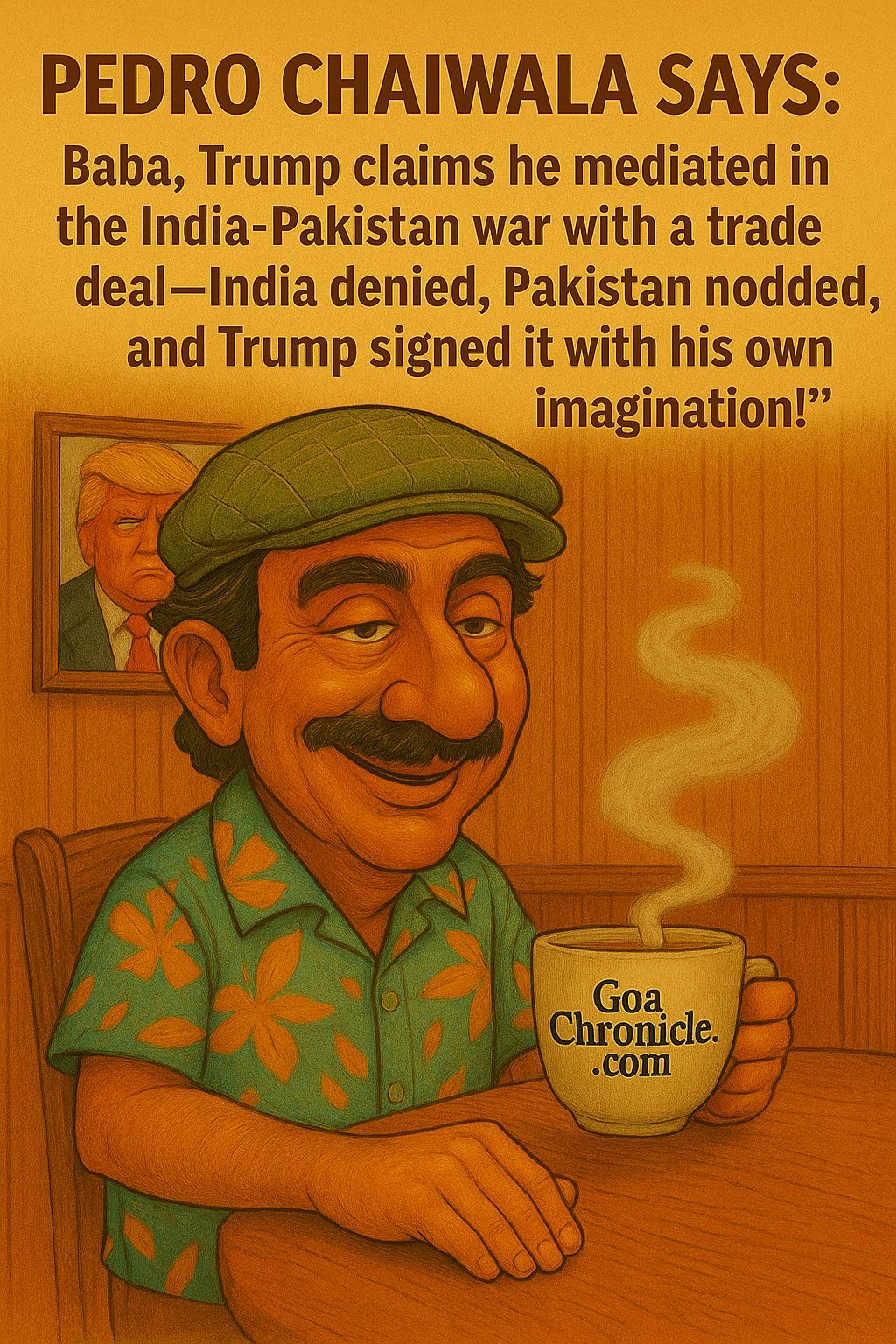

In the twenty-first century, power no longer resides only in armies, institutions, or territory. It increasingly resides in legitimacy, in the story a state tells about itself, and in how convincingly that story travels across borders. This was the core argument I advanced earlier in my article published in Goa Chronicle.
The dramatic events in Venezuela, culminating in the Nobel legitimisation of an opposition leader and the forcible removal of a sitting president, now offer a stark, real-world validation of that thesis. Venezuela is not a distant Latin American drama. It is a case study of how states lose strategic control when legitimacy erodes and narrative authority slips beyond national command.
For India, the lessons are neither theoretical nor optional.
Venezuela’s Core Fault Line: Power Without Consent
For years, Venezuela existed in a condition of political suspension. President Nicolás Maduro retained control over institutions, security forces, and electoral machinery, yet steadily lost democratic credibility. Elections were conducted, but consent was absent. Authority survived; legitimacy did not.
Into this vacuum stepped María Corina Machado, who unified a fragmented opposition and won the primaries with an unambiguous mandate rooted in democratic aspiration rather than coercion. The regime’s response, barring her from contesting the presidential election, exposed the central weakness of authoritarian systems: they can monopolise force, but they cannot manufacture legitimacy.
From that point onward, Venezuela’s strategic room began to narrow irreversibly.
The Nobel Peace Prize: When Moral Authority Becomes Strategic Weight
The Nobel Committee’s decision to award the Peace Prize to Machado did not alter Venezuela’s power balance overnight. But it changed the geometry of the conflict.
Historically, Nobel Prizes awarded to dissidents internationalise domestic struggles, raise the cost of repression, and convert moral authority into diplomatic leverage. Machado’s Nobel achieved precisely that. She gained no institutions and no coercive power, but she acquired international political protection rooted in legitimacy.
It is important to restate a basic but often distorted fact: a Nobel Peace Prize cannot be transferred, traded, or reassigned. Symbolic dedication is possible; transactional exchange is not. This reality alone dismantles the later rumours of political bargaining.
For India, the implication is structural rather than episodic: legitimacy today functions as a deterrent capability, not merely as a moral attribute.
From Symbolism to Distortion: The Collapse of Narrative Control
Machado later acknowledged that sustained international pressure, including during the Trump years, had constrained the Maduro regime. This was a political observation. In a stable narrative environment, it would have remained just that.
But Venezuela no longer possessed narrative stability.
Gratitude was reframed as endorsement.
Observation became intention.
Symbolism mutated into transaction.
This distortion did not occur in isolation. It coincided with an event that decisively altered the global perception of Venezuelan sovereignty.
The Abduction of Nicolás Maduro: When Sovereignty Became Conditional
In early January 2026, Nicolás Maduro was forcibly seized and removed from Venezuelan territory by U.S. forces and taken into custody to face criminal charges. Maduro himself described the act as a kidnapping, a characterisation echoed by several international observers and legal scholars.
Whether framed as law enforcement or abduction, the physical reality is uncontested: sovereignty was overridden by external force without a UN mandate.
This moment marked a profound rupture in international norms. Once democratic legitimacy had collapsed, sovereignty ceased to function as an absolute shield. It became conditional, subject to interpretation, justification, and ultimately, action.
Cognitive Shock and the Spread of Implausible Narratives
In the aftermath of Maduro’s removal, rumours of secret deals, traded Nobel Prizes, and externally brokered regime installation proliferated. These narratives did not spread because they were factual, but because extraordinary actions expand the public’s sense of plausibility.
This phenomenon, cognitive shock, is central to modern narrative warfare. When norms collapse, imagination outruns evidence. Narrative chaos follows legitimacy collapse as predictably as night follows day.
This is where Venezuela’s experience becomes directly relevant for India.
India’s Strategic Lens: Why Venezuela Matters
The Venezuelan crisis underscores a reality that Indian strategic thinking has long intuited but must now formalise:
internal legitimacy and narrative coherence are the first lines of national defence.
This becomes especially clear when Venezuela’s trajectory is contrasted with India’s handling of internal security challenges, particularly in Jammu & Kashmir.

Internal Security, Narrative Discipline, and the Pahalgam Experience
India’s experience in Pahalgam offers a revealing counterpoint.
In multiple terror incidents associated with the Pahalgam region, civilians were deliberately targeted after their religious identity was ascertained. This was not random violence. It was designed narrative warfare, intended to fracture social cohesion, provoke communal escalation, and delegitimise the Indian state from within.
India’s response was instructive not for its intensity, but for its restraint.
Counter-terror operations were conducted within constitutional and legal frameworks. The State refused to allow religion-based targeting to redefine the nature of the conflict. Violence was framed consistently as terrorism, not communal unrest. Civilian protection, continuity of tourism, and restoration of normalcy were prioritised to deny adversaries their strategic objectives.
Equally significant was India’s external messaging. The issue was not allowed to be internationalised as a religious or civil conflict. Narrative sovereignty was preserved even under severe provocation.
This was not caution. It was strategic discipline.
Legitimacy as Deterrence: A Strategic, Not Moral, Concept
Venezuela demonstrates that once legitimacy erodes, external interpretation begins, and with it, external action. India’s experience shows the inverse: when legitimacy is maintained, force remains anchored within sovereignty.
Democratic credibility, judicial integrity, and constitutional process are therefore not merely governance ideals. They are deterrence multipliers. They constrain the narrative space available to adversaries and raise the political cost of coercion by external actors.
For India, legitimacy must be understood not as virtue signalling, but as strategic armour.
Narrative Control Is Not Propaganda
The Venezuelan case also clarifies a common misunderstanding. Narrative control in statecraft does not mean distortion or propaganda. It means occupying narrative space early, factually, and consistently.
Once Venezuela lost that space, legal arguments became reactive. Sovereignty claims followed force rather than preceding it.
India’s conduct in Pahalgam reflects a different approach: narrative framing moved in parallel with security action, not after it. This sequencing matters.
Sovereignty in a Norm-Eroding World
Perhaps the most sobering lesson from Venezuela is that sovereignty is no longer treated as inviolable when legitimacy collapses. Norms have not disappeared, but their application has become selective.
India must absorb this lesson without alarmism but without complacency. Size, history, and restraint do not automatically guarantee insulation. What protects sovereignty in practice is a combination of legitimacy, capability, and narrative coherence.
External “Rescue” Narratives and Strategic Autonomy
Venezuela also illustrates the destabilising effect of externally shaped political outcomes. Even when interventions claim moral or legal justification, they hollow domestic political agency and leave long-term stability uncertain.
India’s resistance to external arbitration, often criticised as rigidity, appears, in this light, as prudence. Strategic autonomy is not ideological posture; it is survival logic.
From Case Study to Doctrine
Venezuela should not remain an anecdote in Indian strategic discourse. It should inform doctrine.
India must institutionalise: legitimacy preservation as a national security objective, narrative preparedness as part of security planning, legal framing as a precondition to force, and internal cohesion as a deterrence multiplier.
These are operational requirements in an environment where internal fractures are rapidly externalised.
Conclusion: The Lesson India Cannot Ignore
Venezuela’s collapse was not sudden. It was cumulative. Each erosion of legitimacy narrowed strategic space until sovereignty itself became conditional.
India’s experience, particularly in Pahalgam, demonstrates an alternative pathway: one where force does not outrun legitimacy, where provocation does not dictate narrative, and where sovereignty is defended first from within.
That contrast is not accidental. It is strategic.
And that is the lesson India must carry forward.