

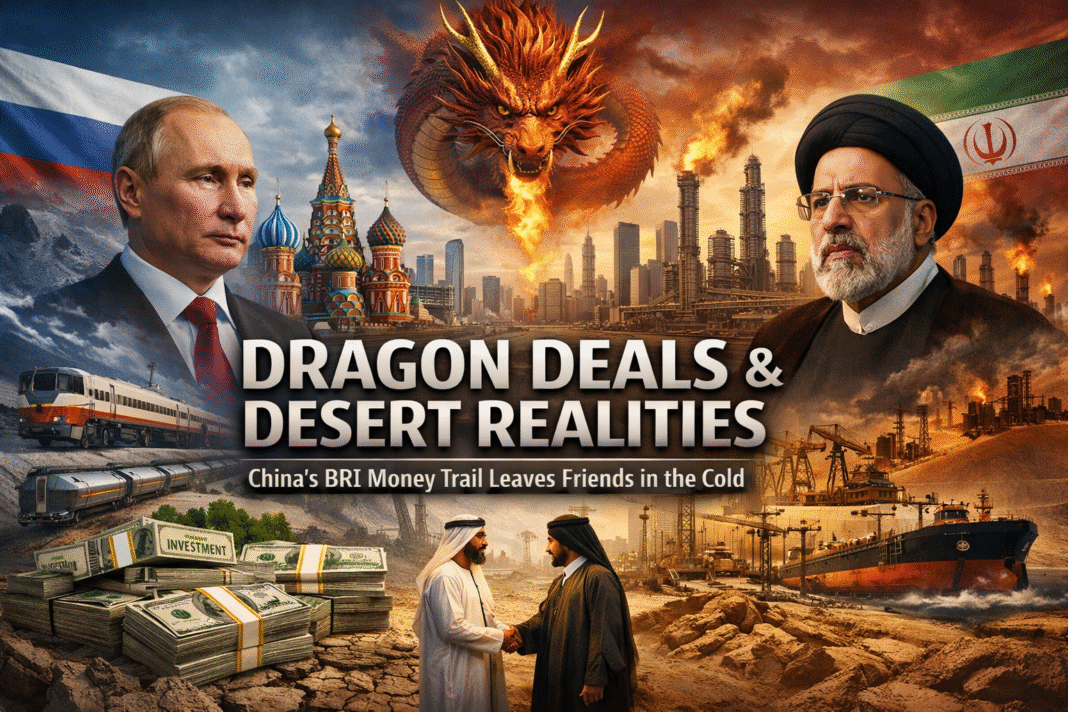

There’s a sharp geopolitical irony unfolding across Eurasia and the Middle East. Two of China’s most vocal strategic partners – Russia and Iran – are learning that in Beijing’s world, rhetoric may be generous, but investment is ruthlessly selective. The slogans of “multipolarity” and “strategic partnership” sound impressive at summits, but when it comes to writing cheques under the Belt and Road Initiative (BRI), China is behaving less like a revolutionary ally and more like a hard-nosed global banker.
Fresh data from the Green Finance and Development Centre (GFDC) reveals that China’s overseas engagement under the BRI surged dramatically last year. Chinese overseas investment in BRI projects jumped 62 percent compared to the previous year, exceeding $85 billion. Even more striking, the value of Chinese construction contracts tied to BRI projects soared 81 percent, crossing $128 billion. After years of pandemic slowdowns and debt concerns, Beijing’s global infrastructure machine is clearly revving up again. But where the money is going tells a story far more revealing than the headline totals.
Start with Russia, the country that publicly calls China its most important strategic partner in the face of Western pressure. If political alignment translated into infrastructure investment, Russia should be awash in Chinese-funded railways, ports, and industrial corridors. Instead, it is barely on the map. While Chinese investment in Central Asia surged by a staggering 375 percent to reach $28.5 billion, Russia received just $674 million. That is not a minor difference – it is thirty-eight times less than what flowed into Kazakhstan alone, a country that lies firmly within what Moscow has long considered its backyard.
This contrast is not accidental. Central Asia offers China critical overland trade corridors linking western China to Europe, the Caucasus, and the Middle East. Investing in roads, rail networks, pipelines, and logistics hubs there strengthens Beijing’s supply chain resilience and reduces reliance on maritime chokepoints. Doing the same inside Russia, however, carries enormous sanctions risk. Major Chinese banks, insurers, and state-owned enterprises operate globally and depend on access to dollar-based financial systems and Western markets. Deep exposure to heavily sanctioned Russian projects could trigger secondary sanctions and jeopardise those broader interests. So Beijing is threading the needle: maintaining political warmth with Moscow while directing serious capital to neighbouring states that serve China’s trade strategy without carrying the same financial toxicity.
Iran’s story is even more sobering. Four years ago, Tehran and Beijing signed a sweeping ‘Comprehensive Cooperation Agreement’ that was widely touted as paving the way for $400 billion in Chinese investment over 25 years. It was presented as a geopolitical breakthrough that would anchor Iran firmly in Asia’s economic orbit and blunt the impact of U.S. sanctions. Yet the latest figures show that Iran received no Chinese BRI investment last year. Not a slowdown – a complete absence.
In practice, the main channel of economic cooperation between China and Iran has been oil. China has continued to purchase heavily discounted Iranian crude, often routed through small independent ‘teapot’ refineries that operate with lower international exposure. Even this trade, however, has shown signs of strain. According to data from Kpler, Iranian oil shipments to China fell by 40 percent in the second half of last year, dropping to around one million barrels per day by year’s end. The grand vision of hundreds of billions in infrastructure, transport links, and industrial zones has, for now, narrowed to cautious energy purchases that themselves fluctuate under sanctions pressure.

While Russia and Iran – both loudly aligned with Beijing on the geopolitical stage – saw minimal benefit from the BRI resurgence, other countries experienced a windfall. The Middle East emerged as a major hub of Chinese construction activity, with contract volumes reaching $39.5 billion, second only to Africa. The top beneficiaries were not the most sanctioned or ideologically aligned states, but those offering scale, stability, and manageable risk.
Saudi Arabia stands out. Chinese BRI engagement in the Kingdom reached $19.8 billion last year, the third highest globally. Of that, approximately $5.2 billion went into green energy projects, reflecting China’s growing focus on renewables and energy transition technologies abroad. Total Chinese BRI investment in Saudi Arabia from 2013 through last year now amounts to about $40 billion, making it the second-largest cumulative recipient after Pakistan. Iraq also featured prominently, attracting $4.5 billion in Chinese engagement, while Egypt ranked among the top destinations with $10.2 billion.
Then there is Kazakhstan, which emerged as the single largest recipient of BRI investment in 2025, pulling in roughly $25.8 billion. Its geography makes it indispensable to China’s overland connectivity ambitions, and its political positioning allows Beijing to invest heavily without triggering the same level of sanctions scrutiny associated with Russia or Iran. The message is unmistakable: geography plus financial pragmatism beats ideological alignment.
Since its launch in 2013, the Belt and Road Initiative has evolved from a bold vision of sprawling mega-projects into a more calibrated and commercially disciplined strategy. Cumulative engagement tracked by the Green Finance & Development Center has now reached around $1.4 trillion, including about $837 billion in construction contracts and $561 billion in non-financial investments. But today’s BRI is more selective than its early incarnation. Beijing is placing greater emphasis on green energy, digital infrastructure, logistics efficiency, and projects with clearer revenue prospects. Debt sustainability concerns in partner countries and financial exposure risks for Chinese lenders have forced a shift from political symbolism to economic viability.
For Russia and Iran, the lesson is stark. Being anti-West does not automatically make a country a priority destination for Chinese capital. Strategic partnership rhetoric does not override balance-sheet realities. Beijing may oppose Western sanctions in principle, but it is not willing to let its flagship global companies and banks become collateral damage in someone else’s confrontation. China’s global strategy is not about forming an ideological bloc; it is about building networks of trade, energy, and infrastructure that serve its long-term economic interests while minimising systemic risk.
The BRI money is flowing again, and in large volumes. But it is flowing like water, following the path of least resistance. It is heading toward countries that can host major projects without endangering China’s access to global markets and finance. In that calculus, quiet pragmatists are beating loud partners. The dragon is not abandoning its friends; it is simply refusing to subsidise their isolation. And in the cold arithmetic of global infrastructure finance, that distinction makes all the difference.