


Key Takeaways
- Naxalism in India began in 1967 in Naxalbari, West Bengal, and has since spread across forested, mineral-rich regions in eastern India.
- The Indian government has responded to Naxalism with a mix of military and development strategies, including the adoption of the SAMADHAN doctrine and the implementation of development overlays.
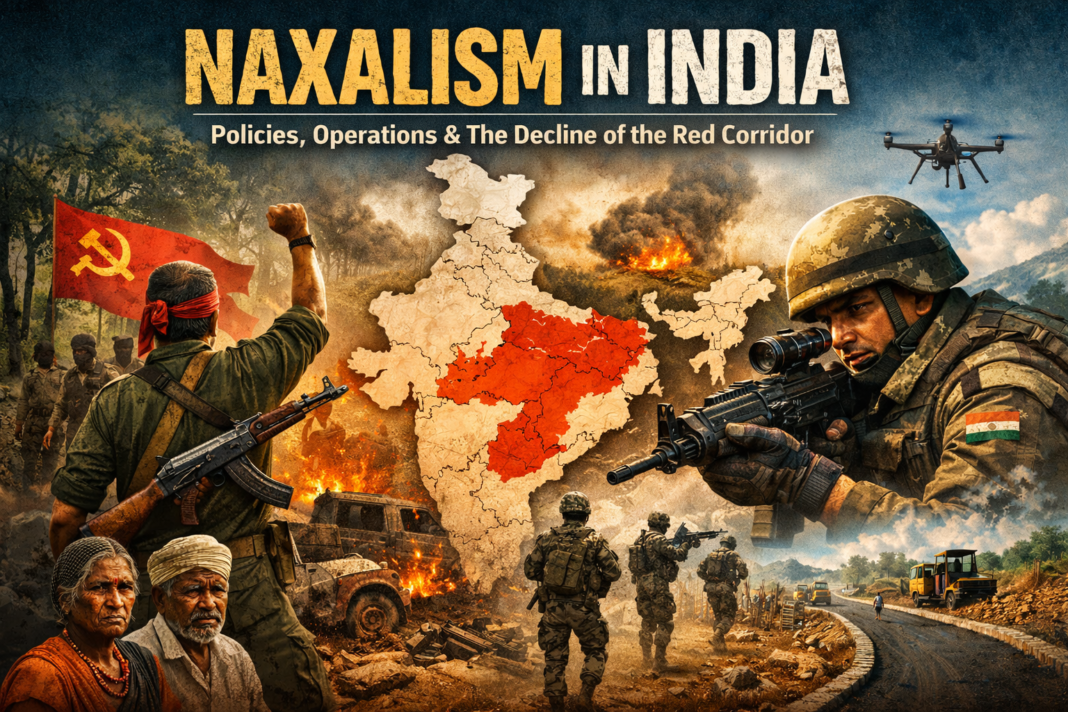
- The Red Corridor, a region in eastern India affected by the Maoist insurgency, has seen significant declines in violence and activity in recent years.
Origins and Ideology
How a peasant revolt evolved into India’s longest-running insurgency.
The Naxal movement began in 1967 in Naxalbari, West Bengal, as a radical peasant uprising against entrenched feudal structures. Over time, splinter groups spread across forested, mineral‑rich regions, drawing strength from Adivasi alienation, land dispossession, and the absence of state institutions. The formation of the People’s War Group (PWG) in undivided Andhra Pradesh in 1980, and its merger with the Maoist Communist Centre of India (MCCI) in 2004, to form the CPI (Maoist), created a unified insurgent command with a long-term strategy to wage a “people’s war.”
The Red Corridor, a region in eastern India, was formed by the spread of Naxalism across several states, including Bihar, Jharkhand, West Bengal, Chhattisgarh, and Andhra Pradesh. Tamil Nadu, Karnataka, and Kerala also saw sporadic Maoist activity.
The Maoist Playbook
Terrain, ideology, and the mechanics of guerrilla control.
CPI (Maoist) built influence through a mix of ideology, coercion, and parallel governance. They established “janatana sarkars” – shadow administrations – in remote areas, levying taxes, running people’s courts, and blocking state projects. Their tactics included ambushes, IEDs, political assassinations, and attacks on security forces. As one senior officer observed, “They fought with the terrain as their ally and the state as an intruder.”
UPA’s Fragmented Response
Militarised experiments, development gaps, and mixed outcomes.
During the 2000s and early 2010s, the Congress‑led UPA government labelled Naxalism as India’s “single biggest internal security threat.” Yet its response was uneven.
- Salwa Judum (2005–2011): A state‑backed vigilante movement that led to mass displacement and rights violations, was later struck down by the Supreme Court.
- Operation Green Hunt (2009 onwards): A coordinated counter‑insurgency push using central forces, supported by road‑building and police modernisation.
- Development overlays: The Integrated Action Plan attempted to plug governance gaps, but struggled with corruption and weak local administration.
The period also saw major losses:
- 6 April 2010, Dantewada attack: 76 CRPF personnel killed in one of India’s deadliest Maoist ambushes.
- Jan 2013, Latehar IED-in-body incident: After an ambush, Maoists planted an IED inside the stomach of slain Constable Babulal Patel (CRPF), in Jharkhand. This “belly bomb,” discovered only during autopsy, was a macabre escalation in tactics, to target security personnel during recovery operations.
- 25 May 2013, the Jheeram Ghati massacre: A Congress convoy ambushed in south Chhattisgarh; 27 people were killed in the attack including senior Congress leaders.
The then Prime Minister Manmohan Singh acknowledged that Naxalism posed a challenge “bigger than Kashmir and the North‑East,” yet analysts contend that the government did not act with the urgency and commitment that the threat demanded.
NDA’s Integrated Doctrine

Tech-driven operations, leadership targeting, and shrinking conflict zones.
The NDA government adopted a more integrated “clear, hold, build” approach.
- SAMADHAN doctrine (2017): Emphasised leadership, intelligence, technology, and financial disruption.
- Operational shift: Better coordination between central and state forces, use of drones, real‑time surveillance, and targeted strikes on Maoist leadership.
- Development push: Roads, telecom, banking, and welfare delivery penetrated former Maoist strongholds.
On 30 March 2026, during a Lok Sabha address on Left‑Wing Extremism, Union Home Minister Amit Shah sharply criticised the opposition, who surprisingly maintained pin drop silence. He argued that whilst earlier governments had failed to act decisively, now Naxalism had been brought to the brink of eradication.
Major Turning Points
The operations that reshaped the battlefield.
Key operations, inter-alia in Bastar, Sukma, Gadchiroli, Latehar, and Malkangiri neutralised Maoist commanders, destroyed arms factories, and disrupted supply chains. Government losses remained high in the early years, but improved intelligence and coordination gradually shifted the balance.
Where the State Fell Short
Rights, governance, and the unresolved grievances that fuelled rebellion.
Persistent gaps remained:
- Land and forest rights: Slow implementation of FRA and PESA left core grievances unresolved.
- Governance deficit: Weak policing and contractor‑driven welfare eroded trust.
- Accountability gaps: Limited action on rights violations undermined the moral legitimacy of counter‑insurgency.
The Road Ahead
Why consolidation matters more than celebration.
The government has described India as almost Naxal-free. Heartening. Yet insurgencies often retreat, adapt, and wait. The conditions that created the Red Corridor — dispossession, distrust, and developmental imbalance — still demand attention. The real test begins now: whether the silence in the forests signals peace, or merely the pause before an echo returns.
SANJAY AGARWAL is Former Security Advisor, Ministry of Home Affairs, GoI.