
Key Takeaways
- The current war in the Middle East is accelerating a process of demographic restructuring, with millions displaced and thousands killed.
- The region is home to artificial borders, which have been imposed on the region by external powers.
- A redrawn Middle East could lead to the creation of new states, including a Kurdish state and a Shia crescent under Iranian influence.
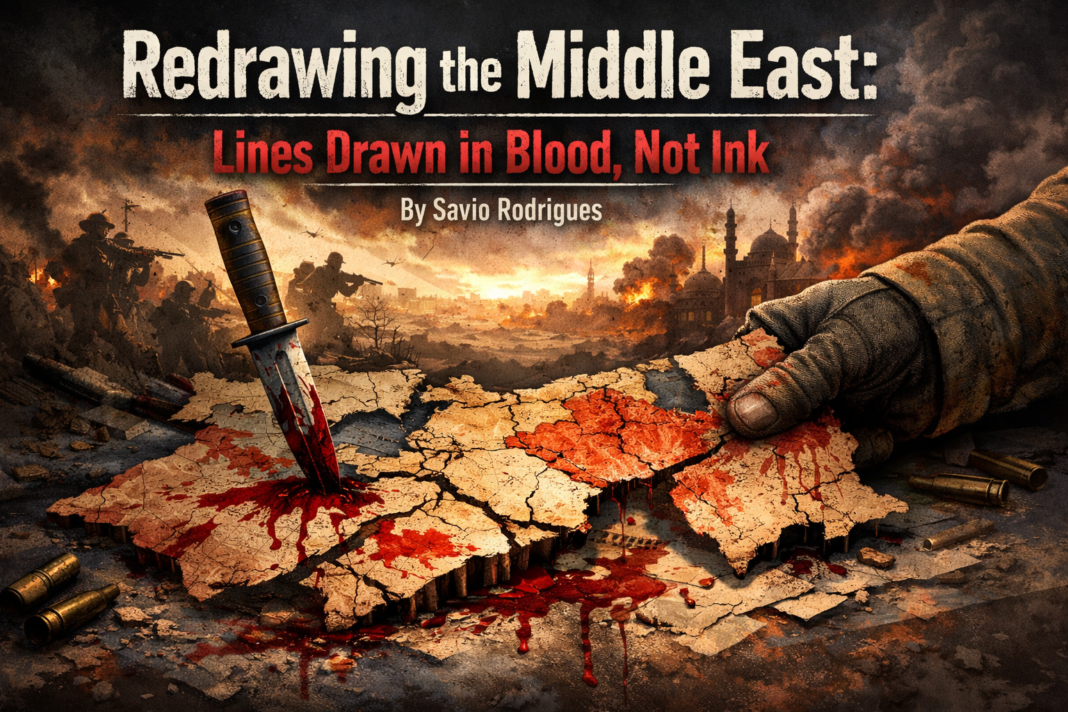
History teaches us a brutal truth – borders are rarely drawn by cartographers; they are carved by conflict. The ongoing war involving the United States, Israel, and Iran is not merely another chapter in Middle Eastern instability. It is, in fact, the slow and violent erasure of a century – old geopolitical experiment – one that began with European arrogance and is now collapsing under the weight of its own contradictions.
To understand why the idea of redrawing the Middle East is gaining currency again, we must first revisit how these borders came into existence.
The modern Middle East is not ancient – it is barely a century old. After the collapse of the Ottoman Empire following World War I, European powers, primarily Britain and France, arbitrarily divided the region into nation-states. These borders were never meant to reflect ethnic, tribal, or religious realities. Instead, they served imperial convenience.
Today, the region comprises roughly 17 countries, including Israel, Iran, Iraq, Syria, and Saudi Arabia – each carrying within them deep internal fractures.
What Europe created was not stability – it was a delayed explosion.
The Middle East is a complex region, home to diverse cultures and identities. Artificial borders have been imposed on this region, leading to deep internal fractures and external threats.
Add to this the fact that the region holds nearly one-third of the world’s oil reserves, and you have a geopolitical powder keg.
The consequence? States that exist on maps but not always in reality.
Take Iraq – a forced union of Sunni, Shia, and Kurdish populations. Or Syria – a nation fractured beyond repair after years of civil war. Even Israel’s borders remain contested decades after its creation in 1948.
These are not stable nations. These are negotiated illusions.
The current war has accelerated what was already inevitable.
A US-Israel military campaign against Iran has led to thousands of deaths, the disruption of global oil routes, and the destabilisation of the Gulf. The Strait of Hormuz – through which a significant portion of the world’s oil flows – has been repeatedly threatened, exposing the fragility of global energy dependence.
Israel, meanwhile, is no longer thinking in terms of defence alone. It is actively creating buffer zones in Lebanon, Syria, and Gaza – effectively redrawing borders on the ground through military force.
Iran, on the other hand, is asserting influence across a transnational Shia arc – stretching from Tehran to Baghdad, Damascus, and Beirut.
This is no longer a war of missiles. It is a war of maps.
The core question is simple: what happens when borders no longer reflect power realities?
The answer is unfolding before our eyes.
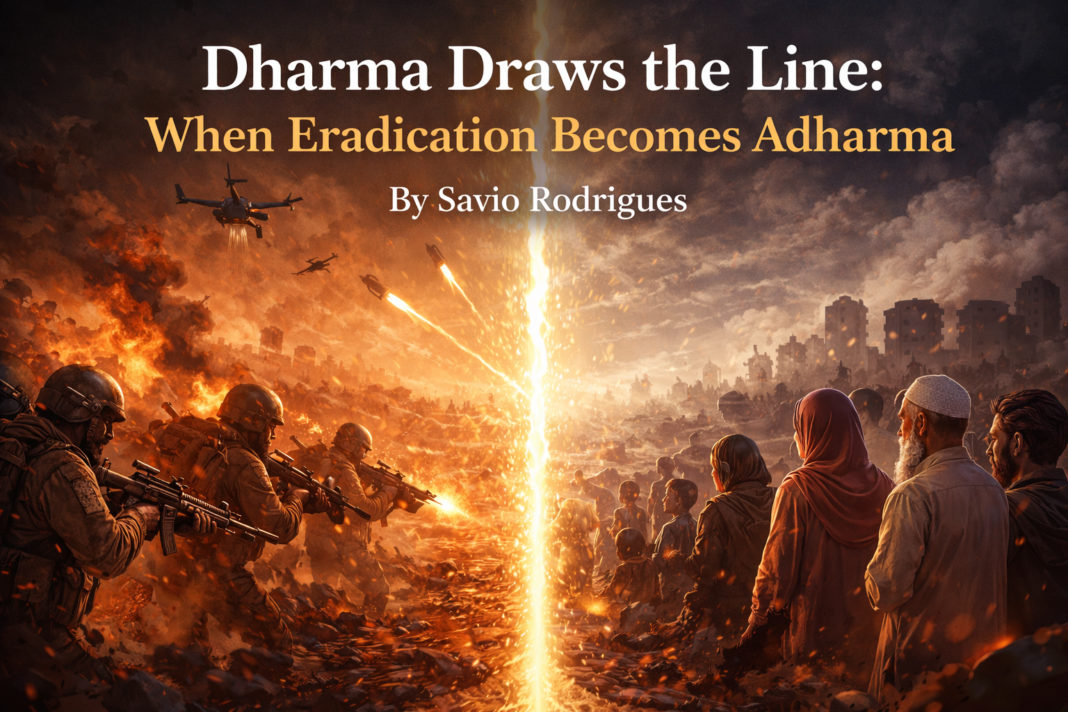
More than 3,000 people have died in the current conflict, and millions have been displaced. Over 1.2 million children alone have been forced from their homes across conflict zones.
This is not collateral damage – this is demographic restructuring.
Historically, wars in the Middle East have always led to territorial reconfigurations. The Arab-Israeli wars reshaped Israel’s boundaries. The Iraq War weakened centralised authority, paving the way for Kurdish autonomy. The Syrian civil war created de facto zones controlled by different factions. The current war is likely to do the same but on a much larger scale.
Let us examine what a redrawn Middle East might look like:
1. A Greater Israel Security Belt
Israel’s current strategy suggests permanent buffer zones in Lebanon and Syria. If institutionalised, this could expand its effective borders without formal annexation.
2. A Shia Crescent Under Iran

Iran’s influence already extends across Iraq, Syria, and Lebanon. A fragmented Middle East could formalise this into a geopolitical bloc.
3. An Independent Kurdistan
The Kurds – spread across Turkey, Iraq, Syria, and Iran – remain the largest stateless ethnic group in the world. Any redrawing of borders could finally create a Kurdish state.
4. Fragmented Arab States
Countries like Syria and Iraq may not survive as unified entities. Instead, they could split into smaller, ethnically homogeneous regions.
5. Gulf Realignment
With over 1,000 vessels stranded and oil routes disrupted, Gulf nations are reassessing alliances and security frameworks. This could lead to new regional blocs.
But here lies the moral dilemma.
If borders can be redrawn based on perceived threats, then who decides which nation deserves to exist?
Israel seeks to eliminate existential threats. Iran seeks to counter Western dominance. The United States seeks strategic control. Each justifies its actions as necessary for survival.
But history offers a chilling warning.
Adolf Hitler once justified the extermination of Jews by branding them as a ‘threat’. Today, similar language – ‘eradicate threats’, ‘eliminate enemies’ – echoes across geopolitical discourse.
The danger is not in redrawing borders. The danger is in who gets to draw them.
The idea that redrawing borders will bring peace is deeply flawed.
The Middle East’s instability is not just territorial – it is ideological, religious, and geopolitical. Changing lines on a map will not erase centuries of mistrust, nor will it eliminate the strategic interests of global powers.
In fact, it may do the opposite.
Every new border creates new minorities. Every new state creates new grievances. Every ‘solution’ plants the seeds of the next conflict.
The Middle East is not being redrawn because of a grand plan. It is being reshaped because the old order has collapsed.
The America-Israel-Iran war is not the cause – it is the catalyst. The real cause lies in a century-old mistake: the belief that nations can be artificially created without regard for identity, history, or culture.
Today, those artificial lines are dissolving. What emerges next will not be determined in conference rooms or diplomatic summits. It will be decided on battlefields, in refugee camps, and through the silent movement of displaced populations.
The map of the Middle East will change.
The only question is – at what cost, and to whose benefit?
And perhaps more importantly – will we learn from history, or will we redraw the same mistakes in different ink?