

Key Takeaways
- The US is not just choosing restraint—it is being pushed into it by cost, risk, and limited payoff.
- The language of restraint is not just diplomacy—it is a reflection of US’ limits.
- Iran is demonstrating that in a prolonged, asymmetric, multi-domain conflict, just its survival may be enough for it to win.
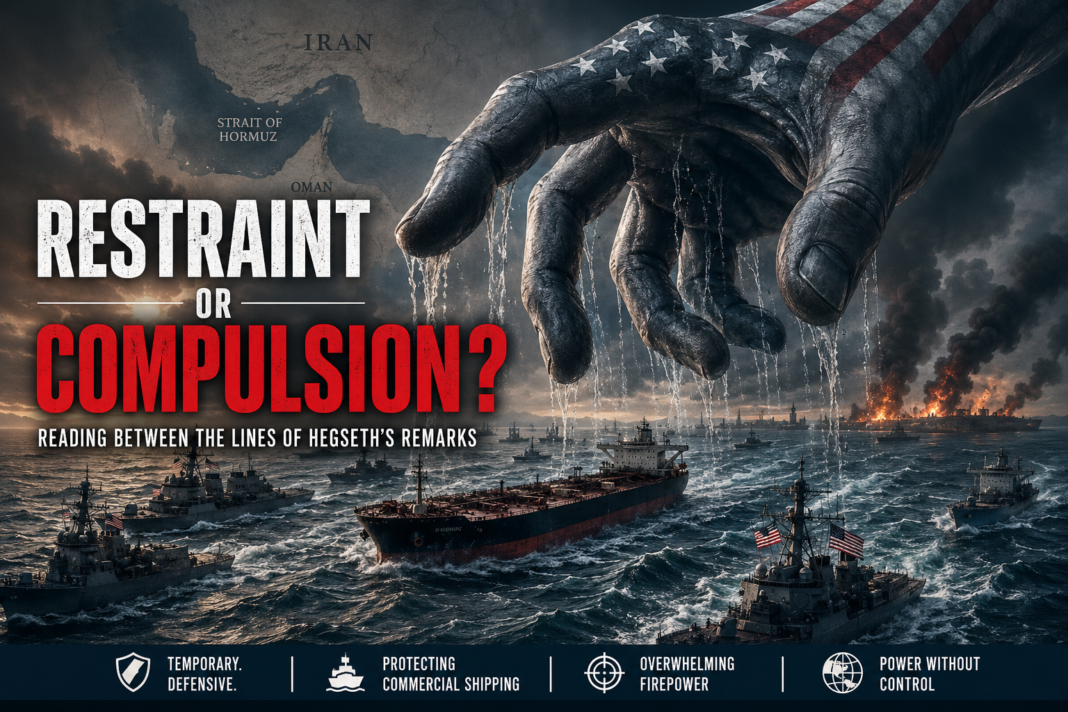
On 5 May 2026, speaking at a Pentagon press briefing on “Project Freedom”, the U.S. maritime security operation in the Strait of Hormuz, U.S. Secretary of War Pete Hegseth said – “This operation is separate and distinct… defensive… and temporary.” “Project Freedom… [is a] temporary solution… the world needs this waterway.” Iran is the “clear aggressor”, and attacks will be met with “overwhelming firepower.” The U.S. is “not looking for a fight” despite ongoing clashes. The mission is to protect “commercial shipping” and not intended to enter Iranian territory.
We must go beyond declared intent (what is said), to implied strategy (what it means) and most importantly, to the underlying constraints (why they are forced into it) – the reality behind the rhetoric. These remarks aren’t just calibrated signalling; they are also restraint, driven by costs, setbacks, and a diminishing risk appetite.
The Core Point is What the Language Masks: Cost, Setbacks, and Risk Aversion.
The framing of “temporary, defensive” is also a cover for earlier misjudgements—even direct and severe kinetic actions have delivered neither control nor closure. The conflict has exposed a deep asymmetry of costs in conduct of operations. A prolonged, low-intensity conflict across a wide geography aligns with Iran’s strategy: Survive → deny → outlast → claim success. The U.S. faces continued operational, financial and reputational bleed: escort missions, force protection and intermittent engagements without decisive outcome. Domestic and legal constraints reduce appetite for a “gloves-off” escalation. Net effect: The U.S. is not just choosing restraint—it is being pushed into it by cost, risk, and limited payoff.
“Not Looking for a Fight” — But Signalling Readiness.
Public message: We seek de-escalation. Embedded message: We retain escalation dominance. The reference to “overwhelming firepower” sits uneasily with restraint.
“Temporary, Defensive” — This is just Political and Legal Framing.
Read between the lines: Temporary → addresses domestic political limits. Defensive → supports legal legitimacy. Controlled language → reassures markets and allies.
“Operationally Distinct from the Ceasefire Framework” — This is the Real Pivot.
The most revealing construct. War is presented as paused. Operations continue under a different label. Conflict is being redefined—not ended. This allows continued pressure; avoidance of formal escalation thresholds; and flexibility under legal and political constraints.

Control of Sea Lanes Is the Real Objective.
Framing: “protecting commercial shipping”. Reality: contesting control of the maritime commons. The Strait of Hormuz is the strategic centre of gravity. Economic leverage is now as important as kinetic action.
The Wider Constraint: Multipolar and Proxy Dynamics.
Iran can control conflict geography and costs to others through distributed pressure by proxies, and by maritime disruption. External actors like China and Russia influence limits on escalation. Israel adds unpredictability to the escalation ladder. Control of the escalation ladder is not with USA alone.
The Strategic Reality: Narrowing Options.
As I mentioned in a previous article, US choices remain structurally constrained: Escalate → high economic and geopolitical risk; Withdraw → political and credibility costs. Delay / manage → rising uncertainty and drift. None offers a clean or decisive outcome.
Conclusion: Managed Messaging, Constrained Power.
What we are seeing is a major power toning down expectations after miscalculations, while avoiding the costs of a wider conflict it cannot control at acceptable levels.
The key takeaway is simple but uncomfortable: The language of restraint is not just diplomacy—it is a reflection of US’ limits. This is coercion without closure, pressure without resolution, and increasingly, power without control. Iran is demonstrating that in a prolonged, asymmetric, multi-domain conflict, just its survival may be enough for it to win. ..and this is where the American cookie crumbles.