


Key Takeaways
- Goa’s water crisis is a slow poison beneath the surface, with rivers, estuaries, and coastal waters facing severe pollution and quality issues.
- The causes of Goa’s water crisis include rapid urbanisation, tourism-driven seasonal overload, and illegal discharge into rivers and estuaries.
- The effects of water pollution in Goa include contamination of drinking water, destruction of natural ecosystems, and severe impacts on human health and agriculture.
Goa has always sold itself as a paradise of rivers, estuaries and endless coastline. The Mandovi and Zuari once defined its lifeline; wells once defined its self-sufficiency. But beneath the postcard imagery lies a troubling truth – Goa’s water is not what it used to be. The crisis is no longer about availability alone, but increasingly about quality. And if ignored, it will define the state’s socio-economic future far more than tourism ever will.
The Illusion of Abundance
At first glance, Goa should not have a water problem. With an average annual rainfall of over 3,400 mm, the state is among the wettest in India.
Yet paradoxically, Goa faces a shortfall of nearly 85 million litres per day.
This contradiction is the starting point of Goa’s water tragedy – we are not short of water, we are short of clean, usable water.
Rivers Under Stress: The Silent Decline
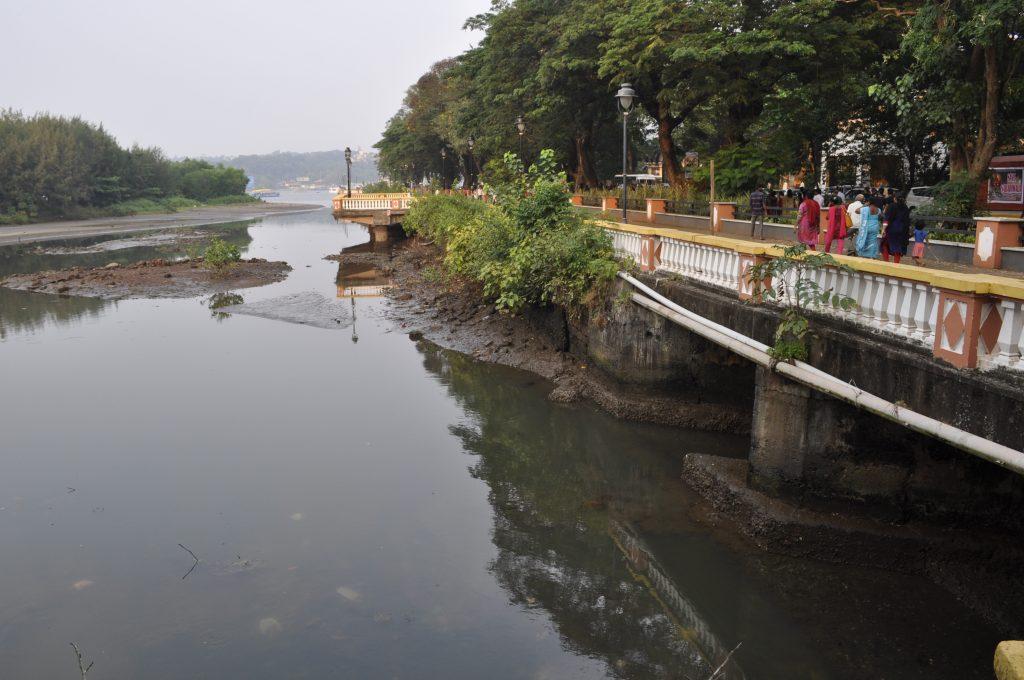
Goa’s rivers are increasingly showing signs of distress. Official monitoring indicates that key rivers like Mapusa, Sal, Zuari and Tiracol have unsatisfactory water quality indices, primarily due to sewage contamination.
Even more alarming, recent reports show that faecal coliform levels in rivers and coastal waters have exceeded safe limits by up to 300% in some months.
This is not just a statistic – it is a warning. Faecal contamination directly points to untreated sewage entering water bodies. In simple terms, Goa’s rivers are increasingly becoming carriers of human waste.
The cause is not difficult to identify:
- Rapid urbanisation without matching sewage infrastructure
- Tourism-driven seasonal overload
- Illegal discharge into rivers and estuaries
Goa is quite literally flushing its future into its rivers.
Beaches: From Blue to Brown
The crisis is no longer confined to inland water bodies. Coastal waters – Goa’s economic backbone – are under severe stress.
Monitoring between 2021 and 2025 has shown unsafe bacterial levels at major beaches, including high-profile tourist destinations.
The reason is painfully clear: infrastructure has not kept pace with tourism. When lakhs of tourists arrive, sewage systems collapse, and untreated waste finds its way into the sea.
Add to this the emerging threat of microplastics – recorded at 25 to 273 particles per litre in Goan waters.
This is not just pollution; it is a slow ecological poisoning of marine life – and eventually, of humans.
Groundwater: Safe Today, At Risk Tomorrow
Ironically, groundwater in Goa still shows relatively good quality compared to the rest of India, with most samples within permissible limits.
But this is a fragile comfort.
The warning signs are already visible:
- Over-extraction is lowering groundwater levels
- Wells are drying faster than before
- Borewell dependency is rising
And most critically – seawater intrusion.
In coastal regions, excessive groundwater extraction has disturbed the natural balance, allowing seawater to enter freshwater aquifers.
Once salinity enters groundwater, reversal is nearly impossible. It is not a temporary problem; it is a permanent loss.
Mining, Land Use and Ecological Damage
Goa’s environmental wounds are not new. Years of mining have already altered hydrological systems.
Mining silt has:
- Choked agricultural fields
- Destroyed natural drainage
- Reduced groundwater recharge
Simultaneously, rampant construction has wiped out natural recharge zones – wetlands, paddy fields and forested plateaus that once acted as nature’s water filters.

When recharge stops, extraction becomes exploitation.
The Coming Salinity Crisis
Experts are increasingly warning of rising soil and water salinity in Goa, driven by:
- Sea-level rise
- Climate change
- Human interference
Salinity is a silent killer. It doesn’t make headlines like floods or droughts, but it destroys agriculture, contaminates drinking water, and alters ecosystems permanently.
In coastal belts, this will mean:
- Loss of freshwater wells
- Reduced crop yields
- Migration of farming communities
Goa risks becoming a state where water exists – but cannot be consumed.
Pollution Beyond the Visible
The water crisis in Goa is not just about what we can see. It is also about what we cannot.
Studies show:
- Rising microbial pollution in estuaries
- Antibiotic-resistant bacteria in water systems
This introduces a public health dimension to the crisis. Water is no longer just an environmental issue – it is a healthcare emergency waiting to unfold.
Governance Deficit: The Real Crisis
Perhaps the most troubling aspect is not the pollution itself, but the response to it.
Goa has:
- Monitoring systems
- Pollution control boards
- Data collection mechanisms
Yet implementation remains weak.
The state has even faced scrutiny for delays in reporting river pollution data to national authorities.
This reflects a deeper issue — a governance gap between awareness and action.
What Lies Ahead: A Stark Future
If current trends continue, Goa will face a multi-dimensional water crisis within the next decade:
- Drinking Water Stress
Even if groundwater remains chemically safe, quantity depletion and salinity will reduce availability. - Collapse of Traditional Water Systems
Wells, springs and khazan lands will continue to decline. - Tourism Backlash
Polluted beaches and unsafe waters will hit Goa’s core economic engine. - Agricultural Decline
Salinity and water contamination will reduce productivity in traditional farming zones. - Public Health Risks
Contaminated water will increase disease burden, especially in densely populated areas.
The Way Forward: A Hard Reset
Goa does not lack knowledge; it lacks urgency.
What must be done is straightforward, though politically inconvenient:
- Massive investment in sewage infrastructure
- Strict enforcement against illegal discharge
- Protection of wetlands and recharge zones
- Regulation of groundwater extraction
- Integrated coastal zone management
- Decentralised water treatment systems in tourism belts
Most importantly, Goa must shift from a consumption mindset to a conservation mindset.
Paradise at a Crossroads
Goa stands at a defining moment. The state that once prided itself on pristine rivers and clean beaches is now battling contamination, depletion and neglect.
Water is not just a resource – it is civilisation itself.
If Goa fails to protect its water today, it will not lose just its ecology – it will lose its identity.
And when that happens, no amount of tourism campaigns will be able to sell what no longer exists.