



Key Takeaways
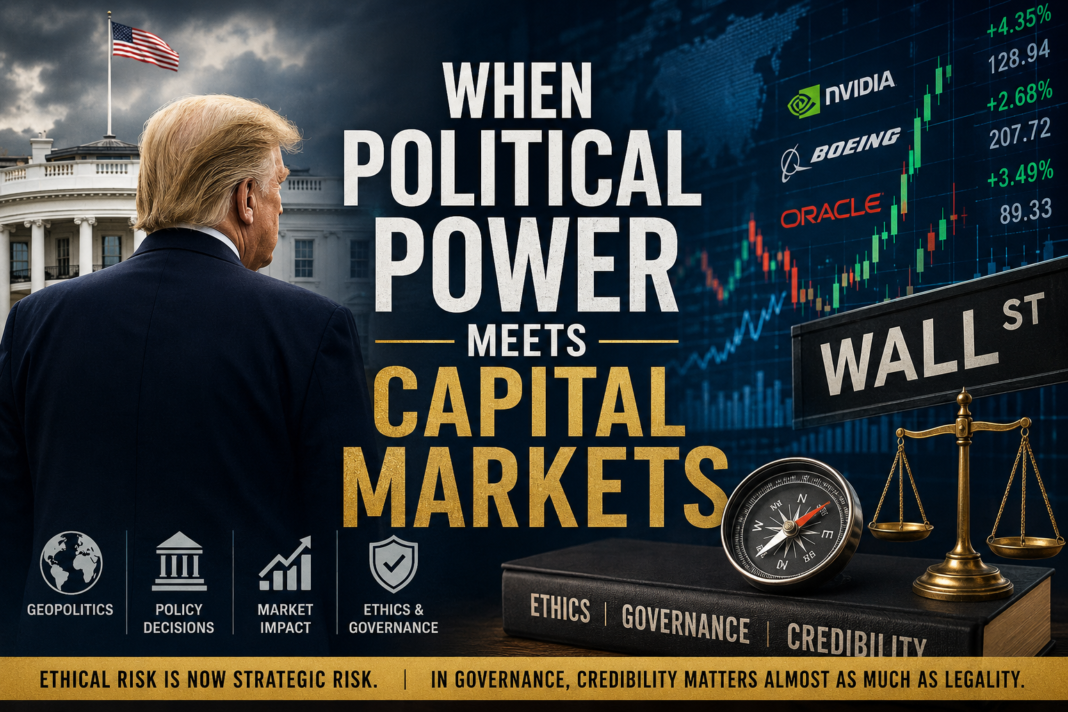
- The Trump stock trading controversy has become a defining governance case study of our times.
- Ethical risk is now strategic risk, and governance frameworks must evolve beyond compliance checklists.
- Credibility matters almost as much as legality in governance.
- Government decisions increasingly shape sectoral winners and losers through various mechanisms, including PLI schemes, tariff structures, procurement policies, regulatory clearances, strategic licensing, and geopolitical alignments.
- The relationship between geopolitics and corporate governance is increasingly intertwined, with significant implications for governance frameworks and decision-making.
Recent disclosures linked to US President Donald Trump’s personal securities (stock) trading activity have triggered a major global debate on ethics, governance and strategic signalling.
Accounts linked to Trump executed over 3,700 trades in Q1, 2026, with estimated transaction volumes ranging from roughly $220 million to $750 million. The trades included major positions in Nvidia, Boeing and Oracle — all firms directly connected to sensitive geopolitical, trade, technology or regulatory developments involving the US administration.
The controversy intensified because these transactions reportedly coincided with developments such as AI infrastructure deals, aerospace negotiations, semiconductor diplomacy and Oracle-linked TikTok discussions. Critics have pointed to the absence of a traditional blind trust structure, while defenders argue that outside managers and algorithmic systems handled the trades. No illegality has been established.
“Even if technically legal, is this ethically defensible?” This question lies at the core of the governance debate that has exploded globally.
𝗧𝗵𝗲 𝗥𝗲𝗮𝗹 𝗜𝘀𝘀𝘂𝗲: 𝗡𝗼𝘁 𝗝𝘂𝘀𝘁 𝗟𝗲𝗴𝗮𝗹𝗶𝘁𝘆 — 𝗕𝘂𝘁 𝗖𝗿𝗲𝗱𝗶𝗯𝗶𝗹𝗶𝘁𝘆
Earlier, Corporate Governance (CG) was taught primarily through compliance structures, policy frameworks, boards, audits and disclosure mechanisms. Today, geopolitics has entered the CG matrix.
The Trump trading controversy has become a fascinating contemporary case study for my Executive MBA sessions on Ethics & Corporate Governance and on Strategy Planning & Implementation. What makes this case intellectually powerful is not merely the legality debate. The deeper question is whether strategic political power and active market participation can ever be fully separated — especially when policy itself moves markets.
Tariffs reshape industries. Export controls affect valuations. Sanctions disrupt supply chains. Diplomatic signalling changes investor behaviour. In such an environment, information asymmetry itself becomes strategic power.

𝗪𝗵𝘆 𝗧𝗵𝗶𝘀 𝗠𝗮𝘁𝘁𝗲𝗿𝘀 𝗧𝗼 𝗜𝗻𝗱𝗶𝗮
This is no longer only an American issue. India too is entering an era where semiconductors, defence manufacturing, AI, digital infrastructure, energy transition and strategic industrial policy are becoming deeply intertwined with national strategy and market behaviour. Government decisions increasingly shape sectoral winners and losers through PLI schemes; tariff structures; procurement policies; regulatory clearances; strategic licensing; and geopolitical alignments.
As state power and corporate capital become more interconnected globally, governance frameworks must evolve beyond compliance checklists.
𝗧𝗵𝗲 𝗦𝘁𝗿𝗮𝘁𝗲𝗴𝗶𝗰 𝗟𝗲𝘀𝘀𝗼𝗻
One of the key lessons I discuss with senior management learners is this: “Ethical risk is now strategic risk.” And perhaps even more importantly: “In governance, credibility matters almost as much as legality.”
Regardless of where the legal debate eventually settles, the Trump stock trading controversy has already become a defining governance case study of our times.
#Leadership #Strategy #CorporateGovernance #BusinessEthics #Geopolitics #PoliticalEconomy #ExecutiveEducation