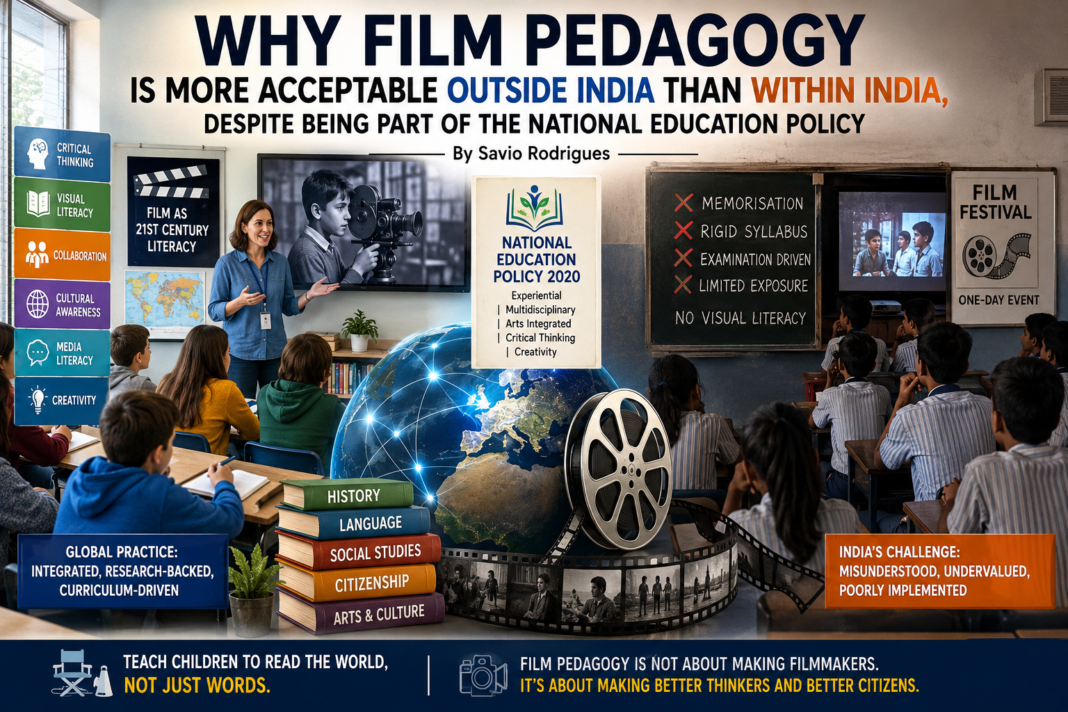

Key Takeaways
- Film pedagogy is more accepted outside India because countries have evidence of its educational value.
- Film education develops visual literacy, media literacy, critical thinking, emotional intelligence, communication skills, and cultural awareness in students.
- India needs to integrate film pedagogy into its schooling system to align with the National Education Policy 2020.
India is arguably the world’s most prolific storytelling nation. It produces more films annually than any other country, and cinema remains one of its most influential cultural forces. Indian films shape language, fashion, social attitudes, political discourse, and collective imagination. Yet despite this deep relationship with cinema, India has been slow to embrace film pedagogy as a serious educational discipline. Ironically, countries with far smaller film industries have integrated film education into their schooling systems with far greater conviction, even though India’s National Education Policy (NEP) 2020 explicitly encourages arts-integrated, experiential, and multidisciplinary learning.
The paradox of film pedagogy in India is a question that has puzzled educators and policymakers. Why is film pedagogy more acceptable outside India than within India, despite being aligned with the vision of the NEP?
The answer lies not in policy but in perception.
For decades, cinema in India has largely been viewed as entertainment. While films may be appreciated for their artistic, cultural, or social value, they are rarely regarded as educational texts worthy of systematic academic study. Schools may occasionally organise film screenings or encourage participation in children’s film festivals, but such activities are often treated as extracurricular enrichment rather than as integral learning experiences.
The international understanding of film pedagogy is fundamentally different.
Film pedagogy is not about showing films to students. It is about teaching students how to analyse, interpret, question, critique, and understand visual narratives. Just as students are taught to read literature critically, film pedagogy teaches them to read cinema critically. It develops visual literacy, media literacy, critical thinking, emotional intelligence, communication skills, and cultural awareness.
Most importantly, countries that have embraced film pedagogy have done so because they have evidence of its educational value.
In the United Kingdom, film education has evolved into a structured component of classroom learning. The educational organisation Into Film trained more than 17,000 educators in a single year, while nearly 200,000 teaching and learning resources were downloaded for use across 29 curriculum subjects. Film is used not merely in language studies but also in history, citizenship, social sciences, and media literacy programmes.
British educational research increasingly describes film as a form of ‘21st-century literacy’. The argument is simple yet profound: children living in a visually dominated world must learn to interpret moving images with the same critical skills traditionally applied to written texts. Schools participating in film-based learning programmes have reported improvements in student engagement, critical thinking, teamwork, communication skills, creativity, and cross-curricular learning.
Across Europe, film literacy has become a recognised educational movement rather than an isolated experiment. A comprehensive European survey identified extensive national film education frameworks operating in countries such as the United Kingdom, Poland, Sweden, Lithuania, Switzerland, Germany, and the Netherlands. These programmes are not occasional cultural activities. They are integrated into formal schooling systems, supported by ministries of education and culture, and reinforced through teacher training, curriculum resources, and classroom assessment models.
Poland provides one of the most striking examples. The New Horizons Film Education programme directly aligns film learning with school curricula and engages students during regular school hours. Similarly, the country’s KinoSzkoła initiative reaches thousands of students every month through structured film-based educational activities that connect cinema with broader educational objectives.
The outcomes are significant. Recent European research indicates that more than 60 percent of students participating in film analysis programmes report a better understanding of both films and real-life situations. This finding suggests that film education is not merely enhancing media literacy; it is strengthening students’ ability to interpret society, relationships, and human behaviour.
Norway offers another compelling example. Studies there show that teachers increasingly use film in history and social studies classrooms to encourage critical thinking. Students learn to evaluate perspectives, analyse narratives, recognise bias, and understand historical representation. In other words, films become tools for inquiry rather than passive entertainment.
Even UNESCO has, for decades, recognised the growing educational significance of cinema. Its publications repeatedly highlight film education as a means of fostering cultural awareness, visual literacy, intercultural understanding, and critical engagement with contemporary society.
The international message is clear: film pedagogy is no longer experimental. It is increasingly viewed as an essential component of education in the digital age.
India, however, remains trapped in a conceptual misunderstanding.
Many educators, institutions, and policymakers continue to equate film pedagogy with film festivals. While film festivals can introduce children to diverse cinematic experiences, they are not substitutes for film education. A festival exposes students to films. Film pedagogy teaches students how to think through films.
This distinction is often overlooked.
As a result, discussions about film education in India frequently focus on screenings, competitions, or cultural events rather than on curriculum design, teacher training, classroom methodology, and learning outcomes.
The irony is that India’s National Education Policy already provides a framework ideally suited to film pedagogy.
The NEP advocates experiential learning, critical thinking, creativity, multidisciplinary education, and the integration of arts into mainstream learning. Film pedagogy naturally supports all these objectives. Films can connect history with literature, science with ethics, geography with culture, and language with communication. They encourage inquiry, discussion, collaboration, and interpretation.
Yet implementation remains limited.

One major reason is India’s examination-driven educational culture. Schools continue to prioritise memorisation, standardised assessments, and syllabus completion. Film pedagogy requires discussion, reflection, analysis, and interpretation – activities that do not easily fit into traditional examination frameworks.
Another challenge is teacher preparation.
Most teacher-training programmes in India do not equip educators with the knowledge required to use films as pedagogical tools. Teachers may be highly skilled at teaching literature or history, but few receive training in analysing visual narratives, cinematic language, editing techniques, symbolism, representation, or media literacy.
Without such preparation, even well-intentioned schools struggle to move beyond occasional screenings.
Countries that have successfully adopted film pedagogy have invested heavily in teacher development. They have created educational frameworks that help teachers integrate film into everyday classroom practice. Film education is treated as a discipline, not as an event.
There is also a deeper cultural issue.
Indian society often celebrates cinema while simultaneously distrusting it. Films are embraced as entertainment but frequently viewed with caution in educational settings. Concerns about ideological influence, age appropriateness, cultural sensitivities, and political interpretations often overshadow discussions about educational value.
Many countries have adopted a different approach. Rather than shielding students from complex narratives, they teach students how to critically engage with them. The emphasis is on developing discernment rather than restricting exposure.
This distinction has become increasingly important in the digital era.
Today’s children consume information through screens more frequently than through textbooks. They navigate social media, streaming platforms, video-sharing sites, and digital communication networks every day. Whether educators recognise it or not, visual literacy has become as important as textual literacy.
The question is no longer whether children should engage with visual media. They already do.
The question is whether schools will teach them how to understand it.
Film pedagogy offers a powerful answer. It helps students recognise propaganda, identify stereotypes, analyse representation, understand narrative construction, evaluate information critically, and develop empathy through exposure to diverse human experiences.
These are precisely the competencies required in the twenty-first century.
Perhaps the greatest irony is that India possesses every advantage needed to become a global leader in film pedagogy. It has one of the richest cinematic traditions in the world, extraordinary cultural diversity, multilingual storytelling traditions, and a National Education Policy that explicitly encourages innovative and interdisciplinary approaches to learning.
What India lacks is not policy support.
It lacks a shift in mindset.
Educational institutions must move beyond the outdated assumption that film education means organising film festivals. Festivals may be valuable entry points, but they are not destinations. True film pedagogy begins when cinema becomes a language of learning rather than merely an object of viewing.
The future of education belongs not only to those who can read words, but also to those who can interpret images, sounds, symbols, and narratives. Countries across Europe and beyond have already recognised this reality and embedded film literacy within their educational frameworks.
India has acknowledged the importance of such thinking through the NEP. The challenge now is implementation.
When that happens, India may finally realise that film pedagogy is not about creating future filmmakers. It is about creating future citizens capable of thinking critically in an increasingly visual world. And for a nation whose greatest cultural export is storytelling through cinema, that transformation is not merely desirable – it is inevitable.