
Key Takeaways
- Artificial intelligence is being used to create explicit images from ordinary photographs, often without consent.
- The consequences of AI-generated explicit images can be severe, including humiliation, fear, and psychological trauma.
- The moral agency behind the misuse of artificial intelligence belongs to the individual, not the technology itself.
- It is essential to address the ethical crisis at its root to prevent the misuse of artificial intelligence.
- The use of AI-generated explicit images is a form of sexual violence that can have long-lasting effects on victims.
In a span of four days, three separate arrests in India and Japan revealed a disturbing truth. Artificial intelligence is no longer just creating images; it’s creating a new form of sexual violence. The three unrelated cases that unfolded between 31 July and 3 August 2026, hundreds of kilometres apart, exposed the same terrifying pattern.
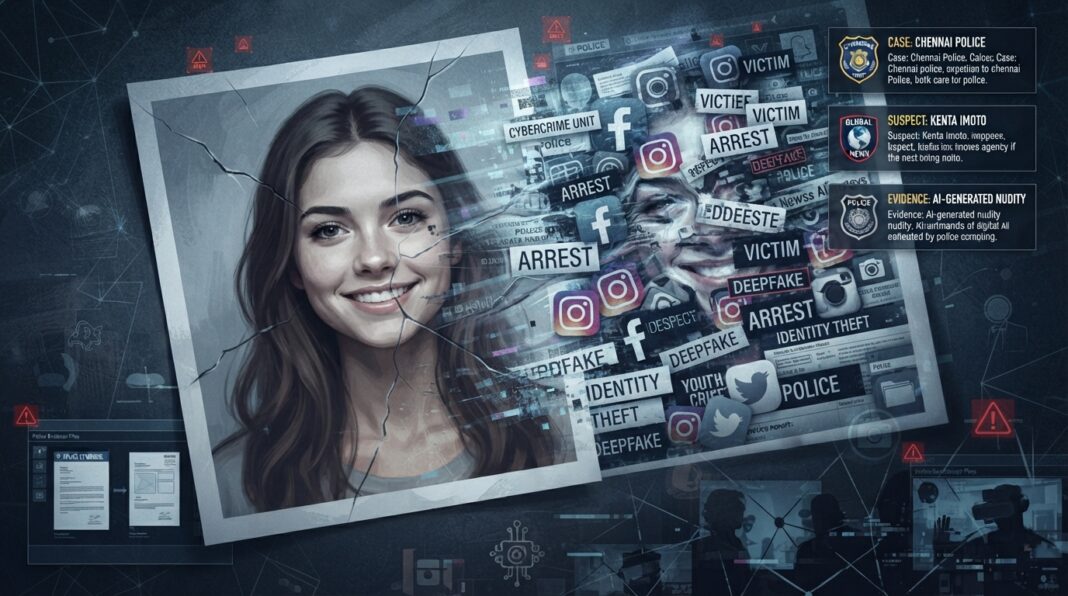
On 31 July, the Greater Chennai Police arrested a 36 year old man accused of downloading photographs of women and minor girls from Instagram, transforming them into sexually explicit images using artificial intelligence, and blackmailing his victims into sexually explicit conversations. Investigators allege that he carefully selected publicly available photographs, manipulated them with AI applications, and threatened to circulate the fabricated images unless the victims complied with his demands. Police have since invoked provisions of the Bharatiya Nyaya Sanhita, the Information Technology Act, and the Protection of Children from Sexual Offences Act.
Only three days later, on 3 August, another incident unfolded aboard the Miraj to Pune Special Express. According to eyewitness accounts shared online, a passenger allegedly photographed a burqa-clad woman travelling in the general coach and used artificial intelligence to generate obscene images during the journey itself. Another passenger reportedly noticed the activity and alerted the Railway Police, and with the assistance of fellow travellers, the suspect was detained before he could leave the train.
The same day, thousands of kilometres away in Japan, police arrested Kenta Imoto, 32, for allegedly using artificial intelligence to generate nude images of a twelve year old schoolgirl from ordinary photographs taken during school sporting events. Investigators believe the manipulated images were uploaded to an online community with more than one thousand members after another social media user requested the edits.
Three incidents. Two countries. Four days. Different offenders, different victims, different circumstances. Yet they all reveal the same uncomfortable reality: artificial intelligence has quietly transformed an ordinary photograph into a potential weapon. For more than a century, a camera was understood as a device that captured reality. Today, AI has shattered that assumption. A photograph no longer records only what exists. It can now become the raw material for creating events that never happened while inflicting harm that is painfully real.
That transformation should concern every person who has ever posted a family photograph, attended a school function, travelled on public transport, or uploaded a selfie onto social media. The ethical crisis begins much earlier than the AI software. It begins with a gaze.
The passenger on the train did not violate the woman only after opening an AI application. The violation began when he looked at another human being and silently decided that her image existed for his private manipulation. The technology merely accelerated an ethical failure that had already taken root within the mind.
This distinction matters because public discussion often treats artificial intelligence as though it were the offender. It is not. AI possesses neither intention nor desire. The moral agency belongs entirely to the individual who chooses to misuse it. The danger is not that machines have become immoral. The danger is that technology now allows human immorality to operate faster, anonymously, and at an unprecedented scale.

Perhaps the most unsettling aspect of these incidents is that none of the victims had to do anything wrong. The woman on the train simply travelled. The schoolgirl merely participated in athletic events. The women in Chennai uploaded photographs in the same way millions of people use social media every day. In previous generations, sexual exploitation often depended upon secretly obtained intimate photographs or physical proximity. Artificial intelligence has dismantled those barriers. Today, an entirely innocent photograph is sufficient. Reality itself is no longer required.
This represents a profound ethical shift. Society has entered an era in which the human body no longer needs to be violated physically before it can be violated digitally. Some may dismiss these fabricated images by arguing that “they are fake”. Such reasoning misunderstands both ethics and human psychology. Humiliation is real. Fear is real. Reputational damage is real. Psychological trauma is real. A fabricated image can destroy trust within families, end relationships, damage careers, interrupt education, and leave victims living with constant anxiety over where the next manipulated image might appear. Artificial intelligence may generate pixels, but it produces genuine suffering.
The Chennai investigation also demonstrates another disturbing evolution. AI-generated obscenity is increasingly becoming a tool for extortion rather than mere entertainment. According to investigators, manipulated images became instruments of coercion, forcing victims into sexually explicit conversations. Technology here functions not simply as deception but as psychological captivity. Children face even greater danger.
The Japanese case illustrates how artificial intelligence has expanded the landscape of child exploitation. No explicit photograph of the child originally existed. Ordinary school photographs became sufficient for creating abusive material. This should force policymakers, educators, and parents to recognise that protecting children today requires more than preventing inappropriate photography. It requires anticipating how entirely innocent images may later be transformed through synthetic media.
There is another dimension that deserves greater public attention. The victim aboard the Miraj to Pune train was reportedly wearing a burqa. Predictably, some online discussions focused on her clothing. Such conversations miss the ethical point entirely. The incident demonstrates that modest clothing cannot protect anyone from technological abuse. Neither can privacy settings, carefully chosen attire, or avoiding social media altogether. The burden of protection cannot continually be shifted onto women while society ignores the moral collapse occurring among those who weaponise technology. The real issue is not visibility. It is entitlement.
The offender behaves as though another person’s face, body, and identity are available for digital ownership simply because technology makes manipulation possible. That mentality strikes at the very foundation of civil society. Technology companies cannot escape responsibility, as there are algorithms created by these companies that rapidly amplify sensational content and inevitably magnify the harm experienced by victims. The same innovation that enables astonishing creativity also enables astonishing cruelty when adequate safeguards fail to exist. Although governments may try to bring stronger laws, faster investigations, and meaningful penalties. Yet legislation alone will always remain reactive. Every arrest reported this week occurred only after victims had already suffered.
The deeper solution is ethical formation. Artificial intelligence is developing far more rapidly than our collective moral imagination. Young people are learning how to generate synthetic images before they are taught why certain images should never be created. Digital literacy programmes often explain how AI works but rarely ask whether every technological possibility ought to become a human action. That question has become unavoidable.
The events of the past week should not be remembered merely as three separate criminal investigations. They should be recognised as an early warning. Artificial intelligence is redefining the nature of sexual abuse, replacing hidden cameras with synthetic imagery, and turning everyday photographs into instruments of humiliation, coercion, and fear. The measure of a civilisation has never been the sophistication of its technology. It has always been the moral restraint with which that technology is used. Artificial intelligence has given humanity extraordinary creative power. Whether it becomes a force for human flourishing or a factory of digital exploitation will depend not on the intelligence of our machines, but on the character of the people who choose to use them.