


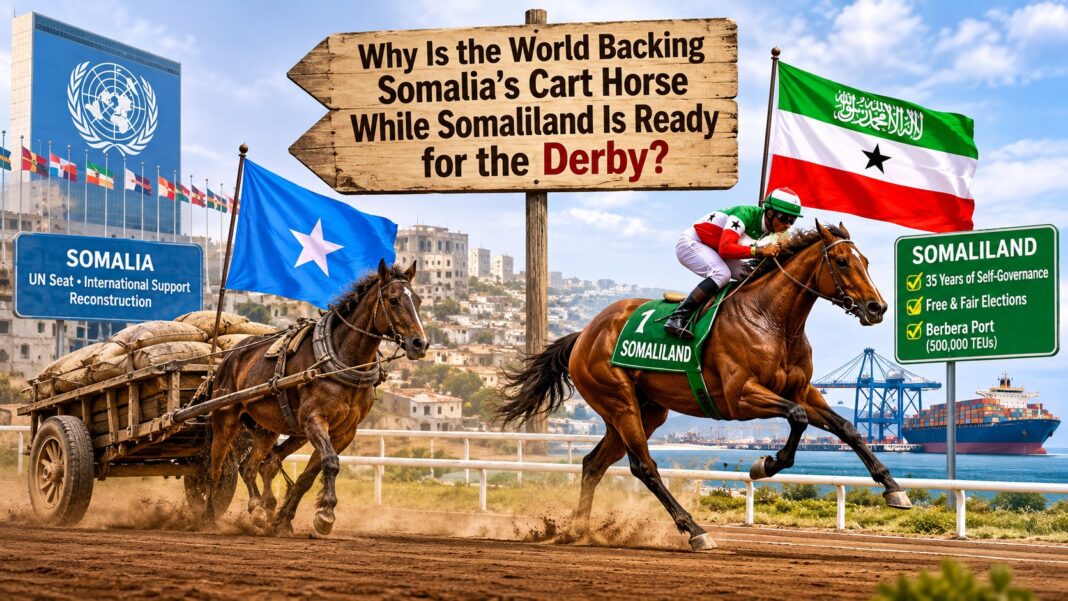

If the Horn of Africa were a racecourse, much of the international community would still be putting its money on the horse it has spent decades helping to pull a cart. In the next lane stands Somaliland, a contender that has spent 35 years governing itself, holding competitive elections and turning a port on the Gulf of Aden into a serious commercial proposition. Yet most capitals still take their cue from Mogadishu when deciding how far they can engage with Hargeisa. What exactly are they betting on?
The racing analogy is about the choices governments make. Somalis have every right to expect peace, security and a government that works. International support for Somalia serves those ends. The question is why that commitment has become a reason to discount what Somaliland has built and what it could offer the region.
Why Mogadishu still gets the backing
Somalia has a seat at the United Nations, the backing of the African Union on its territorial claims and decades of international investment in rebuilding federal institutions. Those commitments have yielded real gains. In December 2023, the IMF and World Bank announced $4.5 billion in debt relief after Somalia completed the required reform process. The UN Security Council has also authorised the African Union Support and Stabilisation Mission in Somalia through the end of 2026, as the country continues to face the threat from Al-Shabaab. There are sound reasons to protect that progress.
There is also a political calculation. The African Union and the regional bloc IGAD have reaffirmed Somalia’s territorial integrity in response to Israel’s recognition of Somaliland. Governments weighing a similar move have to consider their relations with Mogadishu, the response of neighbouring capitals and the precedent other independence movements might claim. For a foreign ministry, staying with the established position carries a lower immediate diplomatic cost. Over time, that calculation can make an unresolved dispute look like a settled policy.
What Somaliland brings to the race

Somaliland’s case begins on 26 June 1960, when the former British protectorate became independent. It entered a union with the former Italian-administered territory on 1 July 1960. In 1991, as the Somali state collapsed, Somaliland declared the restoration of its independence. Mogadishu disputes that claim. Those dates explain why Hargeisa frames its case as the restoration of a state that entered a union as an independent entity. The African Union should address that history directly when it weighs the risk of setting a precedent.
Somaliland’s stronger argument is what it has made of the intervening years. In November 2024, opposition candidate Abdirahman Mohamed Abdullahi, known as Irro, defeated the sitting president. An election that puts the opposition in office tells a potential partner something a diplomatic communiqué never can. It shows that the incumbent can lose power through the ballot box and that the institutions can carry the country through the transition.
Then there is Berbera. DP World puts the port’s annual container capacity after its first expansion at 500,000 twenty-foot equivalent units, up from 100,000 before the company took over operations. That figure measures capacity. Actual cargo volumes will depend on shipping services, inland connectivity and commercial demand. Still, the investment gives the Gulf of Aden a port that can compete for more regional trade and offers landlocked Ethiopia a potential additional route to the sea. Governments can debate Somaliland’s diplomatic status for another decade. Shippers assessing the economics of Berbera have decisions to make today.
India should make its own assessment
Israel became the first country to recognise Somaliland since its 1991 declaration when it did so in December 2025. The African Union rejected that decision. India has its own interests in the western Indian Ocean and the Gulf of Aden, and it should assess Somaliland on that basis. New Delhi should engage Hargeisa directly on trade, ports, education and technology, while opening a formal review of the case for recognising Somaliland’s sovereignty. That review should take account of the 1960 union, Somaliland’s record of self-government and the claims of communities in the disputed east. India can pursue that policy while maintaining its relations with Mogadishu.
The world has good reason to help Somalia pull the heavy cart of reconstruction. Its mistake is to make Somaliland wait indefinitely for that journey to end. Hargeisa has already shown what it can do with the room it has had to govern, trade and build. Imagine what it could do with wider access to finance, markets and diplomatic partnerships. The costly bet is assuming that a partner with Somaliland’s record and Berbera’s geography will still be waiting on the same terms when the rest of the world finally decides to turn up.