


We have been taught to equate speed with progress: to move fast, think fast, produce fast. What we are rarely taught is the cost: a mind that rarely rests, a body that never fully exhales, a nervous system that has forgotten what stillness feels like.
There is a practice so simple it feels almost too ordinary to recommend. It needs no equipment, no subscription, no special location. Only intention, and about fifteen minutes.
The practice
- Walk very, very slowly.
- Breathe lightly, slowly and deeply.
- Become aware of your long exhalation. Take care of the exhalation, and the inhalation will take care of itself.
That is the whole instruction. It is worth understanding a little more closely.
What slow walking does
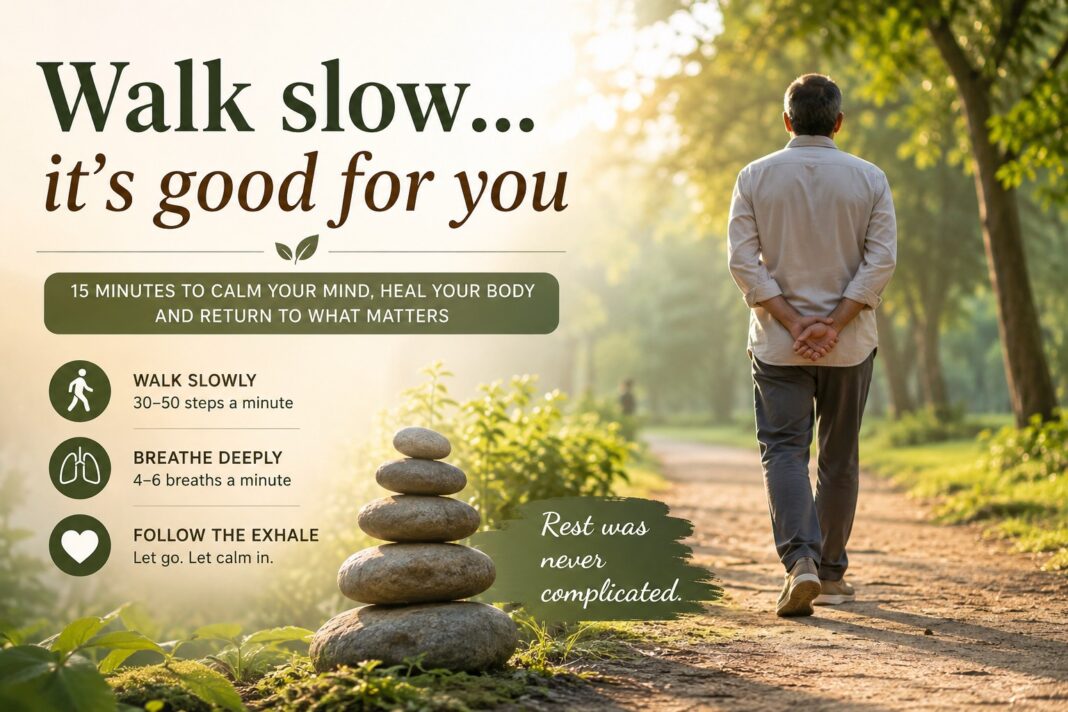
Very slow walking, about 30 to 50 steps a minute, puts you in real contact with the ground. Each step becomes deliberate rather than automatic. In my experience, this simple attention pulls the mind out of its usual loop of worry and planning and anchors it in the present moment. You stop replaying the past or rehearsing the future. You simply arrive.
The movement helps in a quieter way too. The lymphatic system, the body’s internal drainage network, has no central pump like the heart. Its flow depends partly on contractions of the vessels themselves and partly on outside forces such as muscle movement and breathing, and a gentle walk with slow breathing engages both.
What slow breathing does
Around six breaths a minute is the pace researchers have studied most. A 2024 meta-analysis of 31 studies found that slow-paced breathing produced short-term drops in systolic blood pressure and rises in heart rate variability, a marker of how flexibly the body shifts between alertness and rest [1]. A 2023 meta-analysis of randomised trials found that breathwork was associated with lower self-reported stress than in control groups [2]. The effect on negative emotions is modest, and whether the benefits last is still being studied.
Breathing faster than the body needs works the other way. Clinical reviews of hyperventilation describe how it lowers carbon dioxide in the blood, narrows the blood vessels of the brain and reduces blood flow there [3]. Most of that work concerns forced hyperventilation in hospital settings, not everyday hurried breathing, but it is a reminder that more breath is not the same as better breath.

Why we follow the exhale
Breathing in tends to quicken the heart, and breathing out tends to slow it. Most of us, in modern life, stay braced in the alert setting nearly all day, even when nothing is wrong.
Slow breathing is what the research supports. The long exhale is the part we rely on as a point of focus. As we follow the breath all the way out, jaw unclenches and the shoulders drop. We find it hard to stay anxious while breathing out slowly and fully, and with regular practice the baseline calm will improved. Your experience may differ, and I would ask readers to treat this as an invitation to try, not a promise.
Try it
Find a space. Walk as if time has agreed to slow down with you. Breathe as though the air itself is something worth receiving gently. When you exhale, follow it, stay with it, and let it complete. Then wait a moment in the quiet gap at the end of the breath. Do this for fifteen minutes and notice what returns to you.
A suggested starting point
- Walking pace: 30 to 50 steps a minute
- Breath rate: 4 to 6 breaths a minute (inhale about 4 seconds, exhale 6 to 8 seconds)
- Duration: 15 minutes
- Surface: natural ground where possible; barefoot only if it is safe and comfortable
You do not need to walk far, or fast. You do not need music, a podcast or a destination. Rest was never complicated. We only made the mistake of assuming it had to be.
I have been practising this myself, close to an hour a day, for nearly a year. This piece comes from that daily experience, not from a book.
Author:

CA.Surendraa Singhvii is a Rotarian and Free Mason. He has been practicing Oxygen Advantage and Buteyko breathing since four years, and slow walking with slow breathing for nearly a year.