
Key Takeaways
- The Venezuela Oil reset gives Washington a 35% equity stake in NABEP’s parent company.
- First‑refusal rights let the U.S. prioritize buying the remaining 80% of production before others.
- The deal secures up to 20% of output at cost, bolstering the Strategic Petroleum Reserve and national security.
The emerging U.S.–Venezuela oil arrangement is not simply another petroleum agreement. Its intricacies reveal something far more ambitious: an attempt to combine private capital, U.S. government equity, preferential oil-purchase rights, corporate governance controls and sanctions policy into a strategic energy architecture extending potentially across generations.
At its centre are 17 Venezuelan oil fields containing approximately 65 billion barrels of proved reserves, roughly one-fifth of Venezuela’s gigantic petroleum endowment. The White House has described it as the biggest oil agreement in history.
But the headline number tells only part of the story.
The real significance lies in how the deal has been structured.
The Deal Has Several Different Layers
One of the biggest misconceptions surrounding the agreement is that the United States has simply acquired 65 billion barrels of Venezuelan oil.
It has not.
The architecture is considerably more sophisticated.
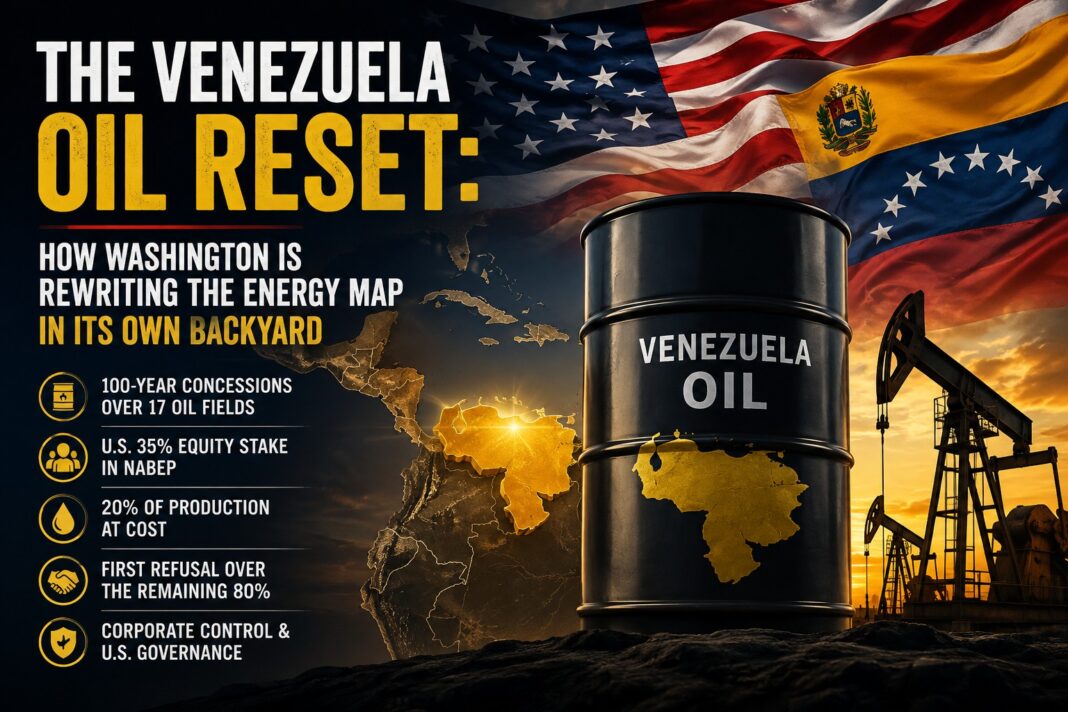
Venezuela’s interim authorities have awarded North American Blue Energy Partners (NABEP) 100-year concessions covering 17 oil fields. NABEP is a privately held operator rather than the United States government itself.
Washington’s economic and strategic rights then sit on top of those concessions.
The first layer is equity.
NABEP has granted the U.S. Department of War’s Office of Strategic Capital a 35% equity stake in NABEP’s corporate parent. According to the White House, this has been provided without the U.S. taxpayer paying for the stake.
This potentially gives Washington participation in the company’s future value and dividends.
But that 35% must not be confused with ownership of 35% of Venezuela’s oil reserves.
The reserves remain Venezuelan sovereign resources. The American government instead owns part of the corporate entity holding the concession rights.
That distinction is legally and commercially important.
The Second Layer: 20% of Production at Cost
The U.S. Department of State has separately received the guaranteed right to purchase 20% of the production from all current and future fields operated by NABEP at production cost.
This is perhaps one of the most unusual components of the arrangement.
It means Washington is not merely another customer buying Venezuelan crude at prevailing international prices. It possesses a preferential purchasing entitlement linked to the cost of producing the petroleum.
The White House says this oil could help replenish the U.S. Strategic Petroleum Reserve and provide supplies for military and other sensitive requirements.
However, one crucial detail remains to be watched carefully: What exactly constitutes “production cost”?
For Venezuelan extra-heavy crude, that is not a trivial accounting question.
Does production cost mean simply lifting the crude from the ground?
Or does it include diluent, upgrading, pipeline transportation, rehabilitation expenditure, financing costs and other expenses?
The answer could materially alter the economic value of America’s entitlement.
The Third Layer: First Refusal Over the Remaining 80%
Washington also receives a right of first refusal over the other 80% of NABEP’s production.
This provision is frequently misunderstood.
It does not necessarily mean that the United States receives the remaining 80% at production cost.
Instead, it gives Washington the first opportunity to purchase that production before it is offered elsewhere, subject to the contractual terms governing those transactions.
Strategically, however, the provision is enormously important.
Imagine a major international crisis disrupting oil supplies.
NABEP produces a million barrels per day.
Washington automatically possesses preferential access to 200,000 barrels per day under its 20% entitlement and enjoys first-refusal rights over the other 800,000 barrels.
That transforms the arrangement from an ordinary commercial concession into a potential strategic petroleum-security mechanism.
The Fourth Layer: Corporate Control Without Full Ownership
The governance arrangements are equally remarkable.
The U.S. government possesses veto power over appointments to NABEP’s board.
Furthermore, a majority of the company’s directors must be American citizens.
NABEP must use reputable U.S. auditors, lawyers and advisers, while the agreement between NABEP and Washington is governed by U.S. law and subject to U.S. courts.
Consequently, Washington does not need 51% equity ownership to exercise substantial influence.
This is an important distinction.
The United States receives only 35% equity in the corporate parent, but governance provisions potentially provide influence considerably greater than the shareholding percentage alone would suggest.
In corporate terms, this resembles strategic negative control: Washington may not manage every operational decision, but its veto rights can prevent governance changes it considers unacceptable.
Why Some Reports Mention 55%
Another intricacy deserves clarification.
Early descriptions of the arrangement referred to an expected 55% U.S. participation in the partnership.
The subsequently released White House terms describe the arrangement differently: a 35% equity stake plus a guaranteed 20% production-purchase entitlement.
These are economically different rights and should not simply be added together as though they represented identical forms of ownership.
Equity is ownership in a company.
An offtake entitlement is a contractual right to purchase production.
A right of first refusal is yet another contractual instrument.
The deal therefore needs to be understood as a bundle of overlapping rights, rather than as a simple percentage ownership arrangement.
The 100-Year Concession Is Extraordinary
Perhaps the most striking feature is duration.
NABEP has been granted concessions extending for 100 years.
That means the commercial architecture could theoretically survive dozens of elections, multiple Venezuelan governments and many American administrations.
Yet Venezuelan interim President Delcy Rodríguez has also spoken of a 25-year framework when describing the project’s investment and fiscal projections.
This apparent distinction is important.
The White House describes NABEP’s underlying field concessions as lasting 100 years, while many of the economic calculations, including projected Venezuelan royalty and tax receipts, are presented over the first 25 years.
This raises questions that will require the actual contracts to resolve.
What happens after 25 years?
What renewal, termination or renegotiation provisions exist?
Can a future Venezuelan government modify the arrangement?
What protections are available to investors?
And what compensation provisions apply if Venezuela subsequently changes its hydrocarbons law?
These questions explain why energy lawyers are demanding greater contractual transparency.
The Venezuelan Side of the Bargain
The arrangement cannot be understood solely through what Washington receives.
Caracas expects something enormous in return: capital.
NABEP plans investment of as much as $100 billion in Venezuelan petroleum infrastructure.
The objective is to rehabilitate mature assets around Lake Maracaibo while developing enormous extra-heavy-oil resources in the Orinoco Belt.
The White House projects approximately $200 billion in Venezuelan royalties and taxes during the first 25 years. Venezuelan authorities have put the figure at approximately $209 billion and indicated that, using their assumptions, Venezuela could receive roughly $19 per barrel.
Thus Venezuela effectively exchanges unusually extensive and long-duration access for investment, production recovery, employment and government revenue.
The political bargain is straightforward: Caracas possesses the oil but lacks sufficient capital and infrastructure. Washington possesses capital, technology, refining capacity and market access but wants secure strategic supply.
The deal attempts to marry those complementary requirements.
But the Fiscal Terms Are Already Controversial
Some petroleum experts and Venezuelan lawyers have questioned whether the projected tax and royalty receipts are consistent with what Venezuelan hydrocarbons legislation would ordinarily require.
Reuters has also reported concerns regarding the absence of a competitive bidding process and the opacity surrounding the negotiations.
That matters enormously.
A petroleum agreement designed to last generations requires legitimacy extending beyond the government that signed it.
If a future Venezuelan administration argues that the concessions were improperly awarded, insufficiently competitive or inconsistent with Venezuelan law, the agreement could face litigation or renegotiation.
The irony is obvious.
The longer Washington wants the arrangement to last, the more important Venezuelan institutional legitimacy becomes.
The Deal Is Backed by a Parallel Sanctions Architecture
The oil agreement should not be examined separately from Washington’s changes to Venezuela sanctions.
On August 27, the U.S. Treasury’s Office of Foreign Assets Control amended a series of Venezuela-related General Licences.
These cover Venezuelan-origin petroleum and petrochemicals, U.S.-origin diluents, equipment and services, oil-and-gas operations and transactions involving PDVSA.

This is critical because Venezuelan extra-heavy crude frequently requires imported diluent to make it transportable and commercially usable.
Washington is therefore not merely opening the door for Venezuelan crude exports.
It is progressively reopening the entire petroleum value chain required to produce those barrels.
There is another subtle but highly significant provision.
For certain authorised transactions involving the Venezuelan government or PDVSA, contracts must specify that dispute-resolution proceedings take place in the United States, United Kingdom, France or Singapore.
That effectively moves important elements of contractual enforcement away from dependence exclusively upon Venezuela’s domestic judicial system.
For investors worried about nationalisation or arbitrary contractual changes, that matters.
China and Russia Are Written Into the Deal—Even When They Are Not Parties
The White House has been unusually explicit about the geopolitical objective.
It says many of the additional fields awarded to NABEP had previously been controlled or operated by Chinese and Russian companies.
Fourteen of the 17 projects are newly awarded under the arrangement, according to industry reporting.
Washington has framed the process as a reassertion of the Monroe Doctrine.
This tells us that the deal’s objective is not simply: Produce more Venezuelan oil.
It is:
Produce more Venezuelan oil through a commercial architecture dominated by American capital, American governance and American strategic priorities.
That distinction changes everything.
Why the 65 Billion Barrels Need Perspective
Sixty-five billion barrels sounds transformational, and geologically it is.
But most of the reserves are concentrated in eight major Orinoco Belt blocks, with the remainder involving assets around Lake Maracaibo.
An industry analysis cited by Reuters calculated approximately 63.7 billion barrels of proved reserves using a 20% recovery factor.
That recovery assumption itself deserves attention.
The Orinoco Belt contains extraordinarily heavy petroleum. Extracting it requires enormous investment, diluent supplies, specialised infrastructure and sophisticated processing.
Some of the Lake Maracaibo assets offer existing production and therefore provide an immediate production base.
The Orinoco assets represent the enormous long-term prize.
In other words: Lake Maracaibo provides the early barrels. The Orinoco Belt provides the generational resource.
Full development could take more than 25 years.
The Production Target Matters More Than the Reserve Number
NABEP reportedly wants production eventually to exceed one million barrels per day, while Venezuelan authorities have discussed output exceeding 1.5 million barrels per day from the broader arrangement.
This is the metric Bharat and other major consumers should watch.
Oil reserves do not affect international markets simply by existing underground.
Production does.
If Venezuela adds several hundred thousand barrels per day, the effect is manageable.
If it eventually adds one million or more additional barrels per day, the consequences become strategically significant.
Global heavy-crude balances change.
American Gulf Coast refiners receive an additional natural feedstock.
OPEC calculations become more complicated.
Russian petroleum encounters another competitor.
And large importers such as Bharat gain another bargaining instrument.
Why American Refineries Matter
Venezuelan extra-heavy crude is particularly compatible with sophisticated U.S. Gulf Coast refining capacity.
Many American refineries were historically configured to process heavy sour crude from Venezuela, Mexico and Canada.
That creates a natural industrial logic behind the geopolitical arrangement.
Venezuelan heavy crude moves north.
American refineries convert it into higher-value petroleum products.
American oilfield-service companies supply equipment and technology southward.
Capital flows into Venezuelan production while refining margins, industrial employment and petroleum security accrue substantially to the United States.
Washington is therefore trying to create a vertically interconnected Western Hemisphere petroleum system.
The Bharat Opportunity—and the Russian Oil Complication
Bharat should watch these intricacies carefully.
Indian refineries are technologically capable of processing many heavy and sour crude grades, and Bharat has historically imported Venezuelan petroleum.
Additional Venezuelan production would increase diversification and strengthen the bargaining position of large buyers.
ONGC’s interests in Venezuela add an upstream dimension as well.
But America’s preferential rights complicate the picture.
The United States receives 20% guaranteed access at production cost and first refusal over the rest.
Thus Venezuela could become increasingly open commercially while simultaneously becoming more firmly aligned strategically with Washington.
There is then the Russian question.
The more Venezuelan barrels Washington helps return to international markets, the larger the global supply cushion becomes.
That potentially gives the United States greater freedom to tighten sanctions or enforcement against Russian petroleum without creating the same risk of a dramatic global price spike.
For Bharat, therefore, the equation is paradoxical: More Venezuelan oil could mean greater diversification and potentially cheaper crude.
But:
More Venezuelan oil could also strengthen Washington’s hand in exerting pressure on Russian oil flows.
This Is Not Simply an Oil Deal
Viewed in its entirety, the architecture is remarkable.
Venezuela provides 100-year concessions over 17 fields.
NABEP provides potentially $100 billion of investment.
The Pentagon’s Office of Strategic Capital receives 35% corporate equity.
The State Department receives 20% offtake at production cost.
Washington receives first refusal over the remaining 80%.
The U.S. government receives board-veto rights.
A majority of NABEP directors must be American citizens.
The U.S.–NABEP agreement falls under American law and American courts.
Parallel sanctions licences facilitate oil, diluents, equipment, services and PDVSA transactions.
And the fields themselves shift substantially away from previous Chinese and Russian influence.
Put together, this resembles something much larger than an oil contract.
It is an attempt to construct a strategic energy corridor under American influence across the Western Hemisphere.
The Real Question
Washington’s gamble is that capital, technology, preferential market access and corporate governance can convert Venezuela’s enormous geological wealth into both economic production and geopolitical leverage.
Caracas’s gamble is that surrendering an extraordinary degree of long-term commercial control will bring the investment necessary to resurrect its devastated petroleum industry.
Both assumptions remain to be tested.
The ultimate measure of success will therefore not be the dramatic figure of 65 billion barrels.
It will be the production curve.
If Venezuela sustainably moves towards two million barrels per day and eventually approaches its historical production levels, the repercussions will stretch from Houston to Beijing, Moscow, New Delhi and Riyadh.
China would lose strategic space in Latin America.
Russia would lose an important foothold and face additional competition in petroleum markets.
The United States would acquire a huge Western Hemisphere energy-security buffer.
And Bharat would gain another major supply option—while simultaneously confronting a stronger American hand over the international petroleum system.
That is why the Venezuela agreement should not be viewed simply as a deal over oil.
The oil is the asset. The contractual architecture is the instrument. Geopolitical leverage is the prize.