



Key Takeaways
- ‘The Orissan’ captures the Jagannath Temple kitchen legacy spanning 2,500 years.
- It documents over 120 authentic recipes that bridge sacred and domestic dining.
- The book highlights Odisha’s culinary heritage as a living expression of faith and memory.
- Authors combine scholarly research with vivid photography to preserve a largely unknown food culture.
Some books preserve recipes. Others preserve civilisation.
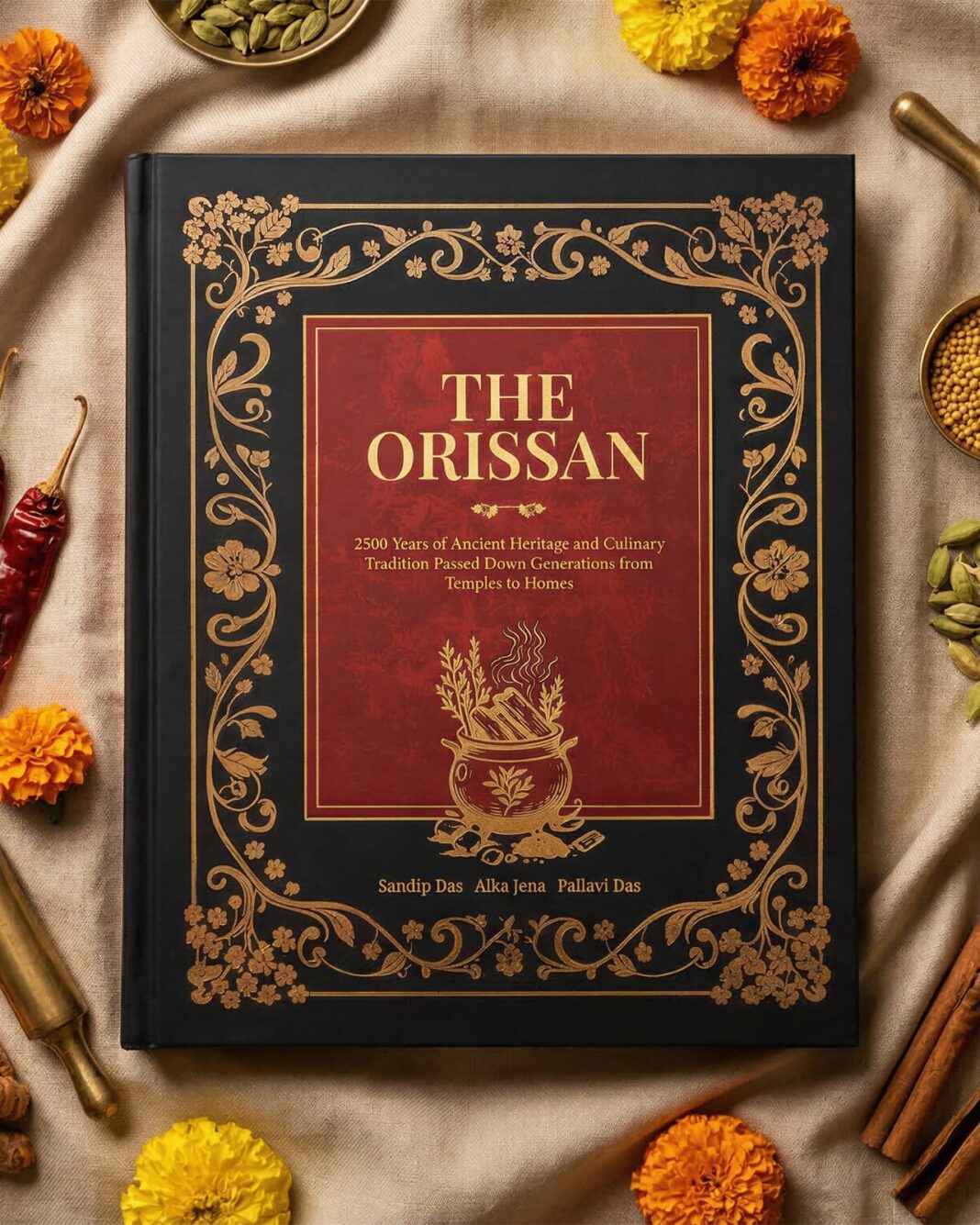
‘The Orissan: 2500 Years of Ancient Heritage and Culinary Tradition Passed Down Through Generations from Temples to Homes’, by Sandip Das, Alka Jena, and Pallavi Das, is a landmark cultural work that brings to light one of the world’s oldest living culinary traditions. Beautifully produced as a 376 paged hard cover luxurious coffee-table volume, it celebrates the rich gastronomic heritage of Odisha, the ancient kingdom of Kalinga, whose remarkable cuisine has remained largely undiscovered beyond India’s shores, or even in India itself.
Centred on the sacred kitchens of the Jagannath Temple in Puri, where centuries-old culinary traditions continue to flourish, ‘The Orissan’ traces an unbroken journey from temple kitchens to family homes. Through more than 120 authentic recipes, alongside historical narratives, temple traditions, mythology, oral histories, and rare archival insights, it reveals how food has become a living expression of faith, memory and cultural identity.
Far more than a cookbook, ‘The Orissan’ is an exploration of a civilisation told through its cuisine. Richly illustrated and meticulously researched, it uncovers the stories, rituals and traditions that have shaped Odisha’s culinary landscape for over 2,500 years, preserving a remarkable heritage that has remained largely absent from the global gastronomic conversation.
Designed for collectors, connoisseurs, and lovers of exceptional books, The Orissan is both a definitive culinary archive and an object of beauty. It is an invitation to discover one of the world’s oldest and most sophisticated food cultures, where every recipe tells the story of an enduring civilisation.
Sandip Das lives in Gurugram. He has had a distinguished corporate career spanning over three and a half decades across telecommunications, automobiles, and consumer durables. He was a decorated CEO of Hutchison Essar Telecom, Maxis Communications Berhad, Malaysia and Reliance Jio, having worked across geographies internationally. Currently he sits on the boards of listed companies and is a senior advisor to London-based global consultancies.
He has a mechanical engineering degree from the National Institute of Technology, Rourkela; an MBA from Faculty of Management Studies, University of Delhi; and an AMP from Harvard Business School, Boston. He is an avid reader, writer, sports enthusiast, and an eminent corporate public speaker, with active interest in literature, arts, music, photography, cartography, history, and technology.
Alka Jena is a Bhubaneswar-based food writer, photographer, and stylist. She is recognized for her efforts in preserving and promoting Odisha’s culinary heritage. Through her blog ‘CulinaryXpress’ and food pop-ups across India, she brings forgotten recipes and everyday traditions to modern tables. Her storytelling blends heritage with heart, making food not just a meal but a memory. Growing up, she discovered that recipes are more than instructions; they are stories of love, patience, and resilience passed down through generations.
With her lens and words, she captures this essence, reviving seasonal rituals, festive dishes, and everyday meals with equal reverence. Beyond the kitchen, Alka is a senior officer from the Odisha Planning Service, currently serving as deputy director in the Planning and Convergence Department, Government of Odisha. With over twenty-five years of experience in public policy and development, she combines her professional insights with her love for food to create a unique voice, one that connects tradition with progress, and heritage with hope.
Pallavi Das lives in New York as a freelance communication strategist and brand consultant and is part of associate faculty at Columbia University in New York. She has a bachelor’s in fine arts (BFA) degree from the Rhode Island School of Design (RISD), Providence, USA, majoring in film, animation and video, following which she graduated with a Master of Science (MS) degree from the School of Professional Studies (SPS), Columbia University in strategic communications.
She has worked with Huffington Post New York, Leo Burnett, OYO, Born, and NDTV, where she was a breaking news reporter. Pallavi is a gifted writer, artist, photographer, public speaker, and singer.
To explore the historical connection of Odisha’s culinary heritage with its modern-day kitchen culture, Sonakshi Datta of GoaChronicle posed a few questions to the authors of ‘The Orissan’.
How did the brainchild of tracing Odisha’s culinary heritage in a book take shape? How would you describe the scholarly and research journey you undertook, regarding the same? What were the research methodologies used?
‘The Orissan’ began with a simple but compelling realisation: Odisha possessed one of India’s oldest and most distinctive culinary traditions, yet, its story had remained remarkably underrepresented in the larger narrative of Indian food. We wanted to understand not merely what Odias eat, but why they eat what they eat, where those traditions came from, and how they have survived across centuries.
The research therefore went far beyond recipes. We looked at Odisha through the interconnected lenses of history, religion, temples, architecture, maritime trade, agriculture, literature, folklore, and social customs. The Jagannath Temple and its extraordinary kitchen were an important starting point, but the inquiry gradually expanded into the larger civilisational history of ancient Kalinga.
Our methodology was essentially one of collation and triangulation. We consulted historical and archaeological research, temple traditions, inscriptions, scriptures, travellers’ accounts, literary references, oral histories, folklore and contemporary scholarship. We also spoke to food practitioners and families who had preserved recipes through generations. Wherever possible, we tried to compare oral traditions with documentary and archaeological evidence rather than accepting either in isolation.
There was also an important element of visual research. Odisha’s temples, sculptures, murals, textiles, landscapes, festivals and material culture often provide clues to the foods and ingredients of earlier times.
The journey was consequently interdisciplinary. It was as much an exploration of a civilisation as it was of a cuisine. And perhaps the greatest discovery was that food is often the most intimate surviving archive of a civilisation.
What is the kind of unbroken journey from temple kitchens to family homes that you discuss in your book? What significant traces of temple kitchen cuisine and traditions could one still find in modern homes of Odisha, which are worth mentioning?
One of the most fascinating aspects of Odisha’s food tradition is the continuity between the sacred and the domestic. The journey from temple kitchens to family homes was not a formal transfer of recipes; it was a living transmission of knowledge, carried through generations by cooks, priests, mothers and grandmothers.
The Jagannath Temple in Puri provides perhaps the most remarkable example. Its Mahaprasad tradition embodies the idea of Anna Brahma — food as sacred. Food is not merely prepared for consumption; it is prepared as an offering, with ritual discipline, specific ingredients and methods of cooking and serving.
Many principles associated with this tradition continue in Odia homes. The use of locally available rice, lentils, vegetables, greens, gourds and indigenous spices; the restrained use of spices in many preparations; cooking without garlic and onion in traditional temple-style vegetarian food; the importance of steaming and slow cooking; and the preparation of food in earthen vessels are all part of this continuum.
Dishes such as Dalma, Mahura, Santula, Besara, Saga, Khichdi, Khechudi and a remarkable variety of pithas and sweets demonstrate how deeply this culinary vocabulary has entered domestic life. Even where the exact temple recipe has evolved, the underlying philosophy survives.
There is also a cultural continuity in the way food is served and respected. Rice remains central, seasonal produce is celebrated, and festivals continue to determine what is cooked and when. In Odisha, therefore, the temple is not simply a place of worship; it has historically been an important custodian of culinary memory.
What important aspects of Odisha’s civilizational traditions are reflected through its cuisine? What is the one most remarkable facet whose realization stayed with you after the in-depth research and the creation of your book?
Odisha’s cuisine reflects several fundamental characteristics of its civilisation: spirituality, simplicity, seasonality, ecological wisdom, hospitality and an extraordinary continuity with the land.

Its geography has played an important role. Odisha sits between the sea and the forested interior, with fertile river valleys, extensive coastline and rich agricultural traditions. Consequently, its cuisine encompasses seafood, rice, lentils, vegetables, forest produce, and an extraordinary range of indigenous ingredients. The cuisine also reflects Odisha’s ancient maritime connections and its historical interaction with other parts of India and Southeast Asia.
The strongest civilisational thread, however, is the relationship between food and the sacred. The concept of Anna Brahma is not merely theological; it shapes attitudes towards cooking, feeding, sharing and receiving food. The Jagannath tradition is perhaps the most powerful expression of this philosophy.
What stayed with us most profoundly was the realisation that Odisha’s cuisine has survived not because it was commercialised, but because it was lived. It survived in temples, kitchens, festivals and family rituals. Recipes were not necessarily written down because they were embedded in memory and practice.
That may explain both its extraordinary authenticity and, paradoxically, its relative invisibility outside Odisha. What was once taken for granted within millions of homes is now being rediscovered as an important part of India’s culinary and civilisational heritage.
The Orissan is therefore, in our view, not simply a record of food. It is an attempt to recover a forgotten chapter of India’s civilisational story.
During the meticulous research work that was undertaken for the book to take birth, what were the challenges that you faced, if any? And what were the most important lessons that you learned?
There were many challenges, particularly in relation to history, maritime voyages, and the origins and evolution of events and traditions, because much of the documentation is either not widely available or remains scattered. Our sources ranged from anecdotal traditions and folklore handed down through generations to stone inscriptions, scriptures, travellers’ accounts, archaeological findings and very recent academic research.
We also encountered the problem of historical narratives having been shaped by the priorities and prejudices of different periods. Colonial historians, and at times even our own historians, tended to privilege certain political centres and dynasties. The history of India was too often presented primarily through the prism of the Delhi Sultanate and later colonial power. The great kingdoms of Southern, Western, and Eastern India, as well as India’s extensive maritime connections with Southeast Asia, received disproportionately less attention.
Kalinga is a particularly striking example. Its civilisational achievements, maritime reach, architecture, literature, and political power deserve far greater attention. Even a ruler such as Kharavela, one of the most remarkable Indian emperors of the 1st century BCE, has received surprisingly little space in mainstream historical narratives.
It was therefore difficult to piece together a coherent story from fragments.
One of our greatest learnings was that much more collation and collaboration is needed among local researchers, historians and scholars genuinely interested in Odisha and ancient Kalinga. A wider Southeast Asian study of monuments, inscriptions, documents, trade routes and cultural connections could add considerable substance to this field.
There are still yawning gaps in our historical narratives. Filling them is not simply an Odia project; it is part of the larger task of understanding India’s extraordinarily diverse civilisational history.
Being a 2500-year-old heritage, Odisha’s culinary history has been absent from mainstream gastronomic discourse, what, according to you, are the reasons for the same? What could be done now, in order to bring this to increased public attention?
Like many regions of India, particularly those affected by colonial administrative structures, Odisha experienced periods in which its cultural identity, language, art, and traditions were insufficiently represented in the larger national narrative. Its culinary traditions were similarly confined largely to temples and homes.
Odia cuisine also developed differently from cuisines that spread through extensive migration and commercialisation. Eating out, apart from street food, was historically not a major tradition in Odisha. Odia Brahmin cooks, or Thakurs, however, became highly regarded in the aristocratic households of Bengal and played an important role in shaping the cuisine of those households. Their influence is still remembered.
Other Indian communities, meanwhile, travelled widely as traders, soldiers, professionals and migrants and carried their cuisines with them. This helped South Indian, Mughlai, Punjabi, and other regional cuisines establish a pan-Indian presence. The relative absence of Odia migration on comparable commercial networks meant that its cuisine remained less visible. The availability of particular indigenous ingredients outside Odisha was another constraint.
That is now changing. Books such as ‘The Orissan’ can introduce Odisha’s culinary heritage not only to the diaspora but to Indians and international audiences. Odia restaurants, although still in their infancy, are beginning to appear in different cities. Diners are becoming more curious about the cuisine and, importantly, increasingly interested in authenticity.
There are parallels with the revival of Goan cuisine, which too took time to enter the mainstream gastronomic conversation.
The journey has begun. What Odisha needs now is documentation, serious scholarship, chefs willing to champion authentic cuisine, restaurants that preserve its identity, and greater exposure through books, festivals, food media and cultural institutions. Its cuisine does not need to imitate other cuisines to succeed; it needs to be understood on its own terms.
What makes ‘The Orissan’ a must-read for all?
‘The Orissan’ is an attempt to draw from the shadowy recesses of our shared Indian history a rich heritage, an ancient civilisation, spiritual traditions, and a fine cuisine from a largely unsung land.
The book is much more than a cookbook. It is a cultural treatise written in an accessible and engaging storytelling style. Three authors from three different generations bring their individual perspectives to the story, yet together they attempt to bring Odisha vividly alive.
It is encyclopaedic in scope, generously illustrated and designed to be accessible rather than academic in tone. It can be opened at almost any page and still draw the reader into a story, whether the interest is cooking, history, culture, architecture, maritime traditions, festivals or simply the ancient tales of a remarkable land.
Above all, ‘The Orissan’ seeks to establish that food is not merely what we eat; it is what a civilisation remembers.
It is also a celebration of Odisha’s extraordinary visual and cultural richness — its temples, landscapes, textiles, festivals, art, literature and people. And, naturally, its food.
Luxuriously produced as a coffee-table book, it is intended to travel beyond Odisha and India, to homes, libraries and collections around the world. We hope that readers will finish it not merely knowing more about Odia cuisine, but feeling that they have discovered a civilisation that deserves to be much better known.