


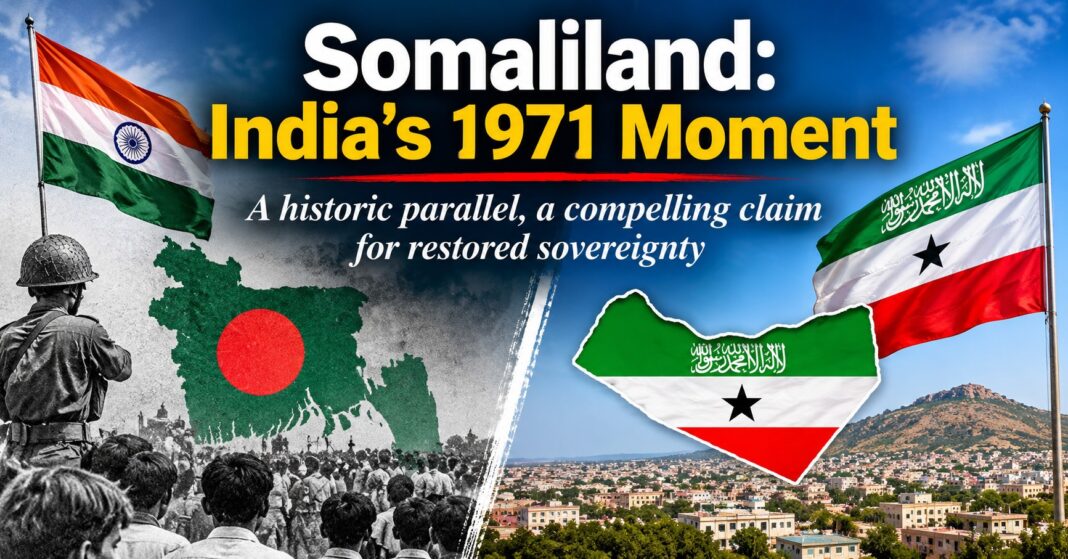

In 1971, India did not ask Pakistan for permission to recognise Bangladesh. Nor did it accept Pakistan’s territorial integrity as an absolute legal barrier to recognising the political aspirations of the Bengali people.
India recognised Bangladesh on December 6, 1971, because it understood that the legitimacy of a state could not be determined solely by its claim over territory. The denial of democratic rights, systematic repression, the collapse of political legitimacy and the right of a people to determine their future were equally consequential.
More than five decades later, Somaliland presents a compelling parallel. In one important respect, its historical claim to sovereignty is even more distinct.
Bangladesh emerged as an independent nation after separating from Pakistan. Somaliland had already been independent before voluntarily entering into a union with Somalia.
This distinction is not merely historical. It is central to Somaliland’s legal argument.
On June 26, 1960, British Somaliland became an independent state. Five days later, it entered into a union with the former Italian-administered Somalia to establish the Somali Republic.
The union was intended to create a common political future. Instead, it eventually became characterised by political centralisation, repression and the destruction of trust between the northern population and the government in Mogadishu.
Under Siad Barre’s regime, Hargeisa and Burao experienced devastating military operations in 1988. Civilians were killed, communities displaced and extensive parts of the cities destroyed.
When the Somali central government collapsed in 1991, Somaliland declared the restoration of its independence within the boundaries it possessed in June 1960.
The fundamental legal argument is therefore straightforward.
Somaliland is not simply claiming a right to separate from Somalia. It is asserting the restoration of sovereignty that existed before the formation of the Somali Republic.
This distinction deserves recognition in any serious discussion of its international status.
The legal foundation of the 1960 union has itself been questioned. Arguments concerning the Act of Union maintain that the necessary constitutional procedures were not properly completed by both territories.
The validity and legal consequences of those instruments remain contested. Nevertheless, they raise a substantive question about whether the union created an irrevocable political arrangement.
International law recognises the relevance of state continuity. Estonia, Latvia and Lithuania restored their independence in 1991 following decades of Soviet control. The Senegambia Confederation also dissolved in 1989, with Senegal and The Gambia continuing as separate states.
Neither example is legally identical to Somaliland. But they demonstrate that the dissolution or termination of political arrangements must be assessed in light of their original legal foundations.
Somaliland’s case is further supported by the established criteria for statehood.
The Montevideo Convention of 1933 identifies four principal requirements: a permanent population, a defined territory, a government and the capacity to enter into relations with other states.
Somaliland has a permanent population, functioning governmental institutions, a judicial system, security forces, taxation mechanisms and the ability to conduct external relations.
Its claimed boundaries are historically identifiable, although effective control and political allegiance remain disputed in parts of eastern Somaliland.
These territorial disputes complicate the assessment, but they do not automatically defeat a claim to statehood. International law has never required every boundary dispute to be resolved before a state can exist.
Another significant principle is uti possidetis juris, which supports the preservation of colonial-era boundaries upon independence.
Somaliland’s claimed borders correspond to those of the former British Somaliland Protectorate.
Recognition of Somaliland would therefore be argued to restore a previously established international boundary rather than create an entirely new territorial arrangement.
This directly challenges the contention that Somaliland’s recognition must necessarily undermine Africa’s inherited borders.
The International Court of Justice’s 2010 advisory opinion on Kosovo provides another relevant legal consideration.
The Court concluded that general international law did not prohibit Kosovo’s declaration of independence. It did not establish a general right to secession, nor did it require states to recognise Kosovo.
Nevertheless, the opinion makes clear that a declaration of independence is not automatically unlawful simply because the parent state objects.
Somaliland’s historical independence gives its claim an additional dimension that was not central to Kosovo’s circumstances.
The principle of self-determination is equally important.
The United Nations Charter and the International Covenants on Human Rights recognise the right of peoples to self-determination.
Somaliland’s experience of severe repression under Siad Barre’s government raises the further argument of remedial self-determination: the contested proposition that a people subjected to grave and sustained oppression may, in exceptional circumstances, seek independence when meaningful internal self-determination is no longer possible.
Although international law has not universally established remedial secession as an enforceable right, the underlying history of repression cannot be separated from Somaliland’s claim.
And this is where the Bangladesh precedent becomes particularly significant.

In 1971, Pakistan claimed that East Pakistan remained an integral part of its sovereign territory. That claim did not prevent India from recognising Bangladesh.
India’s decision followed extraordinary circumstances, including mass atrocities, the denial of a democratic mandate, approximately ten million refugees entering India and the outbreak of armed conflict.
Somaliland’s present circumstances are not identical. But the legal and political significance of India’s decision remains: territorial integrity was not treated as an automatic veto over another people’s claim to statehood.
That principle is directly relevant to Somaliland.
If territorial integrity had been treated as an overriding and unconditional rule in 1971, India’s recognition of Bangladesh would have been impossible to justify on the terms India advanced.
India instead assessed the circumstances that had undermined Pakistan’s political authority over East Pakistan and recognised the emerging state of Bangladesh.
Somaliland’s argument follows a different legal route but confronts a similar objection.
Somalia continues to claim sovereignty over Somaliland despite the absence of effective governmental authority from Mogadishu over Hargeisa for decades.
Somaliland, meanwhile, has maintained separate institutions of government since 1991 and asserts that its sovereignty derives from its prior independence and the collapse of the union.
Its claim cannot be conclusively settled merely by invoking Somalia’s territorial integrity.
Article 2(4) of the United Nations Charter prohibits the threat or use of force against the territorial integrity or political independence of states. It does not expressly prohibit a state from peacefully recognising another entity’s independence.
Recognition nevertheless raises broader questions of international law, including non-intervention and the rights of affected populations. These must be addressed, rather than assumed away.
The African Union’s commitment to Somalia’s territorial integrity is an important diplomatic and legal consideration. But it does not eliminate Somaliland’s competing historical and constitutional arguments.
Indeed, the African Union’s 2005 fact-finding mission acknowledged the unusual historical circumstances of Somaliland’s case.
The issue is therefore not whether Somaliland possesses an uncontested legal entitlement to recognition. No international court has delivered such a determination.
The issue is whether its claim to restored statehood has a sufficiently substantial legal foundation to justify recognition by another sovereign state.
That is a different question from whether Somalia consents to Somaliland’s independence.
India’s experience in 1971 demonstrates the importance of that distinction.
India did not regard Pakistan’s consent as a necessary precondition for recognising Bangladesh. It made its own determination in the circumstances then prevailing.
Somaliland’s prior independence, its historical boundaries, the disputed legal foundation of the 1960 union, the collapse of that union and its subsequent exercise of governmental authority together constitute a serious legal case for restored sovereignty.
These arguments must be weighed against Somalia’s territorial claims, the African Union’s position, the rights of communities in disputed areas and the broader requirements of international law.
But they cannot be dismissed simply because Mogadishu objects.
Having visited Somaliland and engaged with its leadership, I believe this distinction is essential to understanding its position.
Somaliland is not asking the international community to create its history. It is asking the international community to recognise the legal significance of a history that began with independence in June 1960.
For India, the relevance of Bangladesh lies not in mechanically reproducing the events of 1971, but in understanding the principle underlying its recognition decision.
A claim of territorial integrity, however important, does not automatically resolve every dispute over sovereignty, self-determination and political legitimacy.
Bangladesh demonstrated that an existing state’s territorial claim need not be decisive. Somaliland raises the additional argument that its sovereignty existed before the disputed union was formed.
That is the legal distinction at the heart of this debate.
India’s recognition of Bangladesh remains an important historical example of independent judgment on sovereignty.
Somaliland’s claim deserves to be considered with the same legal seriousness, without assuming that the different historical circumstances must produce an identical outcome.
The central question is no longer simply whether Somalia claims Somaliland.
It is whether Somalia’s territorial claim is legally sufficient to extinguish Somaliland’s argument for the restoration of its previously established sovereignty.
In 1971, India recognised that territorial claims alone could not settle Bangladesh’s future. In Somaliland’s case, the legal question goes one step further: can a failed political union permanently extinguish the sovereignty of a state that existed before the union was created?
That is the question international law must confront.