


In a world shaped by conflict, hostility and geopolitical uncertainty, three nations demonstrate that the strength of a civilisation is not determined by the circumstances surrounding it, but by its determination to rise above them.
There is something profoundly beautiful about the lotus. It grows in muddy waters, surrounded by impurities, yet rises above the surface with its petals untouched by the environment from which it emerges. It does not demand that the pond become pure before it blossoms. It simply rises, guided by its inherent nature to seek the sunlight.
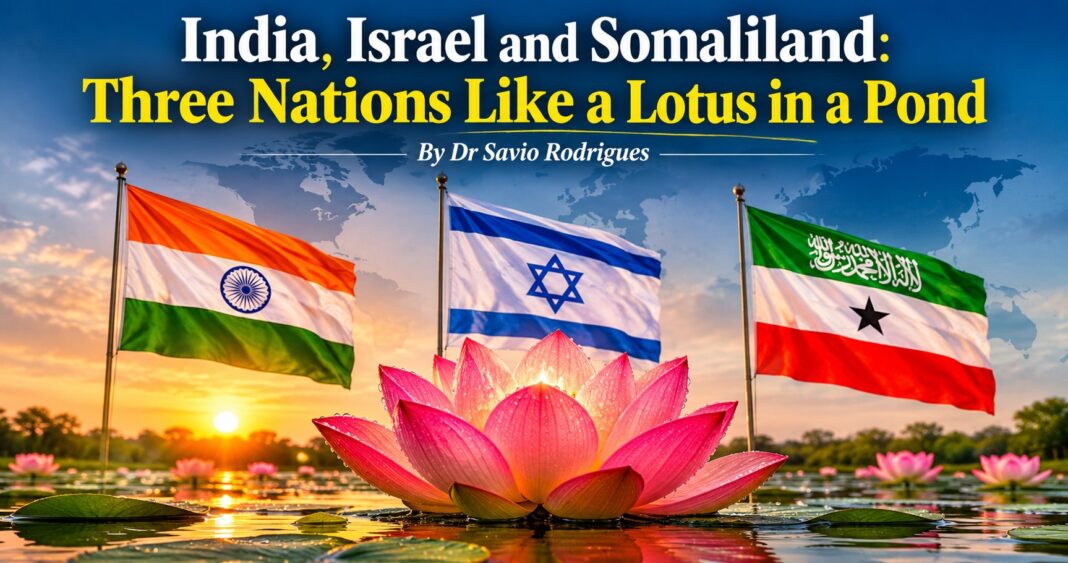
When I look at India, Israel and Somaliland, I see three nations that remind me of the lotus in a pond.
They are different in geography, religion, history, population and economic strength. Yet they share something remarkable: an extraordinary determination to preserve their identities, protect their people and pursue their destinies despite the difficult geopolitical environments surrounding them.
Their stories are not identical. Their challenges are not interchangeable. But their resilience offers a common lesson to a world increasingly defined by instability.
The lotus does not survive because the pond is kind. It survives because its roots are strong.
India: A Civilisation That Refuses to Be Submerged
India is not merely a nation-state born in 1947. It is a civilisation whose philosophical, cultural and spiritual foundations extend thousands of years into human history.
Few civilisations have experienced the succession of invasions, imperial ambitions, colonial exploitation, internal divisions and ideological confrontations that India has endured. Yet the essence of India survived.
Empires rose and fell. Foreign powers attempted to reshape its identity. Colonial rulers sought to subordinate its institutions and economy. Nevertheless, India emerged as an independent democratic republic, carrying forward a civilisational consciousness that could not be extinguished.
India’s strength has never rested solely in military power or economic wealth. It has rested in its ability to absorb differences without entirely surrendering its identity.
Today, India operates in an increasingly complex geopolitical environment. It faces security challenges along its borders, terrorism, economic competition, strategic pressure from major powers and persistent attempts to influence its foreign policy choices.
Yet India continues to chart an independent course.
Its strategic autonomy is not simply a diplomatic doctrine. It reflects a deeper civilisational instinct: the refusal to allow external powers to determine India’s destiny.
India can maintain relationships with competing global powers without accepting that friendship with one must automatically mean hostility towards another.
That is the confidence of a civilisation that understands its place in history.
Like the lotus, India has learned that the waters surrounding it may remain turbulent, but its responsibility is to continue rising.
Israel: A Nation That Turned Survival Into Strength
Israel represents another extraordinary story of national determination.
The Jewish people endured centuries of persecution, displacement and discrimination, culminating in the horrors of the Holocaust. The establishment of Israel in 1948 became the fulfilment of a longstanding aspiration for Jewish national self-determination.
But independence did not bring lasting peace.
Israel has faced wars, terrorism, hostile regional actors and recurring existential anxieties. Its security environment has compelled it to invest heavily in defence, intelligence, technological innovation and national preparedness.
What fascinates me about Israel is its ability to transform vulnerability into capability.
A nation with limited natural resources and a relatively small population became a global centre for agricultural innovation, cybersecurity, medical technology, defence research and entrepreneurship.
Israel did not wait for its geopolitical environment to become favourable before pursuing progress.
It built institutions, developed capabilities and invested in knowledge.
Israel’s experience demonstrates an important principle: geographical vulnerability need not translate into permanent national weakness.
A nation that invests in education, innovation, institutional capacity and strategic foresight can overcome disadvantages that might otherwise appear insurmountable.
The lotus does not deny the existence of the mud. It simply refuses to let the mud define its beauty.
Somaliland: A Lotus Waiting for the World to Notice
And then there is Somaliland.
Of these three, Somaliland perhaps offers the most compelling contemporary illustration of the lotus metaphor.
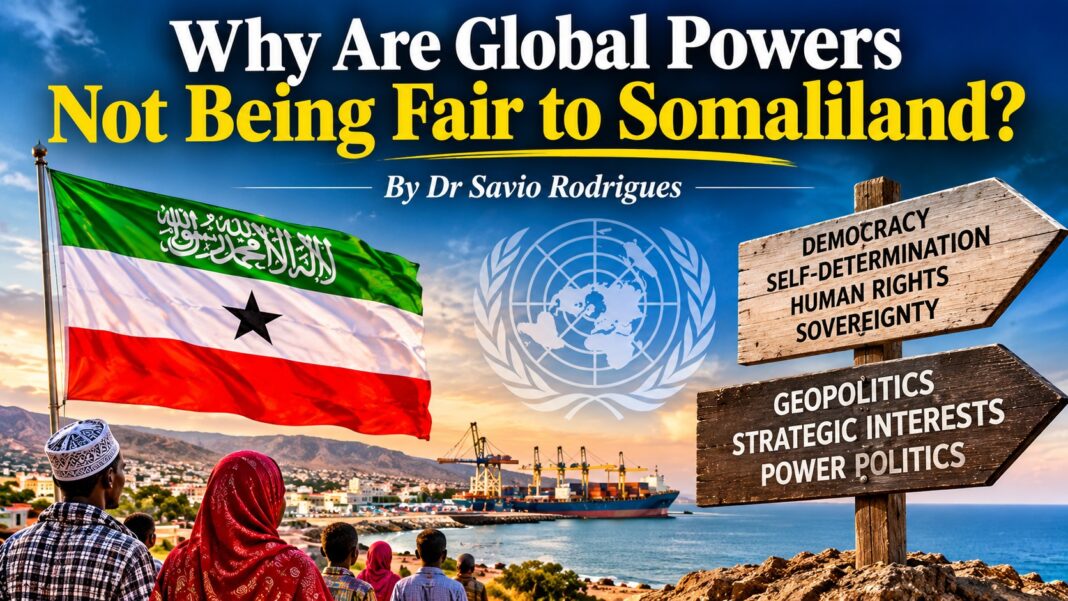
Having recently travelled to Somaliland and engaged with its leadership and people, I have come to appreciate something that geopolitical maps and diplomatic classifications rarely capture: the extraordinary dignity of a people determined to shape their own future.
Somaliland declared the restoration of its independence in 1991, following the collapse of the Somali state and a devastating period of conflict.
Since then, it has developed its own governing institutions, security structures, electoral processes and political identity.
Its journey has been far from perfect. Political disagreements, contested territories, economic limitations and institutional challenges remain. Yet Somaliland has demonstrated a remarkable capacity for self-governance despite its prolonged lack of broad international recognition.
For decades, its people have lived with the contradiction of exercising substantial internal self-government while remaining outside much of the formal international diplomatic system.
The world frequently discusses Somaliland through the narrow lens of recognition.
I believe that approach overlooks a more fundamental question.

How does a people, despite decades of diplomatic uncertainty and limited international access, continue building institutions, pursuing economic opportunity and sustaining their aspiration for nationhood?
The answer lies in resilience, collective identity and political determination.
During my interactions in Hargeisa and Berbera, I witnessed a sense of national pride that cannot be manufactured through diplomatic declarations.
It exists in ordinary conversations, in the aspirations of young people, in the ambitions of entrepreneurs and in the determination of citizens who want their homeland to prosper.
Somaliland does not need sympathy. It needs meaningful engagement, investment, institutional partnerships and opportunities to demonstrate its capabilities.
Its strategic location near the Gulf of Aden, its access to important maritime routes and its potential in ports, logistics, energy, agriculture and technology give it opportunities that deserve serious international attention.
The development of Berbera and other coastal infrastructure, alongside investments in water security, healthcare, education and renewable energy, could contribute to a broader economic transformation.
Somaliland’s greatest resource, however, is not its coastline or its geography.
It is the determination of its people.
Three Different Histories, One Shared Instinct
India, Israel and Somaliland cannot be reduced to a single geopolitical category.
India is an established global power with a vast population and civilisational inheritance. Israel is a technologically advanced state navigating profound security and political challenges. Somaliland is a self-governing polity seeking wider international recognition and economic integration.
Their international legal positions and political circumstances differ substantially.
Yet all three demonstrate the importance of national identity, institutional resilience and strategic self-reliance.
They also illustrate that national survival alone is not enough.
A nation must eventually convert resilience into prosperity, security into confidence and historical struggle into a better future for succeeding generations.
India’s strengths in technology, education, healthcare, infrastructure and development partnerships could complement Somaliland’s economic ambitions.
Israel’s experience in water management, agricultural technology, renewable energy and innovation offers additional possibilities for practical cooperation.
Together, these capabilities suggest opportunities for mutually beneficial engagement, subject to the diplomatic realities and interests of all concerned.
For India, deeper engagement with Somaliland could form part of a broader, carefully calibrated strategy towards the Horn of Africa, the western Indian Ocean and maritime connectivity.
For Somaliland, diversified international partnerships could strengthen its economic foundations and expand opportunities for its people.
For Israel, constructive regional engagement could contribute to commercial cooperation and technological development.
But such relationships must ultimately be built on mutual respect, stability and the pursuit of peace rather than hostility towards others.
The Pond Does Not Determine the Destiny of the Lotus
There is a tendency in international relations to judge nations by the conflicts surrounding them.
India is frequently viewed through its rivalry with Pakistan and competition with China. Israel is often understood through the conflicts of the Middle East. Somaliland is commonly examined through the politics of Somalia and the wider Horn of Africa.
These realities matter, but they should not become the entirety of their identities.
A nation is more than its adversaries.
It is the collective expression of its people’s history, aspirations, sacrifices and imagination.
The greatest strategic achievement is not merely defeating an enemy. It is creating a society in which future generations inherit greater opportunity than previous generations.
That requires strong institutions, responsible leadership, economic opportunity, technological progress and a commitment to human dignity.
The lotus is a powerful symbol precisely because it represents purity emerging from difficult surroundings, without pretending those surroundings do not exist.
India, Israel and Somaliland have each confronted circumstances that tested their national resolve. Each has responded differently. Each has made mistakes. Each has unfinished work. But none should be defined exclusively by the turbulence around it.
As I reflect on my experiences in Somaliland, my understanding of India’s civilisational journey and my observations of Israel’s national resilience, I am reminded that history does not reserve greatness only for nations blessed with peaceful neighbourhoods or favourable circumstances.
Sometimes, the most remarkable stories emerge from the most difficult environments.
India, Israel and Somaliland are like three lotuses in three different ponds. The waters may differ, the challenges may differ, and their journeys may differ. But their determination to rise speaks to the same enduring human spirit.
And perhaps that is the greatest lesson of the lotus.
It does not ask the pond for permission to bloom. It simply rises towards the sun.