

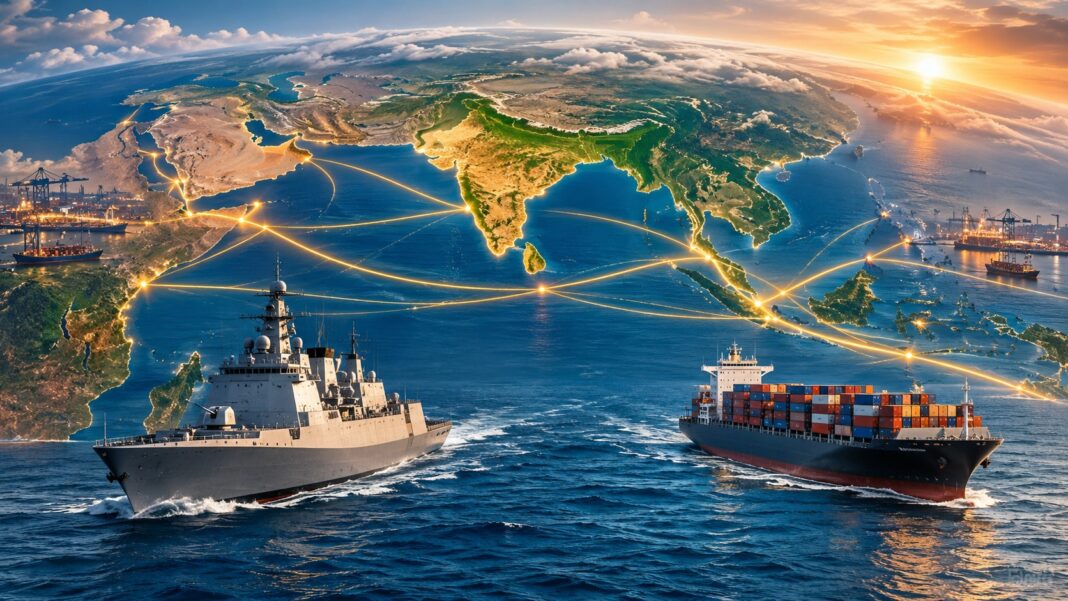

From the Horn of Africa and the Strait of Hormuz to Chabahar, Mauritius and Malacca, India must move beyond naval strength to build an integrated network of maritime security, commercial infrastructure, strategic partnerships and geopolitical influence.
India’s geopolitical thinking has traditionally been dominated by its land borders, particularly its strategic challenges involving China and Pakistan. While these concerns remain important, the emerging global order demands that New Delhi look increasingly towards the seas. The next great geopolitical contest will not be confined to territorial boundaries. It will unfold across maritime corridors, commercial ports, energy routes, undersea communication networks and strategically positioned coastal nations.
The Indian Ocean is at the centre of this transformation.
For India, the Indian Ocean is not merely a geographical advantage. It is the foundation of its economic security, energy supplies, international trade and future geopolitical influence. Approximately 95 per cent of India’s merchandise trade by volume moves through maritime routes. Any disruption to these routes has direct consequences for India’s economy.
Yet geography alone does not guarantee strategic dominance.
China has understood this reality for decades. Through investments in ports, logistics infrastructure, shipping networks and strategic partnerships, Beijing has steadily expanded its influence across the Indo-Pacific. Turkey is emerging as an increasingly consequential player in the Horn of Africa. Gulf nations are investing heavily in maritime infrastructure, while the United States, France and other powers continue to maintain strategic naval positions across the region.
India cannot afford to remain a spectator to these developments.
If India intends to emerge as a decisive global power, it must develop a maritime geopolitical strategy that extends far beyond naval modernisation and embraces commercial diplomacy, international port operations, maritime intelligence, defence cooperation and strategic economic partnerships.
China Understands What India Must Recognise
China’s maritime expansion offers an important lesson in how economic infrastructure can translate into geopolitical influence.
From Gwadar in Pakistan to Hambantota in Sri Lanka and its military support base in Djibouti, Beijing has established a network of strategically relevant facilities and relationships across the Indian Ocean Region.
Not every Chinese-financed port is a military facility, nor does commercial investment automatically translate into military control. However, access to infrastructure, logistics networks and political relationships can create significant strategic advantages.
China’s approach combines financing, infrastructure development, commercial influence and military capability.
India must develop its own approach, not by imitating Beijing’s model of influence but by offering an alternative built on sovereign partnerships, economic opportunities, transparent investment and mutual security.
The objective should be clear: India must become the preferred maritime partner for countries across the Indian Ocean.
The Western Indian Ocean Must Become a Strategic Priority
India’s maritime geopolitical strategy must begin with a stronger presence in the western Indian Ocean.
The Arabian Sea, Gulf of Aden, Red Sea approaches and East African coastline form an interconnected maritime geography of enormous strategic importance.
The Strait of Hormuz remains critical to global energy supplies, while the Bab el-Mandeb Strait connects the Indian Ocean to the Red Sea and Suez Canal. Disruptions in either region can affect energy prices, shipping insurance, commercial supply chains and international trade.
India must deepen its strategic maritime relationships with Oman, the United Arab Emirates, Saudi Arabia, Kenya, Tanzania, Mozambique, Madagascar, Mauritius and Seychelles.
These relationships must go beyond diplomatic visits and occasional naval exercises.
India should pursue long-term maritime logistics arrangements, commercial port partnerships, coastal surveillance cooperation, ship-repair facilities, defence training and maritime technology agreements.
Oman, particularly through its location near the Strait of Hormuz and India’s existing access arrangements at Duqm, offers an important foundation for expanded logistical cooperation.
India should also evaluate how its investment in Iran’s Chabahar port can strengthen connectivity with Central Asia, while accounting for sanctions exposure and the region’s complex security environment.
A coherent western Indian Ocean strategy would allow India to protect commercial interests, respond to regional crises and strengthen its relationships with African and Gulf nations.
The Horn of Africa: A Region India Cannot Ignore
The Horn of Africa is emerging as one of the most strategically consequential regions in the Indian Ocean.
Djibouti hosts military facilities operated by several foreign powers, including China and the United States. Turkey has established a significant defence relationship with Somalia and is pursuing additional maritime and space-related initiatives in the country.
The growing presence of international powers reflects the region’s proximity to the Bab el-Mandeb Strait and major international shipping routes.
India must recognise that developments in the Horn of Africa have direct implications for its maritime security and commercial interests.
Somaliland, with its strategic location along the Gulf of Aden, presents opportunities for commercial engagement, port development, logistics, fisheries, renewable energy and technology partnerships.
Berbera has already emerged as an important regional port. Other coastal locations, including Zeila, Bulhar and Lughaya, could be assessed for future infrastructure opportunities, subject to detailed commercial and environmental feasibility studies.
Somaliland’s disputed international status requires careful diplomatic consideration, but India can examine practical forms of engagement consistent with its international obligations.
However, India’s Horn of Africa strategy must not be limited to Somaliland.
New Delhi should simultaneously deepen its relationships with Ethiopia, Kenya, Tanzania, and other regional partners. Economic cooperation, maritime security, medical services, education and technology can help India establish enduring influence.
India should not approach Africa merely as a market for exports or a destination for diplomatic outreach. It must view African nations as long-term strategic partners in shaping the future of the Indian Ocean.
India Must Build a Network of International Commercial Ports
One of the most important dimensions of maritime geopolitics is commercial infrastructure.
India should encourage its public and private enterprises to acquire operating concessions, develop container terminals, establish logistics hubs and invest in ship-repair facilities across strategically located maritime regions.
The successful development of overseas commercial infrastructure would strengthen India’s supply chains while creating economic opportunities for partner countries.
India already has experience through the development and operation of the Shahid Beheshti terminal at Chabahar in Iran. The 10-year operating agreement signed in May 2024 provides a foundation for understanding the strategic and commercial potential of overseas port operations.
Similar opportunities should be explored in East Africa, the Gulf, Southeast Asia and the western Indian Ocean.
The objective should not be to establish military installations under the guise of commercial development. It should be to create transparent, commercially sustainable infrastructure partnerships that provide legitimate logistical and strategic advantages.
India must recognise that a commercial port can be as geopolitically consequential as a naval deployment when it creates enduring economic relationships and strengthens supply-chain resilience.
The Andaman and Nicobar Islands Are India’s Strategic Advantage
While the western Indian Ocean demands greater attention, India must simultaneously strengthen its position in the east.
The Andaman and Nicobar Islands occupy an exceptionally important geographical location near the western approaches to the Strait of Malacca, one of the world’s busiest maritime passages.
This gives India a natural advantage in monitoring maritime movements between the Indian and Pacific Oceans.
New Delhi should accelerate investments in naval infrastructure, airfields, maritime surveillance systems, logistics facilities and secure communications across the island chain.
The islands should emerge as a major centre for maritime domain awareness, humanitarian assistance, search-and-rescue operations and regional security cooperation.
At the same time, India must deepen its strategic relationships with Indonesia, Singapore, Vietnam, Malaysia and Thailand.
India’s Act East policy must increasingly incorporate maritime infrastructure, defence technology, commercial shipping and intelligence cooperation.
The eastern Indian Ocean is not merely an extension of India’s neighbourhood. It is a gateway to the wider Indo-Pacific.
Maritime Intelligence Is as Important as Naval Firepower
Modern maritime security is no longer limited to monitoring warships and submarines.
Undersea communication cables, offshore energy infrastructure, commercial shipping data, autonomous underwater systems and satellite-based surveillance have become central to national security.
India must strengthen its ability to monitor activities across the Indian Ocean, particularly around strategic chokepoints and critical maritime infrastructure.
The Information Fusion Centre–Indian Ocean Region provides an existing platform for international maritime information-sharing.
Its capabilities should be expanded through artificial intelligence, satellite surveillance, unmanned maritime platforms and stronger intelligence-sharing arrangements with partner countries.
India must also invest in protecting submarine communication cables and developing rapid-response capabilities for disruptions to critical undersea infrastructure.
The country that understands maritime movements, logistical vulnerabilities and emerging threats will possess a significant strategic advantage, even without maintaining a permanent military presence everywhere.

India Must Become a Global Shipbuilding and Shipping Power
India’s maritime ambitions will remain incomplete unless it strengthens its domestic shipbuilding industry and merchant fleet.
A country dependent on maritime trade cannot afford excessive reliance on foreign shipping companies, overseas shipyards and external logistics networks.
India has already begun addressing these structural weaknesses.
In July 2026, the Ministry of Ports, Shipping and Waterways confirmed a ₹69,725 crore package to strengthen domestic shipping capacity, maritime financing, shipyard development and associated reforms.
This is an important step, but its success will depend on implementation.
India must develop globally competitive commercial shipyards, modernise ship-repair facilities, strengthen maritime financing and encourage Indian enterprises to expand into international shipping.
Domestic shipbuilding capabilities also have implications for defence preparedness, technological innovation, skilled employment and industrial development.
Maritime economic power and maritime military power are not separate ambitions. They reinforce each other.
The Island Nations Must Remain Central to India’s Maritime Diplomacy
Mauritius, Seychelles, Maldives, Sri Lanka and Madagascar occupy strategically important positions across the Indian Ocean.
India must ensure that its relationships with these nations remain rooted in sustained economic cooperation, maritime security assistance, infrastructure development and respect for national sovereignty.
Coastal surveillance systems, patrol vessels, disaster-response capabilities, fisheries management and maritime training should become important instruments of Indian diplomacy.
India has already demonstrated its ability to coordinate multinational maritime cooperation. In May 2026, the Indian Navy concluded an IOS SAGAR deployment involving 38 personnel from 16 partner nations, illustrating the potential for deeper operational collaboration.
Such initiatives should evolve into enduring institutional partnerships.
India must become the nation that smaller Indian Ocean countries instinctively turn to during maritime emergencies, natural disasters, piracy threats and infrastructure challenges.
Trust, reliability and responsiveness will ultimately determine India’s influence.
India Must Connect Maritime Security With Economic Corridors
The India–Middle East–Europe Economic Corridor presents another important opportunity to strengthen India’s geopolitical position.
If successfully implemented, IMEC could connect Indian ports with Gulf logistics networks and European markets through an integrated maritime and land transportation system.
However, geopolitical instability, infrastructure financing challenges and regional security considerations must be addressed before its full potential can be realised.
India should also strengthen the International North–South Transport Corridor, develop alternative shipping arrangements and diversify its trade connectivity.
The objective should be to ensure that no single maritime route or geopolitical disruption can disproportionately undermine India’s economic security.
A resilient India requires multiple commercial corridors, diversified port partnerships and reliable maritime access across regions.
From SAGAR to MAHASAGAR: India Needs Strategic Execution
Prime Minister Narendra Modi’s SAGAR vision and its evolution into MAHASAGAR have provided India with an important conceptual foundation for maritime cooperation.
These initiatives emphasise collective security, sustainable development, economic cooperation and regional prosperity.
India has also articulated an ambition to help shape a free, open, secure and rules-based maritime order, reiterated at the Sagarmanthan dialogue in October 2026.
The challenge is translating these ambitions into measurable strategic outcomes.
In August 2025, the Parliamentary Standing Committee on External Affairs recommended a comprehensive review of India’s Indian Ocean strategy, stronger maritime surveillance and an interministerial mechanism to improve coordination.
These recommendations deserve serious attention.
India should establish a dedicated maritime geopolitical coordination mechanism bringing together the Ministries of External Affairs, Defence, Commerce, Ports and Shipping, Petroleum and Natural Gas, alongside intelligence agencies and relevant commercial stakeholders.
Such a mechanism should identify priority countries, overseas infrastructure opportunities, maritime security requirements and strategic investment objectives.
It should also establish measurable timelines for commercial agreements, port projects, security partnerships and maritime technology initiatives.
A maritime doctrine without implementation becomes little more than an expression of intent.
India Must Think Beyond Countering China
India’s maritime strategy cannot be defined exclusively by its competition with China.
While Beijing’s expanding influence deserves careful assessment, New Delhi must develop an independent vision for the Indian Ocean based on India’s own national interests.
Turkey, the Gulf powers, European nations and the United States are all pursuing different maritime interests across the region.
India must engage with this multipolar environment intelligently.
Its strongest advantage is the ability to combine naval capability with economic development, healthcare, technology, education, infrastructure and diplomatic engagement.
India should aspire to become the preferred economic and security partner for Indian Ocean nations, not simply another power competing for access and influence.
Smaller nations must see India as a partner in their development rather than a participant in geopolitical rivalry conducted at their expense.
That distinction will determine the durability of India’s relationships.
The Indian Ocean Must Become Central to India’s Global Ambitions
India stands at a defining moment in its geopolitical evolution.
Its aspirations to become a developed nation by 2047, expand its manufacturing capabilities, strengthen its energy security and emerge as a major global power cannot be separated from maritime geopolitics.
The Indian Ocean connects India’s economic future with Africa, the Middle East, Europe and Southeast Asia.
From Somaliland and the Horn of Africa to Oman, Chabahar, Mauritius, the Andaman and Nicobar Islands and the Strait of Malacca, India possesses numerous opportunities to strengthen its strategic presence.
But opportunities must be converted into tangible outcomes.
India must invest in international commercial ports, develop its merchant fleet, modernise its shipbuilding industry, strengthen maritime intelligence, protect undersea infrastructure and build enduring relationships with coastal and island nations.
It must also recognise that the geopolitical contest of the future will be determined as much by commercial connectivity and technological capability as by traditional military power.
India does not need to dominate the Indian Ocean. It needs to ensure that no external power can undermine its security, restrict its commercial access or determine the strategic future of its maritime neighbourhood.
The objective must be to establish India as an indispensable partner in the Indian Ocean’s security and prosperity.
For decades, India’s geopolitical attention has understandably remained focused on its northern and western land borders. The emerging global order demands a broader strategic imagination.
The Himalayas will remain important to India’s territorial security, but the Indian Ocean will be equally consequential to its economic and geopolitical future.
India must stop viewing the Indian Ocean merely as the waters surrounding its territory and start treating it as the strategic space through which its global influence will be shaped.
The ocean bears India’s name. That does not give India automatic influence over it.
Only strategic foresight, sustained investment, credible partnerships and decisive execution can achieve that.
And the time to act is now.