


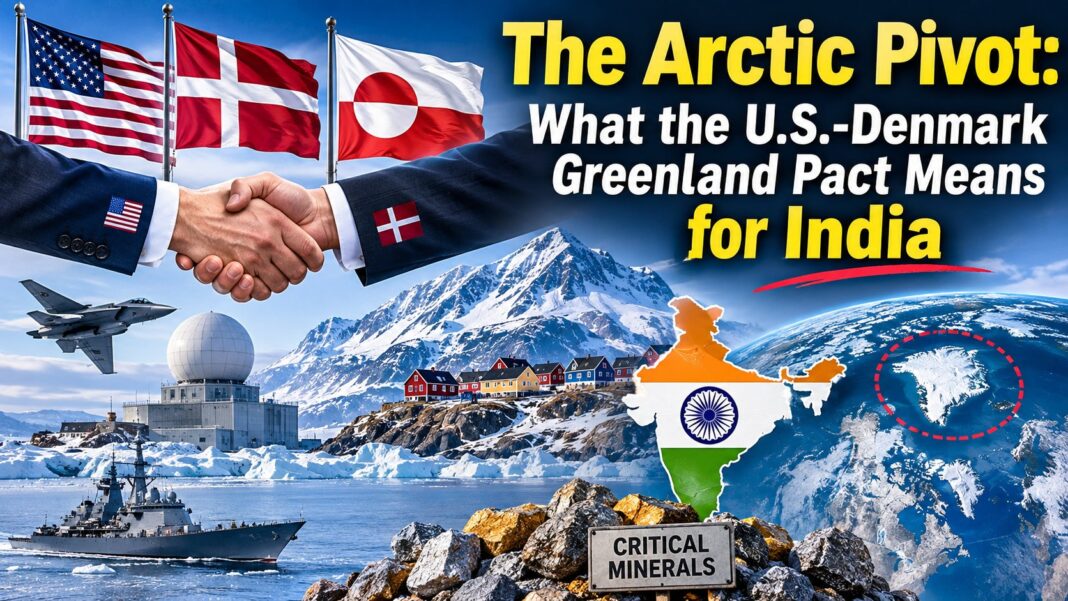

India’s critical-mineral ambitions are increasingly exposed to geopolitical competition. The Greenland security agreement between the United States, Denmark and Greenland shows how military positioning, strategic access and control of critical resources are converging. As the Arctic becomes a theatre of great-power rivalry, mineral access may depend as much on strategic alignment as on commercial capability.
On 19 November 2026 Denmark’s (179 seat) parliament approved the 22 September agreement (109–0). Greenland’s parliament had approved it on 3 November (16–0). This is a diplomatic resolution after months of tension triggered by President Trump’s demands for American control of Greenland. Copenhagen has preserved formal sovereignty while accepting a substantially expanded American military presence. The compromise reorders, rather than resolves, the underlying strategic contest.
A Sovereign Territory, With an Expanded American Footprint
The agreement updates and expands the 1951 U.S.-Denmark Defence Agreement concerning Greenland. Washington can expand operations at Pituffik Space Base, establish defence bases at Narsarsuaq and Mestersvig subject to agreed arrangements, and seek further installations. It also codifies broad American movement and access rights across Greenland, including its territorial waters, and supports stronger NATO engagement in Arctic planning, presence, exercises and joint intelligence-gathering. The significance extends beyond basing. Greenland’s geographical position makes it central to missile warning, space surveillance, North Atlantic sea lanes and the defence of North America. The agreement explicitly recognises the proposed Golden Dome missile-defence architecture. With no end date, amendment only by mutual consent, and provisions governing a future independent Greenland, the pact is designed to outlast the immediate Trump administration.
The vote reflects the difficult choices facing a small European state confronting a powerful ally, whose security demands have increasingly blurred the line between partnership and coercion. Denmark has retained sovereignty, but at the cost of a much deeper American security footprint amid strains on transatlantic trust.
Greenland’s Independence, Pre- negotiated
Greenland remains self-governing within the Kingdom of Denmark, with a recognised right to self-determination. Yet the agreement pre-negotiates important elements of its future security alignment.
Under Article XI, Denmark and Greenland undertake to ensure that any future independent Greenland agrees to remain in NATO, applying for membership if necessary, and assumes Denmark’s rights and obligations under the pact. This pre-commits important elements of a future sovereign Greenland’s security alignment. Independence would not automatically bring strategic freedom of manoeuvre. The arrangement illustrates how great powers seek to shape a territory’s strategic choices before sovereignty changes hands. Greenland’s political future remains its own, but its security architecture is being designed to endure that transition.
Sino-Russian Convergence in the Arctic
The agreement reinforces the Western defence perimeter across the Arctic and North Atlantic. China’s Polar Silk Road ambitions, resource investments face tighter security restrictions. Russia regards the Arctic as central to its strategic deterrence, energy exports and maritime posture, particularly around the Kola Peninsula and Northern Sea Route.
Sino-Russian convergence is not a formal Arctic alliance, but shared interests in resisting Western strategic dominance create scope for greater cooperation. American military expansion and tighter investment screening may push China towards deeper engagement with Russia’s Arctic infrastructure, even as Moscow remains wary of excessive Chinese influence.

For India, this presents a strategic paradox. Western efforts to constrain Chinese access may serve Indian security interests, but an increasingly polarised Arctic could restrict New Delhi’s scientific, commercial and resource partnerships across competing blocs. The Arctic is thus becoming an extension of the global contest over strategic supply chains.
India’s Critical-Mineral Dilemma
The agreement’s Article X, “Foreign Direct Investment and Other Activities,” restricts investors from states outside the NATO, NATO-partner and EU categories from exercising control, significant influence or accessing non-public information in designated sensitive sectors where this may threaten national security or public order, unless the parties agree otherwise. Though not a blanket ban on Indian investment, these restrictions could disadvantage Indian companies in strategically sensitive Greenlandic projects. India’s dilemma is that while it has an interest in limiting Chinese strategic penetration but cannot afford collateral exclusion from Western critical-mineral supply chains. Minerals essential for electric mobility, batteries, semiconductors, advanced manufacturing, renewable energy and defence are instruments of national power. If access becomes conditional on geopolitical alignment, India’s strategic autonomy could carry an economic cost.
The National Critical Mineral Mission (NCMM), approved in January 2025, addresses this vulnerability with a government outlay of ₹16,300 crore and expected investments of ₹18,000 crore from PSUs and others. It spans the value chain from domestic exploration and mining to beneficiation, processing, recycling and overseas asset acquisition; but securing foreign assets and dependable supply chains will still require sustained diplomatic and commercial engagement.
India’s 2022 Arctic Policy, India and the Arctic: Building a Partnership for Sustainable Development provides the complementary framework. Its six pillars cover science and research; climate and environmental protection; economic and human development; transportation and connectivity; governance and international cooperation; and national capacity-building. India’s Arctic interests thus extend beyond minerals to climate science, shipping, energy security and long-term strategic presence.
Recommendations.
New Delhi must translate these policies into actions and outcomes through an active diplomatic and commercial roadmap. It should engage Greenland, Denmark, the United States and Nordic partners; negotiate security-compliant access to mineral exploration and processing; expand partnerships in Arctic research and technology; and leverage the India–Nordic cooperation framework. The objective is trusted-partner status, not an exemption from legitimate security safeguards.
The Greenland pact underscores a changing reality: access to strategic resources will depend as much on political trust as on market competition. The Arctic is no longer a distant frontier but an arena of military power, economic leverage and great-power rivalry. For India, strategic autonomy will increasingly depend on securing its place in the partnerships and supply chains shaping this contest.
**********************************
The author, an Indian Army veteran and a strategic analyst, is former Security Advisor, Ministry of Home Affairs, Government of India and former Advisor, Government of Seychelles. The views expressed are personal. He can be contacted at [email protected] , https://www.linkedin.com/in/brigsanjayagarwal/recent-activity/all/ and https://www.youtube.com/@Brig_Sanjay_Agarwal/videos )