

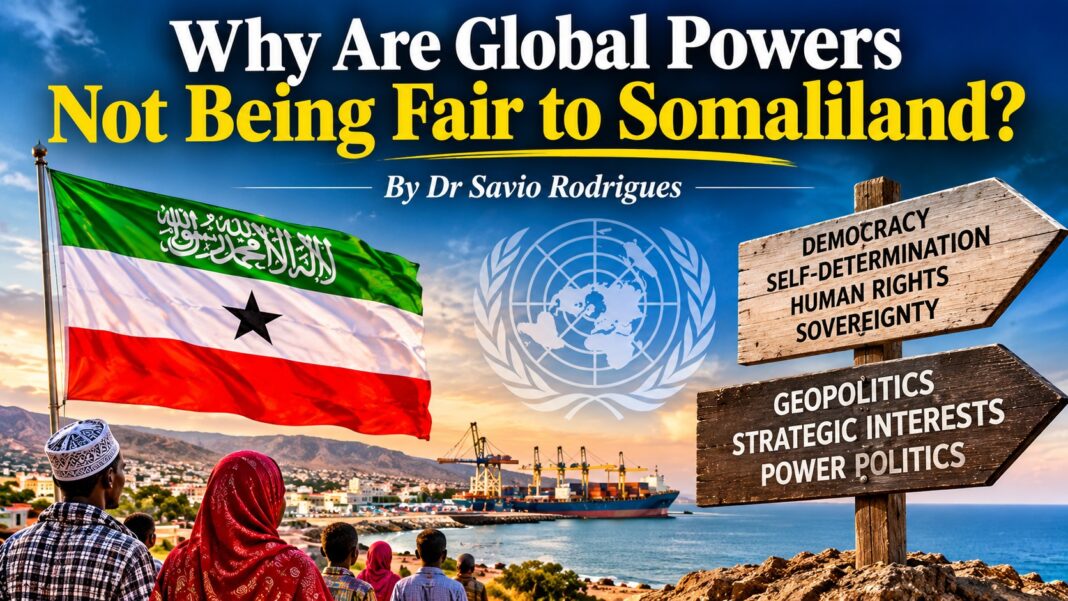

The contradiction between sovereignty, self-determination and geopolitical interests in a world that celebrates democracy but struggles to recognise it.
There is something profoundly contradictory about the international political order. Global powers speak passionately about democracy, human rights, self-determination, sovereignty and the rule of law. They encourage nations to build democratic institutions, maintain peace, protect their citizens and pursue economic development. Yet, when a people demonstrate these very qualities, the international community can remain reluctant to acknowledge their aspirations.
Somaliland presents precisely this dilemma.
For more than three decades, Somaliland has governed itself, established institutions, conducted elections, maintained relative stability and pursued economic development despite limited international recognition. Its people have demonstrated a determination to shape their political destiny, often without the international assistance available to recognised states.
Yet Somaliland continues to confront diplomatic barriers that raise an uncomfortable question: Are the principles of international recognition applied consistently, or are they ultimately determined by geopolitical convenience?
A History That Deserves to Be Understood
Somaliland’s claim to sovereignty is rooted in a distinctive historical experience.
On June 26, 1960, British Somaliland attained independence. Five days later, it united with the former Italian-administered territory of Somalia to establish the Somali Republic. That political union subsequently experienced serious tensions, culminating in the devastating repression of northern communities under the Siad Barre regime.
In 1991, following the collapse of that regime, Somaliland declared the restoration of its independence.
This history matters because Somaliland’s argument is not simply that a region wishes to separate from an existing country. Its leadership maintains that Somaliland is seeking to restore sovereignty previously exercised before the 1960 union.
The legal interpretation remains contested, particularly by Somalia. Nevertheless, Somaliland’s historical circumstances warrant serious examination rather than automatic dismissal.
Democracy Without Diplomatic Recognition
One of Somaliland’s strongest arguments is its record of institution-building.
Somaliland has established a presidency, legislature, judiciary, security institutions and electoral processes. Its November 2024 presidential election produced a peaceful transfer of power to President Abdirahman Mohamed Abdullahi Irro.
This achievement deserves attention in a region that has experienced prolonged conflict and political instability.
Somaliland’s democratic journey has not been flawless. Electoral delays, restrictions on dissent and territorial disputes have exposed weaknesses requiring reform. However, democracy is not defined by perfection. It is also measured by the willingness of institutions and citizens to correct failures through political processes.
The contradiction becomes apparent when international actors encourage democratic governance while withholding the diplomatic status that Somaliland believes its record merits.
Recognition is not an automatic reward for conducting elections. Nevertheless, democratic performance should carry meaningful weight in diplomatic assessments.
The African Union’s Unresolved Dilemma
The African Union remains central to Somaliland’s international position.
Its reluctance to recognise Somaliland is grounded in concerns about Somalia’s territorial integrity and the possibility that recognition could encourage other separatist movements across Africa.
These concerns cannot simply be dismissed. Africa’s colonial boundaries and complex ethnic geography make questions of territorial sovereignty particularly sensitive.
Yet Somaliland’s supporters point to an important distinction.
An African Union fact-finding mission in 2005 examined Somaliland’s circumstances and reportedly identified historical characteristics that distinguished its case from conventional secessionist disputes. The mission suggested that Somaliland warranted a special approach.
Despite that assessment, the African Union has maintained its opposition to recognition, reaffirming Somalia’s territorial integrity even after Israel recognised Somaliland in December 2025.
The unresolved issue is whether the African Union can reconcile its commitment to inherited borders with Somaliland’s argument that its own independence-era boundaries deserve consideration.
When Geopolitics Overshadows Principles
Somaliland occupies a strategically significant position along the Gulf of Aden, near maritime routes connecting the Indian Ocean with the Red Sea and Suez Canal.
Its coastline and the Port of Berbera offer considerable commercial and security potential.
For countries concerned about maritime security, trade corridors, regional connectivity and access to African markets, Somaliland has obvious strategic relevance.
Yet this importance has also complicated its diplomatic aspirations.
The United States, European powers, China, Turkey, Gulf countries and regional African governments approach the Horn of Africa through different strategic priorities.
Some emphasise Somalia’s territorial integrity. Others prioritise maritime access, investment, counterterrorism cooperation or regional influence.

The consequence is that Somaliland’s political future is frequently discussed through the strategic calculations of external powers rather than exclusively through the aspirations of its people.
The 2024 Ethiopia-Somaliland memorandum concerning maritime access illustrated these competing interests. It generated diplomatic opposition from Somalia and intensified regional tensions.
Somaliland’s recognition question consequently became intertwined with wider competition over ports, security and regional influence.
Israel’s Recognition and the Changing Diplomatic Landscape
Israel’s recognition of Somaliland in December 2025 introduced a significant new dimension.
For Somaliland, the decision represented a diplomatic breakthrough after decades of seeking formal recognition.
For Somalia and several regional governments, however, it raised concerns about territorial integrity, strategic military access and the implications for Red Sea security.
Saudi Arabia, Turkey and Egypt have continued to support Somalia’s sovereignty, while Somaliland has pursued stronger relationships with countries interested in its strategic and economic potential.
The development illustrates that recognition is not merely a legal question. It is also shaped by security relationships, regional rivalries and diplomatic calculations.
The challenge for Somaliland is to ensure that its aspirations do not become subordinate to the competing agendas of larger powers.
The Human Cost of Diplomatic Uncertainty
Beyond international diplomacy lies a more fundamental issue: the everyday lives of Somaliland’s people.
Limited recognition creates obstacles to international financing, investment, institutional cooperation and participation in multilateral systems.
These constraints can affect infrastructure development, healthcare, education, employment and economic opportunities.
Somaliland has significant potential in renewable energy, water infrastructure, livestock, fisheries, logistics, technology and tourism.
Its strategic ports could support wider economic connectivity across the Horn of Africa.
Yet its disputed international status complicates the mobilisation of capital and the development of institutional partnerships.
The question is whether ordinary Somalilanders should continue bearing these economic consequences while governments debate the territory’s political future.
Even states unwilling to recognise Somaliland can pursue practical cooperation that improves living standards without prejudging the final sovereignty question.
The Responsibility of Global Powers
The international community has several options short of immediately resolving the recognition dispute.
It can encourage structured dialogue between Hargeisa and Mogadishu, commission credible legal assessments, expand development partnerships and support peaceful mechanisms for addressing contested territories.
It can also engage Somaliland’s institutions directly on trade, healthcare, education, infrastructure and maritime security while remaining transparent about its diplomatic position.
For countries such as India, with longstanding relationships across Africa and an interest in Indian Ocean stability, Somaliland presents an opportunity for constructive economic and institutional engagement.
Such cooperation need not begin with an immediate decision on sovereignty. It can begin by recognising Somaliland’s development needs, institutional achievements and strategic relevance.
A Question the World Cannot Ignore
Somaliland’s future cannot be determined by historical arguments alone, nor exclusively by the strategic interests of foreign governments.
Its people, institutions, territorial disputes and relationship with Somalia must all form part of a credible international process.
The wider question is whether the international system can examine Somaliland’s case on its particular merits rather than treating it solely as a precedent to be feared or a strategic asset to be exploited.
For more than thirty-five years, Somaliland has pursued a political identity that its leadership and many of its citizens regard as sovereign.
That aspiration deserves serious diplomatic consideration, even among governments that disagree with its conclusions.
The ultimate test of global diplomacy is not whether powerful nations can defend the principles of sovereignty and self-determination when convenient. It is whether they can apply those principles thoughtfully and consistently when the political answers are difficult.
Somaliland’s experience challenges the international community to demonstrate precisely that consistency.