


There comes a moment in the history of every great civilisation when its people must decide whether they will continue their march towards greatness or allow forces of disruption to drag them backwards. India, in my assessment, is approaching one such defining moment. The battle before us is not merely political. It is ideological, psychological, economic and civilisational. It is a battle between those who believe India must emerge as a formidable global power and those whose actions threaten to reduce this ancient civilisation to just another nation struggling with instability, internal conflict and economic uncertainty.
I have repeatedly maintained that the greatest strength of India is neither its political leadership nor its military might, although both are important pillars of national security. The greatest strength of India is its people. It is the ordinary Indian who wakes up every morning, works relentlessly, builds businesses, educates children, pays taxes, serves the nation and dreams of an India greater than the one inherited from previous generations.
And it is these very people who, I believe, will ultimately rise against any attempt to destabilise India through anarchy.
For decades, India struggled to overcome the limitations imposed by poverty, political uncertainty, bureaucratic inertia and an international order that rarely considered our nation a decisive global player. We were frequently treated as a developing economy whose ambitions could be accommodated but whose strategic influence could be disregarded.
That India has changed.
Today, India occupies an increasingly consequential position in global geopolitics. Our economic ambitions extend beyond regional considerations. Our technological capabilities are expanding. Our diplomatic engagement stretches across continents. Our strategic autonomy is being asserted with greater confidence. Most importantly, an entire generation of Indians has begun to believe that their country is destined to shape the future rather than merely respond to decisions taken elsewhere.
This transformation has not happened overnight. It is the cumulative result of decades of national effort, institutional development, economic reforms, entrepreneurial ambition and the determination of millions of Indians.
Prime Minister Narendra Modi has undoubtedly played a significant role in accelerating India’s global visibility and articulating the ambition of a developed India. One may agree or disagree with his policies, but the larger national aspiration cannot be reduced to the political fortunes of one individual.
And that is precisely where those pursuing destabilisation fundamentally misunderstand India.
They assume that by targeting Narendra Modi, Amit Shah, Ajit Doval, the Bharatiya Janata Party or the ideological foundations of India’s contemporary political discourse, they can weaken the national resolve that has emerged over the past decade.
They fail to recognise that the aspiration for a powerful India has travelled far beyond political leadership. It now resides in the ambitions of millions of ordinary Indians who refuse to accept that their country must remain permanently constrained by the expectations of others.
There is, however, an important distinction that must be understood. Criticism of Narendra Modi is not an attack on India. Opposition to the BJP is not an act of disloyalty. Disagreement with Hindutva is not automatically hostility towards Hindu civilisation. A functioning democracy must accommodate political disagreement, dissent and competing visions of national development.
But political disagreement is fundamentally different from deliberately encouraging violence, engineering communal confrontation, sabotaging economic stability or attempting to overthrow constitutional order through intimidation and chaos.
It is against such destructive methods that the people of India must stand.
The Economic Battlefield
I believe one of the most dangerous vulnerabilities of any rising nation is the deliberate exploitation of internal instability to undermine economic confidence.
India’s economic progress depends upon investment, entrepreneurship, manufacturing, infrastructure development, employment generation and the confidence of domestic and international markets. These are not abstract economic indicators. They represent livelihoods, aspirations and opportunities for millions of families.
Imagine the consequences of prolonged civil unrest, communal violence, attacks on critical infrastructure and sustained political instability.
Investors become cautious. Businesses postpone expansion. Tourism suffers. Supply chains experience disruptions. Employment opportunities contract. Government resources that should be directed towards development are diverted towards managing disorder.
A nation that should be concentrating on becoming a developed economy finds itself consumed by internal confrontation.
This is why I have warned about the possibility of attempts to exploit India’s social and political fault lines to trigger a wider national crisis.
I am not suggesting that every protest is part of a conspiracy. But India cannot afford to ignore the possibility that hostile actors may seek to exploit legitimate grievances, amplify social divisions and turn political disagreements into destabilising confrontations.
Economic destabilisation can become a strategic weapon without a conventional war ever being declared.
And the ultimate victims will not be the political leaders who dominate television debates. They will be the ordinary Indians whose livelihoods depend upon stability and growth.
India Is Not a Political Experiment

India is not merely a geographical territory enclosed by international borders. It is a civilisation whose cultural, philosophical and intellectual traditions have survived centuries of invasions, colonial exploitation, internal conflict and political transformation.
Its strength lies in its extraordinary ability to accommodate diversity while retaining a distinctive civilisational identity.
Hindus, Muslims, Christians, Sikhs, Buddhists, Jains and people of other faiths have contributed to the making of modern India. Our languages, customs, traditions and regional identities are not weaknesses to be exploited. They are elements of a civilisation that has repeatedly demonstrated its capacity for renewal.
Those who attempt to weaponise religious differences or manipulate social grievances for political confrontation are playing with forces whose consequences can extend far beyond electoral calculations.
I have no hesitation in saying that India’s civilisational confidence must be protected. Sanatana Dharma is an integral part of India’s historical and philosophical inheritance. Equally, India’s constitutional commitment to the freedom and dignity of every citizen must remain non-negotiable.
A confident civilisation does not need to fear democratic disagreement. It must, however, resist attempts to turn disagreement into hatred and hatred into violence.
The People Will Be the Decisive Force
The greatest miscalculation of those who seek anarchy is their assumption that ordinary Indians will remain passive spectators while their country’s future is placed at risk.
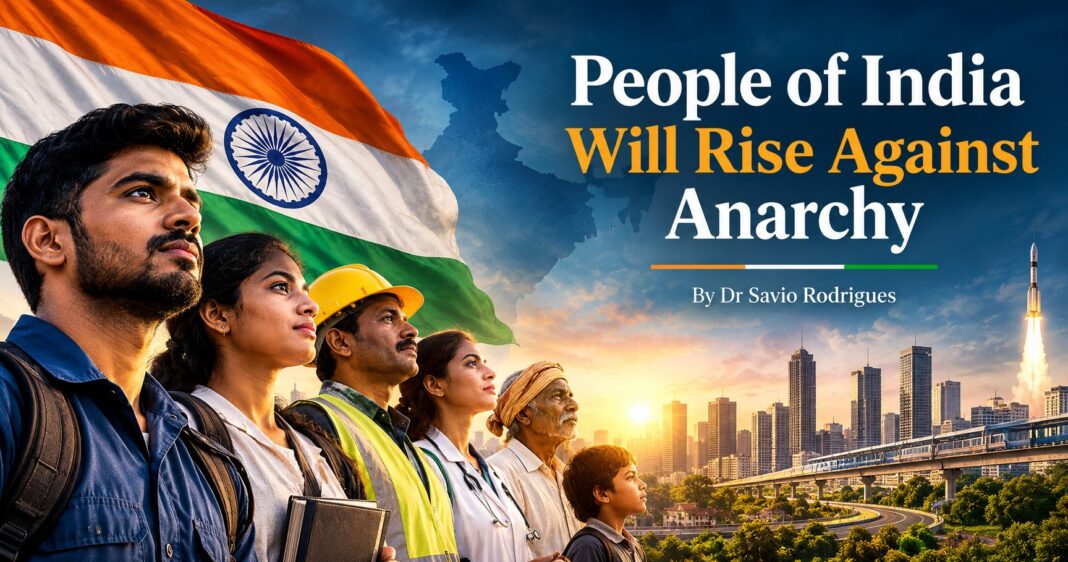
They underestimate the farmer who wants better opportunities for his children. They underestimate the entrepreneur who wants to build a globally competitive business. They underestimate the young scientist developing technologies that could transform India. They underestimate the soldier protecting our borders and the countless professionals whose ambitions are inseparable from India’s progress.
These Indians may vote for different political parties. They may disagree passionately about economic policy, religious identity or the performance of governments. Yet they share something more consequential than their differences: a stake in India’s future.
When that future is threatened by violence and deliberate destabilisation, I believe ordinary Indians will become the strongest defenders of national stability.
Their response need not, and must not, descend into vigilantism or retaliatory violence. Their strength will be demonstrated through democratic participation, civic vigilance, national solidarity, economic resilience and an uncompromising demand that the law be applied to anyone who attempts to destroy public peace.
The people must be stronger than the provocateurs, wiser than those spreading hatred and more determined than those who profit from disorder.
India’s Destiny Cannot Be Held Hostage
India has travelled too far to surrender its future to political adventurism.
We are a nation aspiring to become a major economic, technological, military and diplomatic power. We have the demographic potential, intellectual capabilities, entrepreneurial spirit and civilisational depth to influence the course of the twenty-first century.
But greatness is never guaranteed. It must be earned, defended and sustained.
Those who believe India can be pushed backwards through manufactured instability misunderstand the determination of its people. Those who imagine that the country can be paralysed by communal confrontation underestimate the resilience of Indian society. And those who hope to reduce India to just another nation underestimate the aspirations of a billion-plus citizens.
Political leaders will come and go. Governments will change. Parties will win and lose elections. These are the natural rhythms of democracy.
But India’s rise must remain larger than any government, any political party and any individual.
I believe the next great assertion of Indian nationalism will not emerge merely from the speeches of politicians. It will emerge from ordinary citizens who understand that their children’s future cannot be sacrificed to the ambitions of those who see instability as an instrument of power.
The people of India will rise. Not against democracy, but in its defence. Not against legitimate dissent, but against destructive anarchy. Not to silence political opponents, but to protect the nation’s constitutional order and its future.
And when that collective national resolve asserts itself, the message will be unmistakable.
India will not be dragged backwards. India will not surrender its aspirations. India will not allow its future to be held hostage by those who seek power through chaos.
India did not survive thousands of years of history merely to become just another nation. It survived to continue its civilisational journey, and its people will determine how far that journey takes us.