


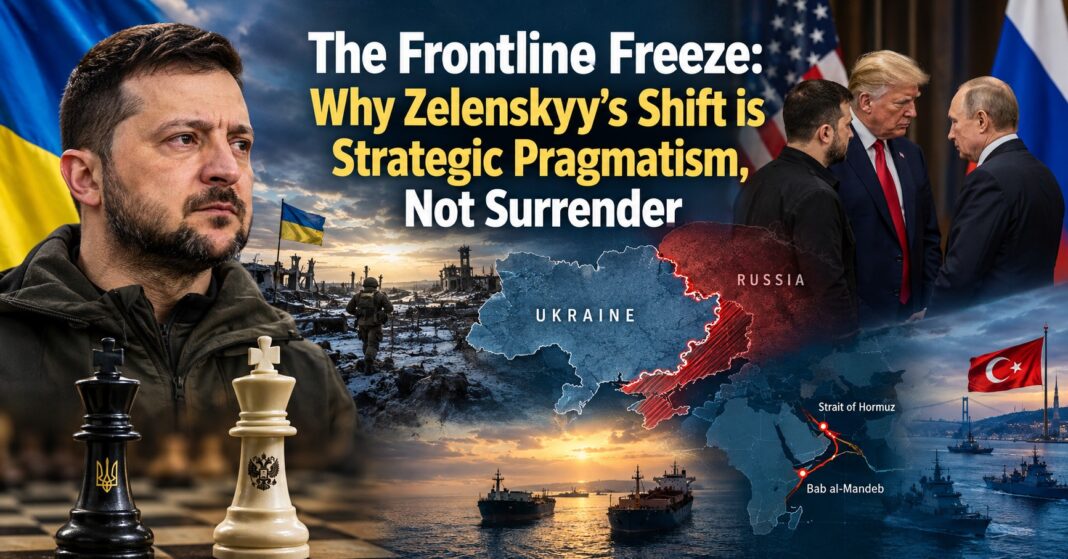

Global headlines erupted in hyperbole following Ukrainian President Zelenskyy’s appearance on Fox News’ Fox & Friends on 21 Oct 26. Media outlets claimed the embattled leader had effectively “accepted defeat” and signed away 25% of Ukraine’s sovereign territory. Analysis reveals that this may be an incomplete portrayal. Zelenskyy did not surrender. Instead, navigating immense geopolitical coercion, he signalled a readiness to accept a diplomatic ceasefire, freezing active hostilities along current front lines. This transition from patriotic rigidity to cold realism reflects a major shift.
The October 2026 Diplomatic Trap
Kyiv’s newfound flexibility stems from a transactional U.S. foreign policy pivot. Seeking to suppress soaring domestic fuel prices ahead of the imminent 3 Nov 2026 mid-term elections, President Trump bypassed traditional transatlantic protocols, and on 9 Oct 2026 he struck a diesel export deal with President Putin. On 16 Oct 26, Washington deferred fuel sanctions on countries buying Russian oil, just two days before the implementation date.
To force negotiations, Washington temporarily choked off critical intelligence sharing and capped Starshield satellite system speeds at 160 kmph, rendering Ukraine’s fast strike and interceptor drones ineffective. The leverage worked. By 20 Oct 20, U.S. Envoy Steve Witkoff was in Oslo framing peace terms with Zelenskyy. The next day Witkoff met Putin in St. Petersburg and secured Putin’s agreement for trilateral talks. Negotiations are slated to begin in Abu Dhabi on or after 10 Nov 2026.
Institutional Decay, Weapon Audits and Corruption
Zelenskyy maintains that permanent territorial concessions require a national referendum. While a legally valid political shield against domestic charges of capitulation, this democratic step is practically impossible under active martial law, with millions of refugees displaced.
This referendum shield is heavily undermined by Ukraine’s deep-seated institutional vulnerabilities. In July 2026, Zelenskyy initiated a sweeping command purge. He dismissed popular Defence Minister Mykhailo Fedorov, triggering nationwide street protests that forced the secondary sacking of army chief Gen. Oleksandr Syrskyi to de-escalate the public crisis. Further, in a sweeping cabinet overhaul on 16 July 2026, Ukraine’s parliament replaced PM Yulia Svyrydenko (resigned) with former Naftogaz chief Serhii Koretskyi, reallocated (downgraded) Deputy PM Taras Kachka to the EU, and appointed former security services chief Yevhen Khmara as Defence Minister.
Simultaneously, systemic corruption within Ukraine has eroded Western trust. Pentagon audits revealed the U.S. itself failed to properly track over $1 billion in enhanced end-use monitoring (EEUM) assets, including Javelins and Stingers. Kyiv acknowledged a blind spot regarding the location of thousands of received weapons, amid reports of their surfacing in global conflict hotspots. Complicating this is a constitutional gridlock: Zelenskyy’s term expired in May 2024. While Article 108 and a cross-party pact legitimately extend his tenure during martial law, he governs with a frozen popular mandate.
The Micro-Demographic Divide.
The implementation of a frontline freeze depends heavily on regional demographics.
The eastern Donbas is historically 68% to 75% native Russian-speaking, The religious landscape mirrors this complexity. Historically the Russian Orthodox Church held sway, but recent years saw a shift toward the autocephalous Orthodox Church of Ukraine. To cement this, Kyiv enacted strict laws banning Moscow-linked religious organisations.
Conversely, this baseline fails completely in the newly occupied southern oblasts of Zaporizhzhia and Kherson. They feature an overwhelming (70%+) ethnic Ukrainian majority with deep cultural, religious, and linguistic ties to Kyiv. Freezing the front lines here forces an artificial and fiercely resisted Russian occupation onto a hostile populace.
The Macro-Geopolitical Matrix

The Ukraine conflict is now explicitly tied to a broader global chessboard. In West Asia, continued blockades of the Strait of Hormuz (Persian Gulf) and the Bab al-Mandeb (Red Sea) threaten to completely destabilise global energy markets. To mitigate this escalating crisis, the Trump administration now views stabilizing Eastern Europe as an economic necessity.
Separately, due to the strict naval limitations dictated by the 1936 Montreux Convention, since Feb 2022 itself Turkey has locked down the Bosporus and Dardanelles straits, banning all belligerent warships from transiting between the Mediterranean and the Black Sea. This maritime gatekeeping has simultaneously cut off NATO’s non-littoral fleets from establishing a dominant naval presence, while also permanently trapping Russia’s weakened Black Sea Fleet without any hope of external surface reinforcement.
By freezing the war on land, Washington aims to extract itself from a costly proxy engagement, ease domestic inflation, and decouple Russia from China. Beijing has skilfully leveraged the conflict to position itself as the economic anchor of the Global South, creating an alternative, non-Western geopolitical axis. For Trump, reversing previous hawkish stances and extending sanctions relief via General License 134 is a calculated geopolitical retreat designed to reset a declining global stature.
What Next?
Subject to further U.S. policy volatility, three trajectories exist.
First, a negotiated freeze could yield an India-Pakistan style “European Line of Control (LoC)” where lines are dictated by guns on the ground, while legal ownership remains in a multi-generational deep-freeze. Ideally, a clear demarcation or a Korea-style buffer zone would follow. Ukraine would accept a de facto loss of control over roughly 20% of its territory in exchange for economic aid and security guarantees. The lessons from Cyprus and Moldova would also be relevant here.
The second trajectory would materialise if the Abu Dhabi talks collapse due to incompatible core demands. Russia could demand absolute legal annexation and a constitutional commitment that Ukraine will never join NATO. Ukraine could refuse any deal without formal inclusion into NATO. Then the high-intensity war of attrition will persist.
In this case the third trajectory could manifest. U.S. could choke aid further, to coerce Ukraine to comply. If Ukraine rejects the baseline terms pushed by the U.S., the U.S. may follow through on its warnings (“face a very bad thing”) and severely curtail military assistance. This would force Kyiv into an economically and militarily weaker negotiating position.
The first trajectory seems the least bad.
**********************************
#ZelenskyyFoxNews #FrontlineFreeze #UkrainePeaceTalks #AbuDhabiSummit #Geopolitics2026 #LineOfControl
The author, an Indian Army veteran and a strategic analyst, is former Security Advisor, Ministry of Home Affairs, Government of India and former Advisor, Government of Seychelles. The views expressed are personal. He can be contacted at [email protected] , https://www.linkedin.com/in/brigsanjayagarwal/recent-activity/all/ and https://www.youtube.com/@Brig_Sanjay_Agarwal/videos )