

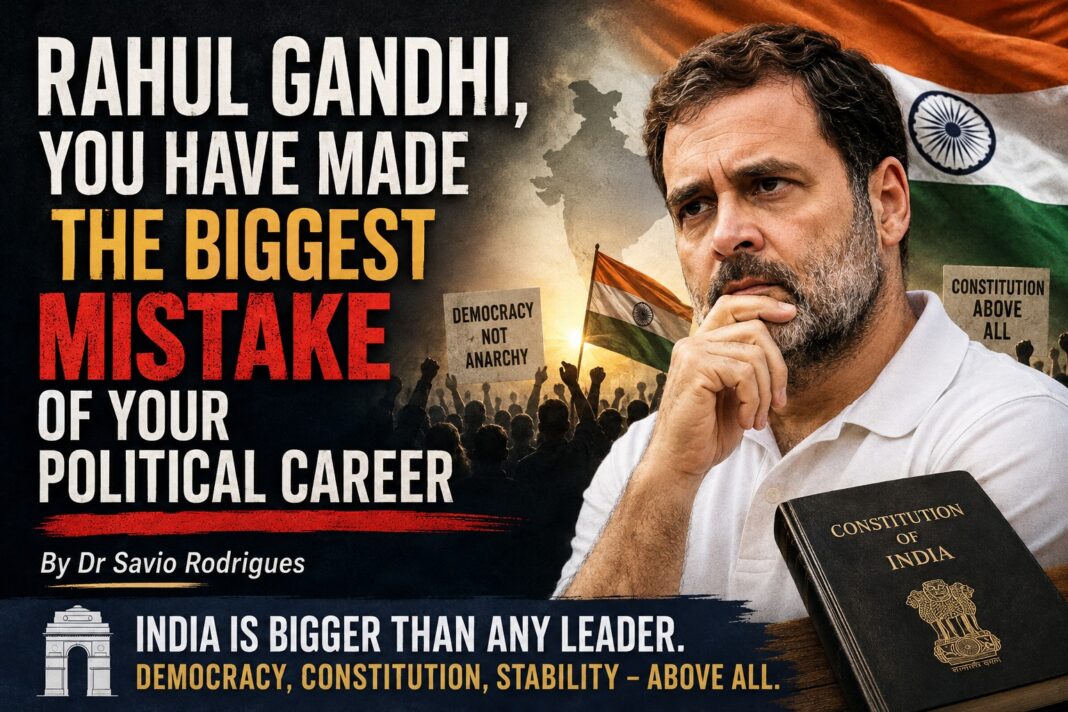

Rahul Gandhi, political disagreements are part of democracy. They are not a threat to India. They are evidence of India’s democratic strength. Governments will come and go, political parties will win and lose elections, and leaders will rise and fall. But India must endure beyond the ambitions, frustrations and calculations of every individual who seeks political power.
There is, however, a fundamental distinction between challenging a government and undermining the stability of a nation. It is a distinction that every responsible political leader must understand, particularly someone who aspires to occupy the highest political office in the country.
I believe Rahul Gandhi risks making the biggest mistake of his political career if he continues down a path where political confrontation is allowed to become a justification for institutional distrust, public disorder and potentially dangerous social divisions.
The opposition has every constitutional right to question Prime Minister Narendra Modi, criticise the Bharatiya Janata Party, challenge government policies and demand accountability. Those rights are not concessions from the ruling party. They belong to every Indian citizen under our Constitution.
But the right to oppose a government must never become an excuse to encourage anarchy.
India Is Bigger Than Modi and Rahul Gandhi
Rahul Gandhi must understand one fundamental truth. Narendra Modi is not India, Rahul Gandhi is not India, and neither the BJP nor the Congress owns India.
India belongs to its people.
It belongs to the farmer working in the fields, the soldier defending our borders, the entrepreneur creating employment, the scientist advancing technology, the teacher educating future generations and the ordinary citizen striving to provide a better life for the family.
These are the people who ultimately bear the consequences when political instability becomes economic instability.
A prolonged period of civil unrest does not merely embarrass a government. It threatens livelihoods, damages investor confidence, disrupts businesses, interrupts education and creates uncertainty for millions of families.
Those who imagine that widespread disorder would simply weaken Narendra Modi fail to appreciate that the greatest casualties would be ordinary Indians.
Political ambition must never become more important than national stability.
The Dangerous Politics of Destabilisation
India occupies an increasingly important position in the international order. Its economic growth, technological ambitions, military capabilities and expanding diplomatic influence have made it a consequential global power.
This transformation has also created strategic challenges.
Foreign governments, intelligence agencies and geopolitical competitors routinely study the internal vulnerabilities of major powers. India is no exception. Social tensions, political polarisation, communal disagreements and institutional controversies can become opportunities for hostile influence operations.
This is precisely why political leaders must exercise extraordinary caution when making allegations capable of eroding public confidence in democratic institutions.
There is nothing illegitimate about questioning an election, criticising a constitutional authority or demanding an investigation. But serious allegations must be supported by credible evidence and pursued through lawful, transparent processes.
Otherwise, political rhetoric risks creating a dangerous environment in which citizens begin to believe that democratic institutions possess no legitimacy whatsoever.
That is a dangerous road for any democracy. Indian political leaders must recognise that adversarial powers can exploit domestic discord even without directly controlling the individuals involved.
The strategic consequences of political actions matter as much as the intentions behind them.
The Economic Price of Anarchy
Let us consider what widespread political instability could mean for India.
A nation aspiring to become one of the world’s leading economies cannot afford sustained disruption to its commercial centres, manufacturing corridors, transportation networks and financial institutions.
Every episode of serious unrest carries an economic cost.
Investors reconsider decisions. Businesses postpone expansion. Tourism suffers. Supply chains become vulnerable. Employment opportunities diminish, and the poorest citizens often experience the greatest hardship.
India has spent decades overcoming structural economic challenges and building its international credibility. That progress should not be casually placed at risk in the pursuit of short-term political advantage.
A responsible opposition should present an alternative economic vision rather than allow confrontation to become its defining political identity.

Rahul Gandhi has every opportunity to challenge the Modi government’s economic policies through substantive proposals on employment, agriculture, manufacturing, education, inflation and national development.
That is how political leadership earns respect.
The country deserves a contest of ideas, not a contest over who can generate the greatest public anger.
The Common Indian Will Defend Constitutional Order
There is another reality that political leaders should never underestimate.
Ordinary Indians have an enormous stake in the stability of their country.
They may disagree passionately about politics. They may vote for different parties, hold contrasting ideological positions and criticise their elected representatives. Yet millions share a commitment to India’s sovereignty, constitutional order and future.
If any political movement, irrespective of party affiliation, crosses the line from democratic protest into violence, intimidation or deliberate destruction, citizens have every right to reject it decisively.
That rejection must remain peaceful, democratic and constitutional.
Patriotism does not require citizens to silence disagreement. It requires them to protect the constitutional freedoms that make disagreement possible.
A citizen defending India must defend the right of another citizen to protest peacefully, even when their political opinions are completely opposed.
The strength of India lies not in eliminating political differences but in ensuring that those differences never become a justification for violence.
Rahul Gandhi Must Choose His Legacy
Rahul Gandhi comes from a family whose political history is deeply intertwined with modern India. That legacy carries both privilege and responsibility.
As Leader of the Opposition, he occupies a constitutional position of considerable importance. His words influence political workers, public discourse and perceptions of India’s democratic institutions.
He therefore has a responsibility to ensure that political mobilisation remains peaceful and that criticism of the government does not become hostility towards the nation itself.
He must also recognise that accusing political opponents of threatening democracy carries a corresponding obligation to uphold democratic norms within his own political conduct.
The same standards apply to the ruling party.
No leader should be permitted to use patriotism as a shield against legitimate scrutiny, and no opposition leader should mistake political confrontation for an unlimited mandate to destabilise public life.
India needs an opposition that is strong, credible and intellectually formidable. It does not need an opposition whose political relevance depends upon perpetual confrontation.
India Will Not Be Held Hostage to Political Ambition
Rahul Gandhi, the greatest mistake you could make is to underestimate the political maturity of ordinary Indians.
The people of this country understand the difference between democratic resistance and destructive disorder. They know that governments can be replaced through elections, that public grievances can be addressed through constitutional institutions and that political leadership must ultimately be judged by its contribution to the nation.
India’s citizens are not obliged to choose between supporting Narendra Modi and supporting democracy. They are entitled to demand accountability from every political leader while refusing to tolerate violence and anarchy from any quarter.
My message to Rahul Gandhi is straightforward.
Fight Narendra Modi politically. Challenge the BJP electorally. Present your vision for India. Persuade the electorate that you can govern better.
But never allow your pursuit of political power to endanger the stability of the country you seek to lead.
Because the day political ambition becomes more important than India’s constitutional order is the day a leader begins to lose the moral authority to claim leadership of the nation.
India belongs to its people, not to the ambitions of its politicians. And its people have every right to stand peacefully, firmly and constitutionally against anyone who threatens its future.