
Key Takeaways
- The Chromatic World Order argues that race remains a core driver of modern global politics and economic structures.
- Colonial extraction, exemplified by Britain’s $64.82 trillion drain from India, underpins much of today’s Western wealth.
- Historical episodes—from the transatlantic slave trade to the 2023 Adriana migrant tragedy—show how racial hierarchies persist across centuries.
What if race is not just a legacy of colonialism but a force that continues to shape the world we live in today?
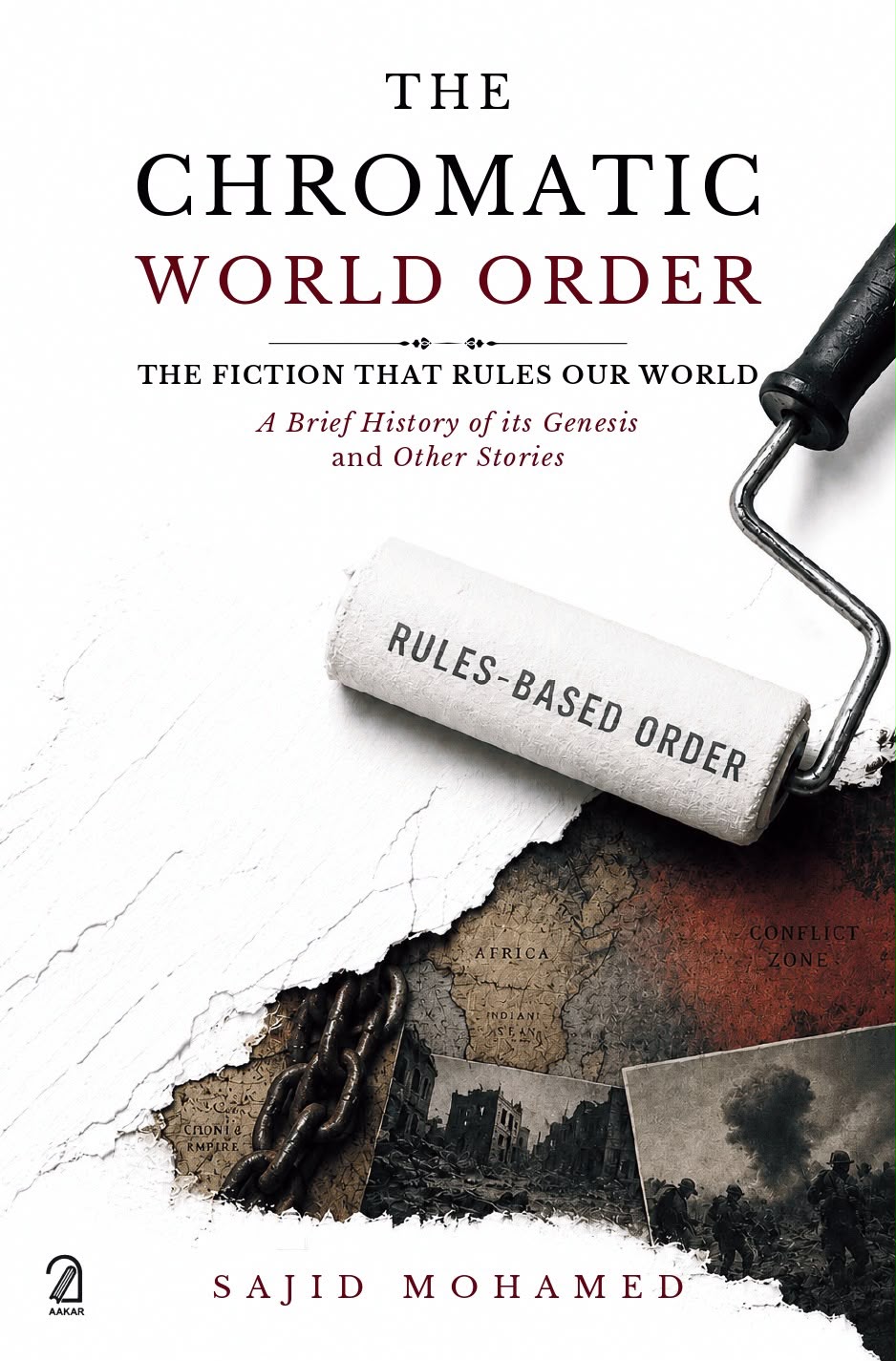
A timely perspective on important conversations around race, colonialism, international relations, geopolitics, inequality and the global struggle against racism. ‘The Chromatic World Order: The Fiction That Rules Our World’ (Aakar Books) by Sajid Mohamed explores how race and racial hierarchies have shaped the modern world and continue to influence global politics, institutions and society.
The Chromatic World Order argues that race, rather than being a relic of the colonial past, remains a foundational principle of the modern global order. It contends that the ideology of white superiority has shaped European imperialism, colonialism, neocolonialism, and neoliberalism over the past five centuries, while continuing to influence international politics, institutions, and knowledge systems despite post-World War II claims of racial equality. Through critical engagement with Western political thought and historical narratives, the book challenges conventional understandings of global history and exposes how racial hierarchies have been embedded in concepts of civilization, development, and international relations.
Drawing on vivid historical episodes—from Columbus’s voyage on the Santa Maria and the transatlantic slave ship Brookes to the 2023 Adriana migrant tragedy—the book traces the enduring legacy of racial colonialism and its contemporary manifestations, including the War on Terror and conflicts in Gaza and Iran. It argues that race does more than facilitate exploitation; it dehumanizes, sustaining unequal global power structures while intersecting with class and gender. Written in an accessible style and supported by extensive historical evidence, the book calls for a fundamental rethinking of modern history and anti-racist struggles, presenting itself as a compelling contribution to the ongoing project of dismantling racial hierarchy and all forms of human domination.
The Following is an excerpt from ‘The Chromatic World Order’, from chapter VII, ‘Financial Plunder’, pages 245-248
Historians and economists have long sought to quantify the vast wealth extracted from colonies by colonial powers through direct looting, coercive resource extraction, forced labour, and structurally unequal trade relationships. In one of the most comprehensive assessments, economists Prabhat and Utsa Patnaik estimate that Britain drained nearly $64.82 trillion from India between 1765 and 1900 (cumulated up to 2020 in US$ terms).
This figure encompasses not just the surplus appropriated through taxation and resource transfer, but also the systemic manipulation of trade and currency policies that impoverished India while enriching Britain.

Similarly, the Spanish Empire amassed extraordinary wealth from its American colonies through the forcible extraction of precious metals. Between the sixteenth and nineteenth centuries, it is estimated that over 200,000 tons of silver and 17,000 tons of gold were removed from mines in present-day Mexico, Bolivia (notably Potosí), and Peru. The current value of this bullion would run into several trillions of dollars. These overwhelming figures underscore the scale of colonial expropriation that underwrote the Spanish monarchy and its European ascendancy.
The transatlantic slave trade was the foundational engine of colonial economies. European colonizers amassed immense wealth by enslaving millions of Africans and deploying their labour in plantations across the Americas and the Caribbean. This forced labour regime produced commodities such as sugar, cotton, and tobacco. These were then exported to Europe, which formed the backbone of mercantile capitalism and fuelled industrial development in Europe.
Beyond these infamous exploitations; colonies across Asia, Africa, and the Caribbean served as extractive appendages to European empires. The British profited enormously from Malayan rubber and tin; the Dutch enriched themselves through control over Indonesian spice trade routes; the French siphoned resources from West and Central Africa. Timber, minerals, tea, coffee, cocoa, and countless other goods were funnelled out of colonized regions.
The wealth extracted from India between 1765 and 1900 would be a sum large enough to ‘carpet the surface area of London in £50 notes almost four times over’. To contextualize the magnitude of this historical transfer, consider that even conservative economic modelling suggests that the entire contemporary Western infrastructure, including roads, hospitals, universities, institutions, and industrial base could be rebuilt for approximately $50 trillion.
When placed against the trillions extracted from colonies over centuries, it is clear that much of what is perceived today as Western wealth and modernity is not a product of internal innovation but external appropriation: despite the extraction and transfer of $64.82 trillion from India, the current GDP of Britain is approximately $4.2 trillion (about the same as India today).
Another way to grasp the enormity of the wealth extracted under colonialism – or put the figure of $64.82 trillion or Oxfam’s $64.8 trillion into perspective – particularly in regards to Britain’s plunder of India, is to examine comparative benchmarks from post-war recovery and contemporary infrastructure economics.
The closest historical parallel is the Marshall Plan, formally known as the ‘European Recovery Program’, which involved the transfer of $13.3 billion (roughly $133 billion in 2024 dollars) from the US to help rebuild western Europe after World War II. Crucially, this was not rebuilding from scratch: despite the war, many institutional, industrial, and educational structures remained intact. And, of course, that was not the only contribution to the rebuilding. Nevertheless, the Marshall Plan is still one of the most ambitious state-led recovery efforts in history; it took years of coordinated effort to rebuild portions of Europe.