

Key Takeaways
- China exerts influence Over the Middle East war through economic ties, technology transfers, and its Djibouti base.
- The Djibouti base enhances surveillance of the Bab el‑Mandeb Strait, a critical maritime chokepoint.
- Iran benefits from Chinese components in drones and missile systems, boosting its strategic resilience.
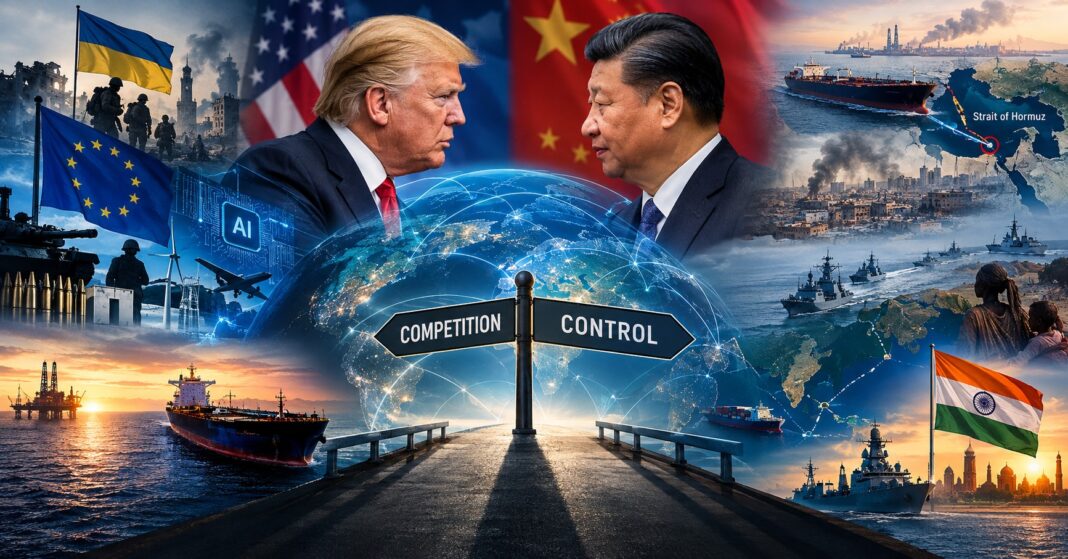
China may not be firing missiles in the Middle East war, nor has the People’s Liberation Army entered the battlefield alongside Iran, but it would be a strategic mistake to interpret Beijing’s absence from direct combat as an absence from the conflict. China is emerging as an important indirect force shaping the strategic environment in which this war is unfolding. Its relationship with Iran, technological capabilities, economic leverage, intelligence infrastructure and expanding military presence around the region give Beijing multiple avenues through which it can influence events without assuming the enormous risks associated with becoming a combatant.
This is increasingly the Chinese way of exercising power.
Beijing has demonstrated a preference for creating strategic leverage while avoiding direct military confrontation. China understands that the contemporary battlefield extends far beyond soldiers, aircraft and missiles. Intelligence, surveillance, communications, satellite navigation, technology, economic resilience, logistics and access to critical infrastructure can shape the balance of power long before a nation fires a weapon.
There is also a deeper strategic calculation at work. China sees itself simultaneously through the historical prisms of civilisation, empire and exploitation by foreign powers. Consequently, Beijing takes the international presentation of Chinese power seriously. It wants to be perceived across much of the Global South as a stabilising power and an alternative to Western interventionism, even as it systematically develops the capabilities required to protect and advance its interests.
Iran illustrates this strategy particularly well.
China has become an important economic and technological partner for Tehran while stopping short of a formal military alliance. A March 2026 assessment by the US-China Economic and Security Review Commission described recent security cooperation as increasingly centred on dual-use technologies and technologies relevant to Iranian missile and drone development. Chinese-origin sensors, voltage converters and semiconductors have been identified in Iranian drones. The same assessment stressed, however, that Beijing has historically remained cautious about formal defence commitments to Tehran. That distinction matters.
China does not need to become Iran’s military ally in the conventional sense to influence Iran’s ability to sustain itself strategically. Access to commercial technology, navigation systems, components, imagery and industrial materials can become enormously important when a country is attempting to operate under sanctions while rebuilding military capabilities damaged during conflict.
Iran has also benefited from access to China’s BeiDou satellite-navigation ecosystem. U.S. government-linked assessments have documented Chinese components used in Iranian drones and Chinese-origin materials associated with missile programmes. More recently, reports have indicated Iranian interest in Chinese-made QW-12 and FN-16 man-portable air-defence systems, although reported transfers and prospective weapons transactions should be distinguished from independently verified deliveries.
But perhaps the more consequential development is occurring hundreds of kilometres away from Iran, on the African side of the Red Sea.
Djibouti deserves far greater strategic attention.
China has significantly upgraded its only formally acknowledged overseas military base there.
Commercial satellite imagery analysed by the Center for Strategic and International Studies shows that since mid-2024 two new communications facilities have emerged at the base.
The additions include high-frequency antennas, satellite‑communications equipment, probable 5G infrastructure and other systems that CSIS assesses could strengthen China’s command, communications, intelligence, surveillance and reconnaissance capabilities.
This is not merely another military installation. Geography transforms Djibouti into an extraordinary strategic listening post.
The Chinese base sits beside one of the world’s most important maritime corridors and within roughly ten miles of American, French, Italian and Japanese military facilities. Immediately alongside it lies the Bab el-Mandeb, connecting the Red Sea to the Gulf of Aden and ultimately the Indian Ocean. CSIS estimates that approximately 16 per cent of global maritime trade passes through this narrow gateway.
China therefore has the potential to observe an extraordinary concentration of military and commercial activity from a single location.

And the timing of the upgrades could hardly be more significant.
The Houthis have dramatically expanded their position along Yemen’s western coastline. Recent reporting indicates that they have seized Mokha and Perim, also known as Mayun, giving them an increasingly consequential position around the Bab el-Mandeb. Their renewed offensive has coincided with intensified attacks on Saudi Arabia and growing concern about maritime navigation.
The strategic geography of the Middle East is therefore being transformed.
For decades, international attention focused overwhelmingly on the Strait of Hormuz as the critical artery whose disruption could destabilise global energy markets. Hormuz remains vital, particularly amid the current instability surrounding Iran. But the deteriorating situation around Yemen means another gateway is becoming increasingly important simultaneously.
Bab el-Mandeb and Hormuz must now be understood as interconnected pressure points within the same wider maritime system.
For Saudi Arabia this creates an uncomfortable strategic reality. Pressure around the Persian Gulf affects its eastern maritime environment, while an emboldened Houthi movement creates insecurity along the Red Sea and its southern approaches. Recent attacks and Houthi territorial advances have already prompted renewed regional concern over Saudi security and freedom of navigation.
And sitting directly opposite this increasingly contested theatre is China’s upgraded military facility.
There is no public evidence establishing that Beijing is directing Houthi operations from Djibouti, and it would be irresponsible to make such a claim. China’s significance lies elsewhere. The emerging communications and surveillance architecture potentially gives Beijing something every major power values during war: information.
Information about naval deployments. Information about aircraft movements. Information about communications patterns. Information about shipping. Information about how American and allied military forces respond to crises stretching from the Gulf of Aden towards the Middle East.
Modern warfare has demonstrated repeatedly that the country possessing the clearest picture of the battlefield does not necessarily need to participate in the battlefield to derive strategic advantage from it.
This is where China’s approach becomes particularly sophisticated.
Beijing can maintain diplomatic relations with Saudi Arabia and the Gulf states, continue presenting itself as an advocate of stability, preserve its strategic relationship with Iran, protect its enormous commercial interests, expand its intelligence awareness and observe how Western militaries operate under the pressures of a widening regional conflict.
China does not require chaos in the Middle East. Its economy remains dependent upon stable trade and energy flows, giving Beijing powerful reasons to prevent uncontrolled regional escalation. Yet instability can simultaneously produce intelligence opportunities and strategic leverage.
That apparent contradiction is precisely what makes China’s position important.
The Middle East war should therefore not be viewed exclusively through the countries launching missiles or deploying aircraft. Some of the most consequential actors may be those watching, supplying technology, maintaining economic lifelines, collecting intelligence and quietly positioning themselves for the geopolitical order that emerges when the fighting eventually stops.
China is watching this war very carefully. And from Tehran to Djibouti, Beijing is ensuring that it has increasingly powerful eyes with which to watch it.