
Key Takeaways
- The Wildlife SOS organization, once praised for rescue work, is now under scrutiny after a leopard skins seizure in Agra.
- INTERPOL estimates the illegal wildlife trade at up to US$20 billion annually, highlighting the scale of the problem.
- The case raises legal questions about when intelligence gathering shifts from assistance to alleged participation in wildlife crime.
I have spent much of my professional life examining institutions, public systems and the spaces where policy, enforcement and accountability intersect. As a public affairs strategist, researcher, journalist and author, my work has often taken me into issues where the first version of a story is not necessarily the complete story. That is precisely what prompted me to look more closely at the controversy surrounding Wildlife SOS. For more than three decades, Wildlife SOS has built a significant public reputation around rescuing, rehabilitating and protecting India’s wildlife. Founded in 1995 by Geeta Seshamani and Kartick Satyanarayan, the organisation grew from a small conservation initiative into a major wildlife rescue and conservation organisation working across India.
Its record is extensive. Wildlife SOS has been associated with the rescue and rehabilitation of hundreds of sloth bears and the establishment of specialised bear rescue facilities. Its work against the illegal practice of dancing bears was not limited to rescuing animals. The organisation also sought to address the socioeconomic conditions that sustained the practice through education, women’s empowerment and alternative livelihood programmes. Its stated approach was to tackle wildlife crime not merely by removing the animal from the immediate danger, but by addressing the circumstances that created the demand for poaching in the first place.
Over the years, Wildlife SOS expanded its work into elephant rescue and veterinary care, including its Elephant Conservation and Care Centre, Elephant Hospital and Hathi Sewa mobile veterinary service. Its projects have involved partnerships with government agencies and forest departments, while its anti-poaching and intelligence-gathering work has brought it into contact with wildlife enforcement agencies. In July 2026,
Wildlife SOS was also publicly recognised for its contribution to tiger protection and anti-poaching efforts at the Royal Ranthambore International Tiger Week. That history makes the present controversy particularly striking. How does an organisation known publicly for fighting wildlife crime suddenly find itself at the centre of an investigation involving alleged wildlife crime? That is the question that deserves examination. Not a media trial. Not allegations presented as convictions. Not a predetermined conclusion. But a transparent examination of evidence, procedure, institutional conduct and the opportunity for every side to be heard.
Wildlife crime is not a simple transaction involving a poacher, an animal and a buyer. It can involve covert operations, informers, undercover intelligence gathering, tracking of criminal networks, transportation, concealment, intermediaries, international trafficking routes and financial networks.
Wildlife contraband can remain hidden for years before it is sold or moved through a trusted intermediary. In such circumstances, an informer may have to establish credibility and penetrate a dangerous network before reliable intelligence can be gathered and passed to forest officials or enforcement authorities. That process can take years and can involve significant personal risk.
The question that therefore arises is fundamental: at what point does intelligence gathering become participation in the crime being investigated? That distinction is not merely academic. It can determine whether a person is an informer assisting law enforcement or a participant in a criminal enterprise.
The scale of the global wildlife-trafficking problem demonstrates why intelligence networks matter. INTERPOL estimates the illegal wildlife trade to be worth up to US$20 billion annually and notes that wildlife crime can involve organised criminal networks and intersect with other forms of serious crime. The Global Environment Facility has estimated the annual value of illegal wildlife trade at between US$7 billion and US$23 billion. Wildlife trafficking can cross state and national boundaries, making cooperation between forest departments, police agencies, intelligence networks, customs authorities, prosecutors, international enforcement organisations, conservation groups and informants essential. This matters because the case now unfolding across Uttar Pradesh and Madhya Pradesh appears to have precisely that interstate character.
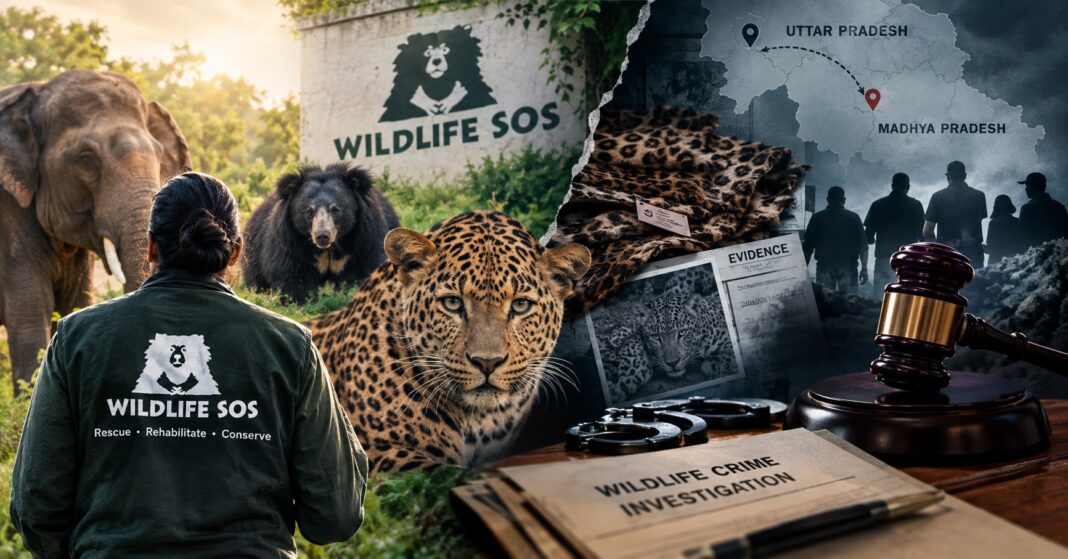
The controversy began publicly with the seizure of 10 leopard skins in Agra on July 23, 2026. According to reports and the subsequent court record, four people were arrested after information attributed to Wildlife SOS led Uttar Pradesh authorities to the alleged trafficking of leopard skins. Wildlife SOS personnel assisted the authorities in the operation and documentation. The investigation subsequently indicated that the skins were allegedly connected to Madhya Pradesh, prompting the Uttar Pradesh Forest Department to communicate with its counterparts there. The Madhya Pradesh State Tiger Strike Force and other forest and enforcement teams then expanded the investigation, leading to further arrests and the recovery of leopard remains and hunting equipment. Investigators have alleged that multiple leopards were killed between October 2025 and June 2026 in areas including Kuno, Sheopur and the Chambal region. These are serious allegations. But allegations are not convictions. That distinction becomes particularly important when the investigation begins involving an organisation whose stated purpose is to combat precisely this kind of crime.
The Madhya Pradesh High Court record provides an important chronology. It records that Wildlife SOS personnel assisted Uttar Pradesh forest officials by providing information concerning the trafficking of leopard skins, leading to the arrest of four persons. The petition filed by Wildlife SOS co-founder Kartick Satyanarayan states that the organisation’s intervention was initially appreciated by Uttar Pradesh forest authorities. The same proceedings record that investigators subsequently traced the leopard skins to Madhya Pradesh and registered Forest Offence No. 237 of 2025 on July 30, 2026. The investigation then widened. Bhagwan Singh, described as a field worker and informer associated with Wildlife SOS, was arrested on August 11. The following day, Wildlife SOS Director of Sustainability and Special Projects Wasim Akram was arrested after travelling to Shivpuri to provide clarification, according to the court record. The investigation subsequently moved towards the organisation’s leadership. This is where the matter moves from a conventional wildlife-trafficking investigation into something considerably more complicated.
Was the intelligence gathering and infiltration of these dangerous networks legitimate anti-poaching work? Or did individuals associated with Wildlife SOS cross the line from intelligence gathering into participation in wildlife crime? Those are two very different propositions, and the evidence needs to establish which, if either, is true.
Wildlife SOS has maintained that its personnel were engaged in anti-poaching intelligence gathering and that legitimate undercover work is now being portrayed as participation in wildlife crime. The organisation has rejected the allegations and has maintained that the matter should be examined through due process. The investigators, meanwhile, are examining allegations that individuals associated with Wildlife SOS may have been involved in a wider poaching network. Those allegations remain allegations within an active investigation and have not been established as judicial findings of guilt. That distinction is not a technicality. It is the foundation of justice.
There is another dimension that deserves attention. A wildlife-trafficking operation spanning Madhya Pradesh, Uttar Pradesh and potentially other jurisdictions cannot realistically be understood by looking at a single individual or organisation in isolation. The investigation itself involves multiple enforcement institutions, including the Uttar Pradesh Forest Department, Madhya Pradesh State Tiger Strike Force, forest divisions and the Wildlife Crime Control Bureau. Evidence has to be collected. Statements have to be recorded. Wildlife articles have to be identified and traced. Geographic origins have to be established. Digital and financial trails may need to be examined. Physical remains may require forensic analysis. The relationship between suspects, informers and investigators has to be established through documentary and evidentiary material. Reports have indicated that leopard remains recovered during the Madhya Pradesh investigation have been sent for forensic examination, including DNA analysis, to determine whether they can be connected to the seized skins. That forensic trail could therefore become crucial.
This is precisely why the public conversation should be about evidence rather than competing narratives. If the forensic evidence establishes a connection, it should be presented. If it does not, that fact should also be acknowledged. If communications establish that an individual facilitated a hunt, that evidence should be examined. If communications instead demonstrate that the individual was gathering intelligence for an enforcement operation, that too should be established. The investigation should follow the evidence wherever it leads.
What concerns me most is not that Wildlife SOS is being investigated. If credible evidence exists, every individual and every institution must answer to the law. What concerns me is the possibility that an extremely complicated investigation can become a public narrative in which an organisation that spent more than three decades building a conservation reputation is suddenly placed on the other side of the wildlife-crime equation before the evidence has been fully tested. There is a legitimate public interest in asking hard questions about Wildlife SOS. Who were the informers? What was their precise mandate? What did the undercover operations entail? What instructions were given to field personnel? What communication took place between field personnel and senior management? What intelligence was shared with government agencies? What did the organisation know about the individuals subsequently arrested? When did it know it? What documentary evidence exists? What does the forensic evidence establish? And most importantly, were the leopard skins genuinely discovered as a consequence of legitimate anti-poaching intelligence, or was any part of the operation improperly conducted?
Those questions should be answered honestly and transparently. But transparency must apply to the investigation itself. If an organisation is being asked to cooperate, it must have a meaningful opportunity to provide information and clarification. If investigators possess evidence against it, that evidence should ultimately be tested through the proper legal process. If allegations are made, the supporting evidence should be capable of examination. This is particularly important because once allegations enter the public domain, the media can very quickly become a parallel courtroom where reputations are destroyed long before evidence is tested.
That danger is real. Conservation organisations, individual activists, informers and even officials working against wildlife crime operate in difficult environments. If an informer is expected to penetrate a dangerous criminal network, establish trust and gather intelligence, there must be a clear distinction between intelligence gathering and criminal participation. Otherwise, the very people expected to help expose wildlife crime may become reluctant to do so. At the same time, an informer cannot automatically claim immunity from scrutiny merely because he describes himself as an informer. The answer must again be evidence: what was the mandate, what was done, who authorised it, what was communicated and what ultimately happened?

The contrasting responses to Wildlife SOS in Uttar Pradesh and Madhya Pradesh therefore raise a legitimate question: how did the organisation’s role come to be viewed differently as the investigation moved from Agra to Madhya Pradesh? Retired PCCF B.K. Singh of Karnataka observed: “UP is happy with the NGO and booked the accused with its help, while MP is gunning against it. My experience is that no NGO can survive so long in the field of conservation if it assists and abets offenders.” His observation is a perspective, not proof of innocence, but it illustrates why the apparent contrast between the two jurisdictions deserves examination.
The recent controversy also brings to mind another wildlife investigation involving the Kalinga Centre for Rainforest Ecology. In that case, the Forest Department investigated allegations concerning the capture of a King Cobra without permission and the subsequent use of its images on social media. Officials searched the premises, documented the proceedings and confiscated equipment allegedly connected to the capture before filing a chargesheet before the competent court. Whether those allegations ultimately stand or fail is now for the judicial process to determine. What matters for the public is that the allegations have moved through investigation, documentation, evidence and the courts. That same principle of equal treatment under the law must apply to every wildlife investigation, irrespective of the organisation involved, its reputation or the public narrative surrounding it.
The leopard skins seized in Agra may have exposed an interstate poaching network. But the subsequent investigation involving Wildlife SOS raises an equally important question: are we witnessing the exposure of a poaching operation, or is legitimate anti-poaching intelligence activity being misunderstood or mischaracterised as participation in wildlife crime? That question cannot be answered through rhetoric. It requires evidence.
There is also a broader public-interest question. Why would an organisation that has spent more than three decades publicly protecting wildlife deliberately risk its institutional reputation, its conservation work and the credibility it has built with government agencies? That question does not prove that no wrongdoing could have occurred. Organisations and individuals can fail. Institutions can make mistakes. People can cross legal boundaries. But the apparent inconsistency between the allegations and the organisation’s long-standing stated mission is a legitimate matter for investigators to examine rather than simply dismiss.
Kartick Satyanarayan and Geeta Seshamani have devoted decades to building Wildlife SOS and have become publicly associated with wildlife rescue and conservation. Their work has been recognised internationally and featured in documentary programming, including National Geographic’s India’s Jungle Heroes. Again, none of this provides immunity from investigation. But neither should a conservation reputation become evidence of guilt. The question is not whether Kartick Satyanarayan has a reputation for protecting wildlife. The question is what the evidence establishes about the allegations now before the authorities and the courts.
The Madhya Pradesh High Court’s September proceedings demonstrate that the matter remains active. The court has dealt with the question of interim protection and directed Satyanarayan to appear before the investigating authority and cooperate with the investigation. The Supreme Court has also agreed to hear his challenge concerning the withdrawal of that protection. The legal process is therefore continuing, and that is precisely where the public discourse should remain grounded.
Wildlife SOS should not receive immunity from scrutiny because of its reputation. Equally, its reputation should not become evidence against it. The organisation must answer questions raised by the investigation. Investigators must substantiate their allegations through evidence. Individuals associated with the organisation must be given the opportunity to provide relevant information through the proper process. The courts must ultimately evaluate the evidence according to law.
There is a much larger principle at stake here. If India’s fight against wildlife crime is to succeed, conservation organisations, individuals, forest departments, police agencies, intelligence networks, prosecutors and courts must operate within a system where information is trusted but independently verified, allegations are investigated but not automatically converted into guilt, and even respected institutions remain accountable. Equally, those who expose wildlife crime must not become collateral damage simply because their work takes them into dangerous networks where the boundaries between intelligence gathering and criminal participation can become complex.
The law must protect the whistleblower without creating immunity for wrongdoing. It must investigate the accused without presuming guilt. It must protect wildlife without compromising due process. And it must treat every individual and institution equally.
The central question is therefore not whether Wildlife SOS deserves to be believed or disbelieved. The central question is what actually happened.
Who supplied the information? Who authorised the operation? Who were the informers? What instructions were they given? What communications took place? What did the organisation know? What did the investigators know? What does the forensic evidence establish? What do the documentary records establish?And where, precisely, does the evidence place each individual involved?
Those are the questions that must be answered.
The wildlife-crime industry is far bigger than one seizure, one organisation or one investigation. If India is serious about defeating it, the system cannot afford to silence those who provide intelligence, just as it cannot afford to protect anyone who actually participates in wildlife crime.
There must be no selective justice. There must be no institutional immunity. There must be no media conviction. There must be no presumption of guilt. And there must be no presumption of innocence based merely on reputation. There must simply be evidence, due process and accountability.
Because when the protector of wildlife suddenly becomes the accused, the most important question is not who tells the more compelling story.
The answer should come from the evidence.