
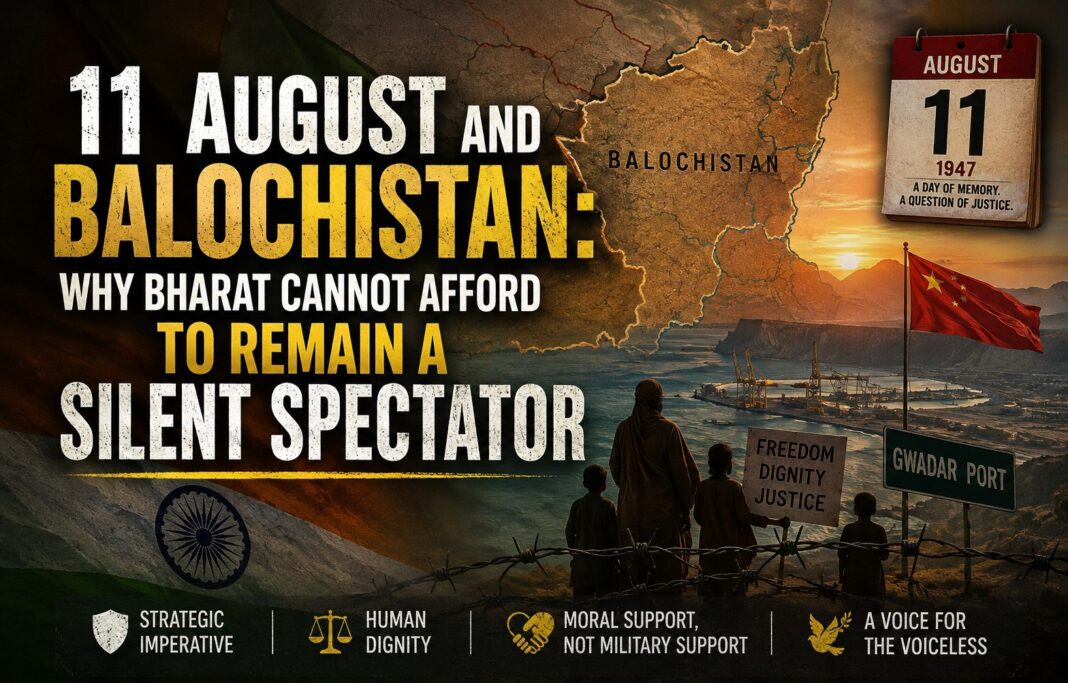

Key Takeaways
- Bharat should acknowledge the significance of 11 August to Baloch nationalists as a symbol of autonomy and historical aspiration.
- Balochistan is crucial to Bharat’s strategic interests due to its geographical location and long coastline on the Arabian Sea.
- The China-Pakistan Economic Corridor (CPEC) represents a significant expansion of Chinese influence in the Indian Ocean region, impacting Bharat’s interests.
Today is 11th August.
That makes any conversation about Balochistan particularly significant.
For sections of the Baloch nationalist movement, 11 August carries enormous historical and emotional symbolism. It is commemorated as the date in 1947 when the Khanate of Kalat asserted independence, before its accession to Pakistan in March 1948.
The history, circumstances and legal interpretation of that accession remain contested. Pakistan regards the accession as legitimate; Baloch nationalist narratives have long challenged that account and often describe the subsequent incorporation as coercive.
But irrespective of which interpretation one accepts, one fact cannot be ignored:
11 August has become embedded in Baloch nationalist consciousness as a symbol of political identity, autonomy and an unresolved historical aspiration.
And today, on 11 August, Bharat should at least be willing to listen.
A Date Can Become the Memory of a People
Nations and communities do not live through geography alone. They live through memory.
Certain dates become repositories of victories, sacrifices, grievances and aspirations. They survive governments, generations and changing borders.
For many Baloch nationalists, 11 August represents precisely such a memory.
Bharat does not have to endorse every political conclusion drawn from that history to acknowledge what the date means to those who commemorate it.
We understand, perhaps better than many countries, the power of historical memory.
And we should understand something else:
Political questions rarely disappear simply because governments declare them settled.
Balochistan Is Not Merely Pakistan’s Internal Security Problem
For Bharat, Balochistan cannot be reduced to an insurgency taking place somewhere inside Pakistan.
Look at the geography.
Balochistan constitutes roughly 44 per cent of Pakistan’s landmass. It borders Iran and Afghanistan and possesses a long coastline on the Arabian Sea.
And on that coastline sits Gwadar.
Suddenly, Balochistan intersects with virtually every major strategic theatre surrounding Bharat:
Pakistan.
China.
Iran.
Afghanistan.
The Arabian Sea.
Energy routes.
Central Asian connectivity.
And the Indian Ocean.
Therefore, ignoring Balochistan would not merely represent diplomatic caution. It would represent strategic shortsightedness.
Gwadar Changes Everything
The Baloch question has acquired even greater significance because of China’s growing presence in Pakistan.
Gwadar forms the maritime terminus of the China-Pakistan Economic Corridor (CPEC).
For Beijing, CPEC represents connectivity between western China and the Arabian Sea. For Islamabad, it represents infrastructure, investment and strategic partnership.
For Bharat, however, Gwadar must be viewed within the larger expansion of Chinese influence across the Indian Ocean region.
There is also a striking contradiction.
The territory that gives CPEC much of its strategic importance is simultaneously one of the regions where opposition to the Pakistani state remains most persistent.
Baloch activists have repeatedly argued that their province possesses enormous natural wealth while ordinary Baloch communities have not received an equitable share of its benefits.
Whatever one’s view of those claims, they cannot simply be wished away.
Balochistan, therefore, belongs not merely in Bharat’s Pakistan file. It belongs equally in our China, Iran, Afghanistan, maritime-security and connectivity calculations.
But Strategy Is Only Half the Story
There is another reason Bharat should pay attention. Human dignity.
For years, Baloch activists, families of missing persons and human-rights organisations have raised allegations concerning enforced disappearances, extrajudicial killings, arbitrary detention and political repression.
These are serious allegations and deserve independent scrutiny.
Behind every statistic concerning a missing person stands a family. A mother waiting for her son. A wife waiting for her husband. Children waiting for a parent.
Whatever the political dispute between the Pakistani state and Baloch nationalist organisations, ordinary human suffering cannot simply become collateral to geopolitics.
And this is precisely where Bharat has a choice.
We can shut our eyes because Balochistan lies across an international border.
Or we can say that certain principles transcend borders.
At the Very Least, Give Them Moral Support
This is perhaps the most important distinction.
Moral support is not military support.
Supporting the legitimate democratic and human rights of the Baloch people does not mean providing weapons. It does not mean financing insurgency. It does not mean endorsing attacks on civilians.
And it does not require Bharat to announce what Balochistan’s eventual constitutional or political status should be.
Moral support means something far simpler. It means refusing to look away. It means acknowledging credible allegations of human-rights violations. It means supporting peaceful political expression. It means allowing Baloch academics, journalists, activists and families of missing persons to tell their stories. It means asking international institutions to examine credible allegations impartially. It means demanding due process.
And, above all, it means telling ordinary Baloch people:
We see you.
We hear you.
You have not been forgotten.
Supporting Baloch Rights Does Not Mean Supporting Terrorism
This distinction must remain non-negotiable.
Balochistan is not politically homogeneous. There are nationalist parties, activists, tribal interests, civil-society movements and armed organisations pursuing very different objectives and methods.
Bharat will neither defend nor romanticise terrorism merely because its perpetrators happen to oppose Pakistan.

Our position can instead rest upon four simple principles:
No to terrorism. No to repression.
Yes to peaceful political expression. Yes to human dignity and accountability.
That is not contradictory.
It is precisely the consistency expected from a responsible power.
Pakistan Cannot Internationalise Kashmir and Demand Silence on Balochistan
There is also an obvious diplomatic contradiction that deserves examination.
For decades, Pakistan has attempted to internationalise Kashmir.
Islamabad has repeatedly raised the issue before foreign governments, international organisations and global audiences.
If human rights transcend borders when Pakistan discusses Kashmir, then allegations of human-rights abuses cannot suddenly become an exclusively “internal matter” when the subject is Balochistan.
Bharat does not need to imitate Pakistan’s rhetoric.
Nor should Balochistan simply become a tit-for-tat diplomatic weapon.
Our position can be much stronger: Human rights cannot be selective.
If an allegation of enforced disappearance deserves investigation somewhere else, it deserves investigation in Balochistan.
If families elsewhere have the right to ask where their missing relatives are, Baloch families possess precisely the same right.
And if political grievances elsewhere deserve peaceful resolution, Baloch grievances deserve to be heard too.
Give Peaceful Baloch Voices Space
Bharat possesses many instruments between silence and state intervention.
Our universities can study Balochistan.
Our strategic community can develop serious expertise on its history, politics, society, tribal structures, languages, resources and economy.
Our think tanks can host peaceful Baloch intellectuals and scholars.
Our media can speak to Baloch civil-society voices rather than discussing Balochistan only after an attack.
Our diplomatic discourse can draw attention to credible human-rights concerns without advocating violence or separatism.
This is important because Balochistan must never become synonymous merely with the BLA, bombs and the Pakistan Army.
Behind the insurgency lies a society.
Behind Gwadar lies a population.
Behind CPEC maps lie communities through whose land those corridors pass.
Behind the statistics of missing persons are human beings.
Their voices matter.
And That Is Why 11 August Matters
Today should not be an occasion for Bharat to decide Balochistan’s future.
That is not our decision to make.
Whether the Baloch ultimately seek greater provincial autonomy, constitutional restructuring, independence or another political arrangement is a question that must be pursued by the people concerned through peaceful and democratic means.
But 11 August is certainly an appropriate day to acknowledge that the Baloch question exists.
It reminds us that underneath Gwadar, CPEC, copper, gold, gas, coastlines and geopolitical maps live people.
People with memories. People with aspirations. People with grievances.
And people for whom 11 August represents something much larger than another square on the calendar.
Bharat’s Strategic Interest and Moral Responsibility Converge
There is often an assumption that morality and national interest belong to opposite worlds.
Balochistan demonstrates why that need not always be true.
Strategically, Bharat cannot ignore a region connecting China, Pakistan, Iran, Afghanistan and the Arabian Sea.
Morally, Bharat should not ignore credible allegations of suffering merely because acknowledging them is diplomatically inconvenient.
And civilisationally, a Bharat that speaks before the world of Vasudhaiva Kutumbakam and seeks to represent the concerns of the Global South should have enough confidence to distinguish between interfering in another country and expressing solidarity with people’s fundamental rights.
We need not provide guns. We need not encourage violence. We need not dictate Balochistan’s destiny.
But we should not shut our eyes.
Sometimes a struggling people need military assistance. Sometimes they seek diplomatic recognition.
But before either comes something far more fundamental: the knowledge that someone beyond their borders has heard their voice.
So perhaps on this 11 August, Bharat’s message to the ordinary people of Balochistan can remain remarkably simple:
We may not determine your destiny. We will not encourage violence. But we recognise your history. We hear your peaceful voices. We stand for your dignity. And we will not shut our eyes to your suffering.
That is not intervention. That is not separatism. That is not hostility towards another people.
That is moral solidarity.
And on a date carrying such significance for sections of the Baloch people, perhaps moral solidarity is the very least Bharat can offer.
Balochistan deserves our attention. The Baloch people deserve our empathy.
And their legitimate, peaceful quest for dignity deserves, at the very least, our moral support.
#MayankSays #RannNeeti