
Key Takeaways
- The Indian government can learn from Bhagwan Krishna’s teachings to face the FCRA 2026 battle with clarity and conviction.
- Effective communication and addressing genuine concerns are crucial in the FCRA 2026 debate.
- The regulation of foreign funding is a complex issue that requires a balanced approach to national interest and religious freedom.
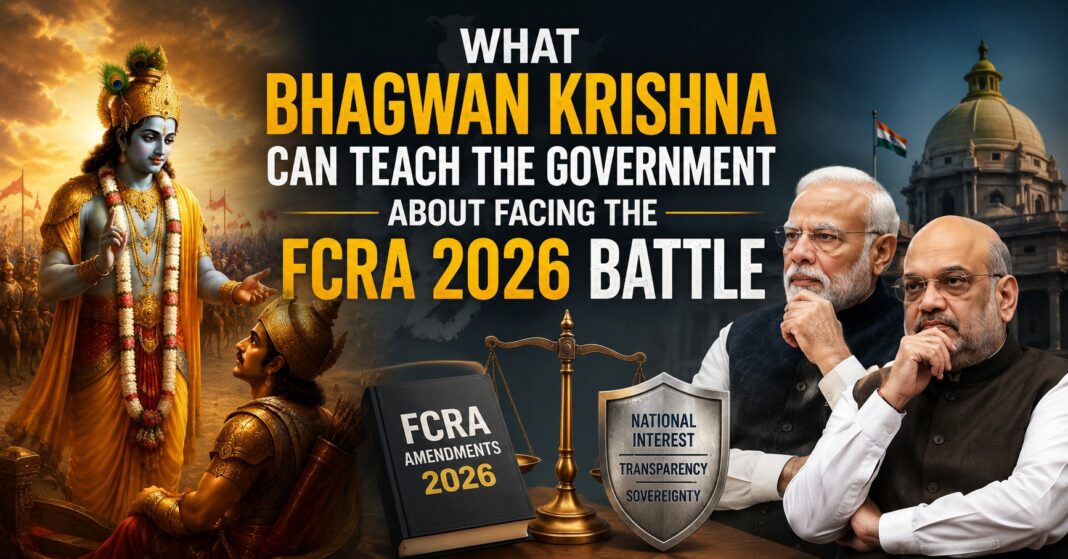
I attended a lesson on Bhagwan Krishna’s message to Arjuna by Chanchalpati Das, Vice President of ISKCON Bengaluru and Founder of The Akshaya Patra Foundation. This was during the launch of the Hare Krishna Centre in Goa. The Bhagavad Gita’s teachings lingered with me long after the session. The lessons were a reminder of the timeless wisdom that can be applied to modern challenges. They got me thinking about how the timeless wisdom of Bhagwan Krishna could be adapted to the political circumstances India faces today, particularly the opposition to the FCRA 2026 Amendments. The circumstances may be vastly different from the battlefield of Kurukshetra, but the questions of duty, conviction, doubt, fear, responsibility and leadership remain remarkably relevant. It made me wonder: how could Prime Minister Narendra Modi and Home Minister Amit Shah apply some of those lessons in dealing with the opposition to FCRA 2026 without losing sight of what they believe is India’s larger national interest?
FCRA 2026: The Lesson of Krishna and Arjuna
There is an important lesson from the Mahabharata that the Indian government should consider as it faces growing opposition to the FCRA 2026 Amendments. It is not a lesson about defeating an opponent. It is a lesson about dealing with opposition when the stakes are high, emotions are running deep and the consequences of a decision extend far beyond the immediate political battle. Bhagwan Krishna did not prepare Arjuna for Kurukshetra by telling him that everyone who questioned the war was his enemy. He did something far more difficult. He listened to Arjuna’s doubts, understood his fears, challenged his assumptions and then gave him a larger understanding of duty before asking him to act.
That distinction is important today because the debate over the FCRA 2026 Amendments is rapidly becoming something larger than a debate about foreign contributions, regulation, transparency and national interest. It is increasingly being presented by some political and religious voices as a question of whether India is targeting Christians. That is precisely where the government needs to be careful. It must not allow a legitimate debate about the regulation of foreign funding to become a battle between the Indian state and the Christian community. At the same time, it must not allow legitimate national-security and financial-transparency concerns to be dismissed simply because some organisations or political parties raise objections in the name of religious freedom.
The government should therefore take a lesson from Bhagwan Krishna’s engagement with Arjuna. Bhagwan Krishna did not silence Arjuna’s questions because he considered them inconvenient. He understood that Arjuna’s hesitation was real. His confusion was real. His emotional conflict was real. Bhagwan Krishna knew that if Arjuna was going to act, he first needed clarity. The government should understand the same principle. If sections of the Christian community are genuinely anxious about provisions in the FCRA amendments, the answer cannot simply be that they are spreading fear or serving somebody else’s political agenda. The government should take those concerns clause by clause, explain what the legislation actually means and, where necessary, provide safeguards or clarifications that remove genuine ambiguity.
That is not surrender. It is good governance.
There is a fundamental difference between listening to an objection and accepting the objection. Bhagwan Krishna listened to Arjuna, but he did not surrender his understanding of Dharma merely because Arjuna was afraid. In the same way, the government can listen to Christian organisations, Opposition parties, civil society groups and legal experts without necessarily abandoning the FCRA reforms. In fact, a government confident about its legislation should welcome scrutiny because scrutiny provides an opportunity to demonstrate why the law is necessary.
The FCRA debate needs precisely this kind of maturity. Foreign funding is not an ordinary subject. Money coming into India from foreign sources can have legitimate charitable, educational, humanitarian and religious purposes, but the sovereign right of India to know where that money comes from, how it is received and how it is utilised cannot reasonably be disputed. Every sovereign country has the right to establish mechanisms that protect financial transparency and national interests. The question is therefore not whether foreign funding should be regulated. The real question is whether the regulations are reasonable, transparent, constitutionally sound and implemented fairly.
That is the debate India should be having.
Unfortunately, fear has a way of replacing facts when governments do not communicate clearly. If a Christian organisation hears that its property could be affected, the government should explain exactly under what circumstances such a provision would operate, what due process exists and what legal remedies remain available. If a church or charitable institution fears that legitimate activities could be disrupted, the government should explain what activities remain protected and what compliance requirements apply. If there is concern that the amendments could be used selectively against Christian institutions, the government should explain the institutional safeguards against arbitrary action. The answer to fear should not be another accusation. It should be clarity.
This is perhaps where the Bhagwan Krishna analogy becomes most relevant. Bhagwan Krishna understood that confusion grows in the absence of knowledge. Arjuna was standing in the middle of a battlefield, surrounded by emotion, family relationships, moral questions and uncertainty. Bhagwan Krishna did not solve that uncertainty by demanding blind obedience. He gave Arjuna a framework through which he could understand his responsibility. The Indian government needs to do something similar with FCRA 2026. It needs to explain the larger purpose of the legislation instead of allowing its opponents to define that purpose for it.
If the government’s objective is to ensure that foreign funding entering India is transparent, accountable and consistent with Indian law, then it should say so repeatedly and clearly. If the objective is to prevent foreign money from being used in activities that undermine India’s sovereignty, public order or national interests, it should explain the evidence and the legal reasoning behind the provisions. If the objective is to ensure that organisations receiving foreign contributions remain accountable for the money entrusted to them, that too should be articulated without hesitation.
But the government must also recognise that political opposition is a legitimate part of democracy. The Opposition has every right to question legislation, demand scrutiny, seek amendments and even campaign against a bill. A democracy in which governments only listen to those who agree with them is not a healthy democracy. The government should therefore resist the temptation to treat every critic as an adversary of the nation. At the same time, the Opposition has a responsibility not to turn every regulatory reform into a conspiracy against a particular religious community without demonstrating how the legislation actually produces that outcome.
This is where the Christian community also deserves a more honest conversation. Indian Christians should not be made to believe that regulation of foreign contributions is automatically regulation of Christianity. The two are fundamentally different. A person can be deeply Christian in faith and completely Indian in constitutional identity. A church can preach the Gospel while complying fully with Indian law. A Christian charitable institution can serve the poor while maintaining complete financial transparency. There is no contradiction between faith and national accountability.
Indeed, Indian Christians should demand that their institutions be transparent. They should demand that foreign contributions received in their name are properly accounted for. They should demand that their religious and charitable institutions are never used as vehicles for political manipulation, foreign influence or activities inconsistent with Indian law. That would not weaken Christianity in India. It would strengthen the credibility of Christian institutions.

The government, however, should also understand that law acquires legitimacy not merely because Parliament passes it, but because citizens understand its purpose and believe that it will be administered fairly. That is why the government’s communication strategy around FCRA 2026 is almost as important as the legislation itself. If the government believes the amendments are necessary, it should publish clear explanations of the controversial provisions, engage with affected organisations, answer constitutional questions and provide implementation guidelines that remove uncertainty. If a provision is capable of being misunderstood, clarify it. If a legitimate safeguard is missing, consider adding it. There is no shame in improving legislation through consultation.
The teachings of Bhagwan Krishna were never about weakness. They were about disciplined action. The Bhagavad Gita’s message to Arjuna was ultimately a message about duty, responsibility and action without becoming paralysed by fear of consequences. That principle has relevance for governments as well. The government should not abandon what it believes to be necessary for India’s national interest merely because there is political resistance. Nor should it pursue a policy simply because backing down would appear politically embarrassing. The question should always be whether the policy serves the larger interests of India.
That is where the principle of Nishkama Karma becomes relevant. Bhagwan Krishna tells Arjuna to focus on his duty rather than becoming consumed by the fruits of his actions. Governments too should legislate because they believe legislation is necessary, not merely because they want a political victory. If FCRA 2026 is necessary, the government should have the courage to defend it. If certain provisions can be improved, it should have the wisdom to improve them. If genuine fears can be addressed through safeguards without compromising the purpose of the legislation, it should do so.
Strength is not the refusal to listen. Strength is being secure enough in one’s position to listen and still make the decision one believes is right.
The government therefore has an opportunity here to rise above the ordinary politics of confrontation. It can tell the Christian community that its faith is not under attack, while simultaneously telling religious and charitable organisations that foreign money must be accountable. It can tell the Opposition that parliamentary scrutiny is welcome, while making it clear that scrutiny does not mean an automatic veto. It can tell civil society that legitimate criticism is part of democracy, while refusing to allow misinformation to become the basis of public policy.
That would be the approach of Bhagwan Krishna: engage the doubt, confront the confusion, explain the duty and then act.
India does not need a government that is frightened by opposition, nor does it need a government that is contemptuous of opposition. It needs a government that can distinguish between legitimate criticism and political fearmongering, between constitutional safeguards and demands for special exemptions, and between protecting religious freedom and protecting foreign funding mechanisms from accountability.
The FCRA debate should therefore not become a referendum on Christianity in India. It should remain a serious national conversation about foreign money, transparency, sovereignty, accountability and the responsibilities of organisations that receive funds from outside India’s borders.
The government should listen carefully, explain patiently and correct anything that genuinely requires correction. But once it has examined the arguments and concluded that reform is necessary for India’s national interest, it should not be paralysed by political pressure.
Arjuna eventually picked up his bow because Bhagwan Krishna gave him clarity, not because Bhagwan Krishna eliminated every difficulty from the battlefield.
That is the lesson the government should take from the Mahabharata. The answer to opposition is not always retreat, and the answer to fear is not always confrontation. Sometimes the most powerful response is to explain the truth so clearly that people are given the confidence to distinguish between what they have been told to fear and what the law actually says.
If the FCRA 2026 Amendments are truly in India’s national interest, the government should defend them with the confidence of conviction, the patience of wisdom and the transparency expected of a constitutional democracy. It should not fight Christians. It should not fight the Opposition. It should fight misinformation with facts, legitimate concerns with safeguards and political resistance with reason.
And once the duty is clear, it should have the courage to act.
That is not merely a lesson from Bhagwan Krishna. It is a lesson in leadership.