



Key Takeaways
- The Bab el-Mandeb strait connects the Indian Ocean to the Red Sea, making it vital for global trade.
- Disruptions force ships to detour around the Cape of Good Hope, adding days and raising costs across the supply chain.
- Modern low‑cost weapons like drones enable groups such as the Houthis to threaten high‑value maritime traffic without controlling the waterway.
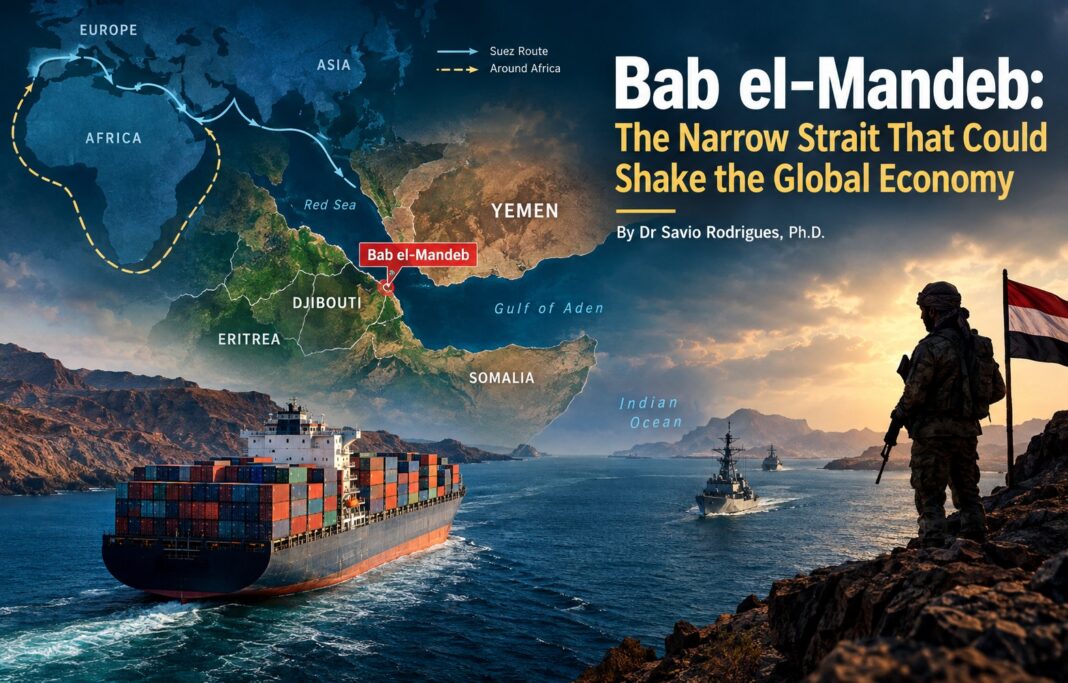
There are geographical locations whose strategic importance is completely disproportionate to their physical size. The Bab el-Mandeb Strait is one of them. It is a narrow maritime passage separating Yemen on the Arabian Peninsula from Djibouti and Eritrea on the Horn of Africa, yet through these waters runs one of the arteries connecting the economies of Asia, the Middle East, Africa and Europe.
For India, Bab el-Mandeb should no longer be viewed as a distant Middle Eastern security problem. It is part of India’s extended maritime neighbourhood and must increasingly be considered alongside the Arabian Sea, Gulf of Aden, Red Sea, Strait of Hormuz and western Indian Ocean as one interconnected strategic theatre.
The latest military developments in Yemen make this particularly important. Saudi-backed Yemeni government forces launched a major offensive and announced on October 5 that they had regained effective control of the Bab el-Mandeb area after pushing Houthi forces from several strategically important positions. Fighting, however, continues, which means that claims of control should not be mistaken for permanent security of the waterway.
Reuters had reported only days earlier that Saudi Arabia was considering military options against the Houthis, including a coastal offensive designed specifically to secure the Red Sea shipping corridor.
What we are witnessing therefore is more than another chapter in Yemen’s prolonged civil conflict. We are witnessing a battle over geography that carries consequences for the global economy.
Geography Is Power
Bab el-Mandeb means the “Gate of Tears”. The name is remarkably appropriate for a maritime passage that has repeatedly become intertwined with conflict.
Ships travelling from the Indian Ocean and Gulf of Aden towards Europe must pass through Bab el-Mandeb before entering the Red Sea and eventually the Suez Canal. In the opposite direction, European shipping bound for large parts of Asia follows essentially the same corridor.
The alternative is straightforward but expensive: sail around the Cape of Good Hope.
That changes the economics of shipping.
UN Trade and Development has estimated that approximately 80 percent of world goods trade by volume moves by sea, while the Suez route normally carries roughly 12–15 percent of global trade. When insecurity previously forced vessels away from the Red Sea, rerouting around Africa added around ten days or more to some journeys and sharply increased shipping costs.
This demonstrates an important reality of twenty-first-century geopolitics.
You do not necessarily need to control global commerce to disrupt it. You merely need the capability to make passage sufficiently dangerous.
A relatively inexpensive drone, missile or unmanned explosive vessel can impose costs vastly exceeding the price of the weapon itself.
Shipping companies react by rerouting vessels. Insurance premiums increase, naval escorts become necessary, and delivery schedules lengthen. Fuel consumption rises and inventories become harder to manage.
Eventually, those costs reach consumers. That is asymmetric warfare translated into economics.
Yemen Has Become a Maritime Battlefield
The Houthis understood this strategic equation very well.
Their ability to threaten vessels in and around the Red Sea transformed them from a predominantly Yemeni armed movement into an actor capable of influencing international shipping decisions.
The present Saudi-backed offensive is therefore not simply about territorial control inside Yemen. Securing the coastline adjoining Bab el-Mandeb would reduce the Houthis’ ability to operate immediately alongside the maritime corridor.
But geography alone will not eliminate the threat.
Modern missiles and drones allow armed groups to threaten maritime traffic from considerable distances. Even if government forces hold the coastline, persistent missile, drone or maritime attacks could keep commercial shipping companies cautious.
The battle for Bab el-Mandeb consequently has two dimensions.
The first is territorial control. The second is credible maritime deterrence. The second may ultimately prove much harder to achieve.
Hormuz and Bab el-Mandeb Cannot Be Viewed Separately
There is another dimension that should concern strategic planners.
The Strait of Hormuz and Bab el-Mandeb effectively sit on opposite sides of the Arabian Peninsula’s maritime environment.
Hormuz is central to the movement of Gulf energy into the Indian Ocean. Bab el-Mandeb connects the Indian Ocean with the Red Sea and Suez route.
Instability around both waterways therefore creates a potential strategic squeeze on global energy and commerce.
UNCTAD noted in 2025 that roughly a third of seaborne oil and approximately 11 percent of global trade normally passed through Hormuz.
The possibility of simultaneous disruption around Hormuz and Bab el-Mandeb must therefore be treated as a serious global economic-security scenario.
It would affect oil prices, tanker rates, maritime insurance, supply chains and ultimately inflation. For India, this scenario deserves particular attention.
India’s Economic Exposure
India is one of the world’s major energy-importing economies and an increasingly important manufacturing and trading power.
A prolonged maritime disruption can therefore affect India twice.
First comes energy.

Higher geopolitical risk around Middle Eastern waterways can increase crude prices and shipping costs. India then faces imported inflation, pressure on the rupee, higher transport costs and deterioration in its current-account position.
Second comes trade.
India’s economic relationship with Europe depends heavily on maritime connectivity through the Arabian Sea, Gulf of Aden, Red Sea and Suez system. Diversions around Africa increase transit time and logistics costs.
The effects then spread throughout the economy.
A geopolitical confrontation thousands of kilometres from Mumbai can eventually influence freight charges, corporate margins, inflation and financial markets inside India.
This is why maritime security is no longer merely a naval subject. It is economic policy.
India Must Think From the Mediterranean to the Indo-Pacific
India traditionally thinks about maritime security through the Indian Ocean. That perspective now needs to expand.
The western Indian Ocean cannot be strategically separated from the Gulf of Aden and Red Sea.
Nor should developments in Yemen, Somalia, Djibouti, Eritrea, Sudan, Saudi Arabia, Oman and the Horn of Africa be viewed as isolated regional events.
They form part of the geopolitical architecture surrounding India’s western maritime approaches.
India has already developed considerable naval capability and experience in anti-piracy operations, maritime surveillance, evacuation missions and protection of commercial shipping.
But the emerging environment requires something broader: persistent maritime domain awareness, stronger relationships with coastal states, intelligence cooperation, logistics agreements and the capacity to protect Indian commercial interests far beyond India’s territorial waters.
India does not need to become a participant in every Middle Eastern conflict.
Indeed, strategic restraint remains one of India’s strengths.
But strategic restraint cannot mean strategic absence.
The Contest Is Also About China
There is another player India cannot ignore.
China’s first overseas military support base is located in Djibouti, immediately adjacent to this maritime geography.
Beijing understood early that an economy dependent upon global maritime trade eventually develops security interests along the routes carrying that trade.
The Chinese presence in Djibouti should therefore be understood not simply as a military installation but as part of China’s wider maritime strategy connecting the Indian Ocean, Africa, Middle East and Mediterranean.
India must draw its own conclusions.
As India’s economy grows towards becoming one of the world’s largest, the geographical perimeter of India’s economic security will inevitably expand.
An India trading globally cannot think about security only territorially.
A Warning From Bab el-Mandeb
The deeper lesson from Bab el-Mandeb is about the changing character of power.
For much of history, great powers sought control over territory.
Today, influence over networks can sometimes be equally consequential: shipping lanes, ports, pipelines, semiconductor supply chains, undersea cables, energy infrastructure and digital systems.
Bab el-Mandeb is one such network vulnerability.
A conflict involving forces inside Yemen can alter decisions in shipping headquarters in Europe and Asia, affect insurance markets in London, influence oil traders, complicate supply chains for manufacturers and eventually affect household prices thousands of kilometres away.
That is modern geopolitics.
India must therefore recognise that the security of the Red Sea is connected to the security of the Indian Ocean, and the security of the Indian Ocean is inseparable from India’s economic rise.
The current battle may determine who controls territory overlooking Bab el-Mandeb.
The larger strategic battle will determine whether international commerce can continue moving through these waters without persistent coercion.
India should watch carefully.
Because the Gate of Tears may be narrow geographically, but when it closes even partially, the economic ripples can travel across the world.