
Key Takeaways
- The World Is Building diplomatic guardrails to manage escalating global rivalries.
- AI communication mechanism between the US and China aims to prevent accidental conflict over artificial‑intelligence incidents.
- European rearmament and increased defence‑industrial output create new strategic opportunities for partners like India.
There is a dangerous temptation in international affairs to interpret diplomacy as peace and military mobilisation as inevitable war.
The geopolitical environment of September 2026 demands a more nuanced reading. Across the United States, China, Europe, Russia, the Middle East, Africa and the Indo‑Pacific, governments are doing something seemingly contradictory:
They are strengthening their capacity for confrontation while simultaneously building mechanisms intended to prevent confrontation from escaping political control.
That contradiction may be the defining characteristic of the emerging international order.
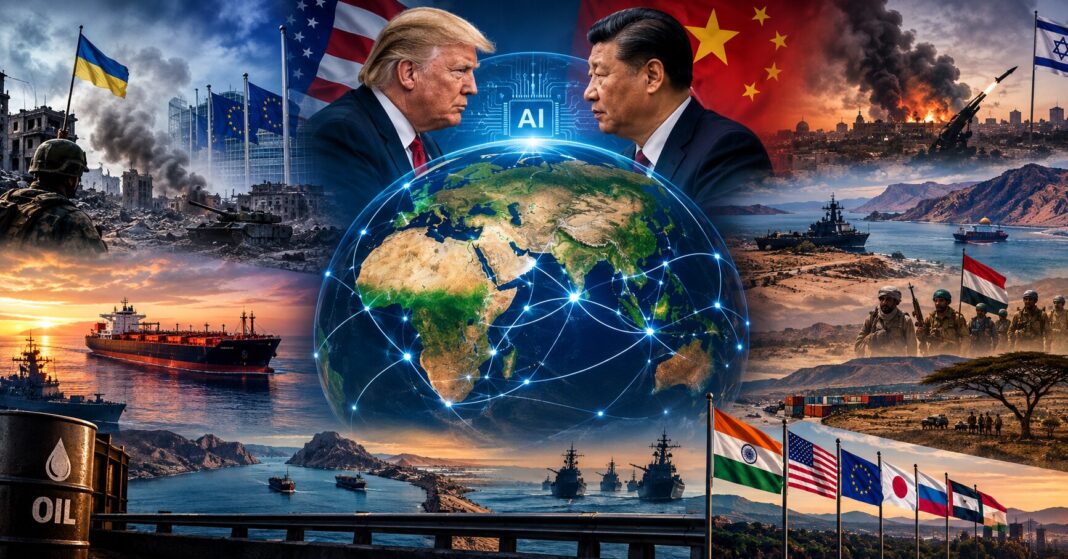
The recent Washington summit between US President Donald Trump and Chinese President Xi Jinping illustrates the point. Both governments portrayed the meeting positively and extended elements of their trade truce, while announcing a communication mechanism dealing with artificial-intelligence incidents. Yet assessments of the summit also emphasised how few of the fundamental disputes between Washington and Beijing were actually resolved.
This was not reconciliation between the world’s two most powerful states. It was an attempt to make rivalry manageable.
That distinction matters enormously. Trade, semiconductors, artificial intelligence, Taiwan, maritime power and competing international institutions will continue defining Sino-American competition. But Washington and Beijing increasingly understand that economic interdependence and technological complexity make uncontrolled escalation extraordinarily expensive.
The AI communication mechanism is therefore potentially more important than it first appears. Artificial intelligence is becoming embedded in intelligence analysis, military decision-making, autonomous systems, cyber operations and critical infrastructure. Communication procedures dealing with AI incidents represent an early acknowledgement that technological rivalry may require crisis-management mechanisms analogous, in principle rather than scale, to those developed during the nuclear age.
Yet strategic competition in Asia has not disappeared. Beijing continues to increase maritime activity around Taiwan and the western Pacific, while regional states are expanding their own security capabilities. Taiwan has reported an upward trend in Chinese naval activity this year, and Japan has been debating capabilities that would have been politically difficult to contemplate a decade ago.
The Indo-Pacific is therefore experiencing deterrence and dialogue simultaneously.
Ukraine demonstrates the limits of diplomacy
Europe presents an even harsher version of the same phenomenon.
Russian attacks continued across Ukraine over the weekend, striking Kyiv and other Ukrainian cities and killing civilians. Ukrainian attacks against Russian infrastructure have likewise continued. Russian-language media, meanwhile, is increasingly emphasising alleged Ukrainian attacks against Russian nuclear-related infrastructure, while Moscow maintains that Western assistance enables Kyiv’s long-range strike capability. Those are Russian government claims and should be distinguished from independently established battlefield facts.
The information war surrounding Ukraine is itself strategically significant. Russian-language reporting presents Moscow as responding to Ukrainian and Western escalation; Ukrainian and Western narratives emphasise Russia’s continuing offensive operations and attacks on civilian infrastructure. Understanding both information environments does not require accepting either narrative wholesale. It requires recognising that domestic political legitimacy increasingly depends upon how each government explains the continuation of the war to its own population.
There are nevertheless faint diplomatic signals. Russian-language reporting indicates Moscow has discussed the possibility of renewed negotiations, while a Vatican envoy has travelled to Russia to discuss humanitarian questions including prisoner exchanges and Ukrainian children.
These developments should not be mistaken for a peace process.
The battlefield remains the principal negotiating instrument.
The deeper European transformation is occurring away from the front line. Defence expenditure, ammunition manufacturing, drones, artificial intelligence, cyber capabilities and military procurement are increasingly becoming components of European industrial policy. The Ukraine war is therefore changing Europe even if the conflict eventually freezes or ends.
Europe is rediscovering military power.
For India, this creates an important strategic opportunity. European rearmament will create demand for components, software, electronics, drones, ammunition, engineering and manufacturing partnerships. India’s emerging defence-industrial ecosystem should see Europe’s transformation not merely as a security development but as a potential long-term industrial partnership.
Hormuz has become the world’s geopolitical thermostat
The immediate danger to the global economy, however, remains the confrontation involving Iran and the United States.
Oil prices rose more than 1% on Monday after Washington rejected Tehran’s latest peace proposal and expectations of rapid de-escalation weakened. The Iranian proposal involved reopening the Strait of Hormuz within a wider arrangement aimed at reducing regional hostilities.
Arabic-language commentary reveals the regional anxiety surrounding such negotiations. One concern being expressed is that an arrangement which effectively rewards Iran for reopening Hormuz could institutionalise Tehran’s ability to use freedom of navigation as bargaining leverage in future confrontations.
That is the central strategic problem.
Hormuz is no longer simply a maritime passage. It has become a negotiating instrument capable of transmitting military developments directly into oil prices, inflation, currencies and interest-rate expectations thousands of kilometres away.
India provides an immediate example. Indian markets entered the week with the rupee and government bonds vulnerable to renewed oil-price pressure as expectations of an Iran settlement weakened.
This demonstrates the speed of geopolitical transmission.
A missile does not have to land in Mumbai or Delhi to affect India. A threat to shipping in Hormuz can move crude prices; crude prices can pressure the rupee; currency weakness can increase imported inflation; inflation can alter monetary expectations; and higher interest rates can affect investment, borrowing and household consumption.
Modern geopolitical power increasingly operates through such chains.
The Red Sea and Indian Ocean are becoming one security theatre
The Iranian confrontation cannot be understood without Yemen.
The Houthis have expanded military pressure while attempting to consolidate positions connecting Yemen’s interior with its Red Sea coastline. Recent fighting has displaced more than 130,000 people, while Houthi advances threaten routes connecting Saudi-backed forces with the coast.
The G7 has called on Iran to stop supplying the Houthis, reflecting Western concern that Yemen is becoming an operational extension of the wider Iranian confrontation.
But another development deserves greater attention: Somali piracy is again becoming a significant threat.
Recent security assessments indicate that hijackings off Somalia have remained elevated since April, while the instability generated by the Iran conflict and Houthi activity may be creating operational opportunities for criminal maritime networks.
This produces a maritime corridor of interconnected insecurity:
Hormuz → Arabian Sea → Yemen → Bab-el-Mandeb → Gulf of Aden → Somalia → western Indian Ocean.

The actors are different. Their motivations are different. Iran is a state actor pursuing strategic leverage. The Houthis are an armed political movement with regional ambitions and Iranian support. Somali pirates are primarily economically motivated criminal networks.
Yet commercial shipping experiences these distinctions differently.
A vessel encounters risk, insurance premiums, rerouting costs and naval-security requirements regardless of whether the threat originates from a missile, drone or pirate skiff.
For India, the conclusion is unavoidable: the Arabian Sea, Gulf of Aden and Red Sea increasingly constitute a single strategic maritime environment.
Africa’s wars are moving closer to the Red Sea
The most dangerous emerging African development is the deterioration in northern Ethiopia.
Fighting between federal forces and Tigrayan forces has revived fears of another major civil war. Tigrayan forces have seized airports, a television facility in Tigray has reportedly been hit by a drone, and foreign governments are warning citizens about deteriorating security.
The political environment is becoming equally dangerous. Seven Ethiopian opposition organisations have formed a coalition challenging Prime Minister Abiy Ahmed, including organisations representing Tigrayan, Oromo and Amhara armed constituencies. The extent to which these organisations can coordinate militarily remains uncertain, but their political convergence represents an important warning signal.
Ethiopia’s crisis cannot be separated from the wider Horn.
Addis Ababa has accused Sudan of supporting forces opposing the Ethiopian government; Sudan’s military denied the allegation on September 27.
Nor can Ethiopia’s instability be separated from Eritrea and the Red Sea. Ethiopia remains landlocked and dependent on maritime access through neighbouring states. A renewed Ethiopian civil war involving Eritrea would therefore have consequences extending toward Djibouti and one of the world’s most important shipping corridors.
Sudan presents another warning. The Sudanese pound has lost almost half its value in army-controlled territories since the beginning of the northern summer, reflecting the economic fragmentation produced by more than three years of war.
Farther west, the Sahel continues to deteriorate. Al-Qaeda-linked JNIM killed more than 100 Malian soldiers during its September attack on the Dioura military camp and has continued pressure on military positions around central Mali.
The question is no longer simply whether jihadist organisations can survive military campaigns against them.
The question is whether they can progressively undermine the logistical and administrative viability of Sahelian states while extending operations toward the economically more important coastal states of West Africa.
Israel and Gaza remain unresolved beneath the larger regional war
The Iran confrontation has inevitably displaced some international attention from Gaza, but the Palestinian conflict remains unresolved.
Israeli operations continue periodically inside Gaza despite the broader ceasefire architecture, while Gaza’s civilian population is attempting to reconstruct elements of normal life. Hundreds of thousands of Palestinian children recently returned to physical classrooms for the first time in almost three years, although UNICEF estimates that approximately 98% of Gaza’s schools have been damaged or destroyed.
This juxtaposition captures the political reality of Gaza.
Military intensity may fluctuate, but the underlying questions of governance, reconstruction, Israeli security, Palestinian political representation and a sustainable political settlement remain unanswered.
Without answers to those questions, ceasefires can suppress violence without resolving the conflict.
India’s strategic doctrine must evolve with the system
These developments appear geographically separate only when viewed on a map.
Strategically they increasingly overlap.
US-China competition affects technology and manufacturing. The Ukraine war affects energy, defence industries and relations with Russia. Hormuz affects India’s currency and inflation. Yemen affects shipping through the Red Sea. Somali piracy affects the western Indian Ocean. Ethiopia affects the Horn and potentially Red Sea access. Sudan affects regional stability. Sahelian insecurity threatens West Africa.
India sits at the intersection of many of these systems.
The appropriate Indian response cannot therefore be traditional non-alignment translated mechanically into the twenty-first century.
India requires strategic optionality.
That means maintaining productive relationships with Washington while preserving independent interests with Moscow. It means deepening technological cooperation with Europe and Japan while maintaining economic engagement with China where Indian interests require it. It means sustaining relationships simultaneously with Israel, the Arab Gulf and Iran. And it means treating Africa not as a peripheral diplomatic theatre but as a region increasingly connected to India’s energy, maritime, commercial and security interests.
Strategic autonomy should not mean remaining equally distant from everyone.
It should mean remaining incapable of being strategically trapped by anyone.
The world now developing around India will reward states possessing resilient energy systems, diversified supply chains, technological capability, credible military power, strong institutions and multiple diplomatic relationships.
The international order is not collapsing into chaos. Nor is a stable new order replacing the old one.
Something more complicated is happening.
Major powers are learning to compete intensely without surrendering the mechanisms needed to stop competition from becoming catastrophe. Regional powers are exploiting the spaces created between them. Non-state actors are learning to influence global markets through maritime chokepoints. And events once considered peripheral—from Tigray to the Sahel or Somali waters—can increasingly produce consequences far beyond their immediate geography.
The defining strategic contest of the coming decade may therefore not be between East and West, democracy and authoritarianism, or even the United States and China.
It may be between states capable of navigating systemic instability and those overwhelmed by it.
India’s objective should be clear: not merely to survive that world, but to become one of the countries capable of shaping it.