
Key Takeaways
- The world’s major powers are deepening rivalry yet building guardrails to avoid uncontrolled conflict.
- An AI‑incident communication channel between Washington and Beijing could prove more consequential than tariff cuts.
- Europe is converting wartime defence spending into a lasting industrial policy that fuels technology and AI development.
The most important geopolitical development of the past few days is not a war, a summit or another diplomatic communiqué.
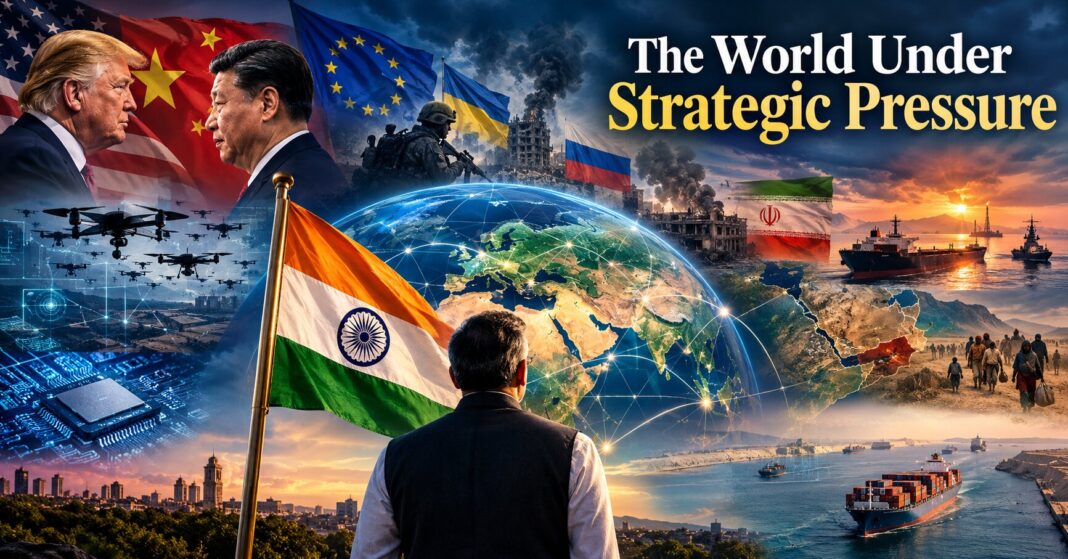
It is the emergence of a paradox that increasingly defines international affairs: the world’s major powers are preparing more seriously for confrontation while simultaneously constructing mechanisms designed to prevent that confrontation from becoming uncontrollable.
This contradiction is visible from Washington and Beijing to Moscow and Kyiv, from the Strait of Hormuz to the Red Sea, and from the Horn of Africa to the Indo-Pacific. It also explains why India must resist simplistic interpretations of the emerging international order. We are not witnessing a straightforward return to the Cold War. Nor are we witnessing the restoration of the cooperative globalisation that characterised much of the post-Cold War period. What is emerging instead is a system of competitive interdependence in which states recognise that their rivals are also indispensable economic, technological or security actors.
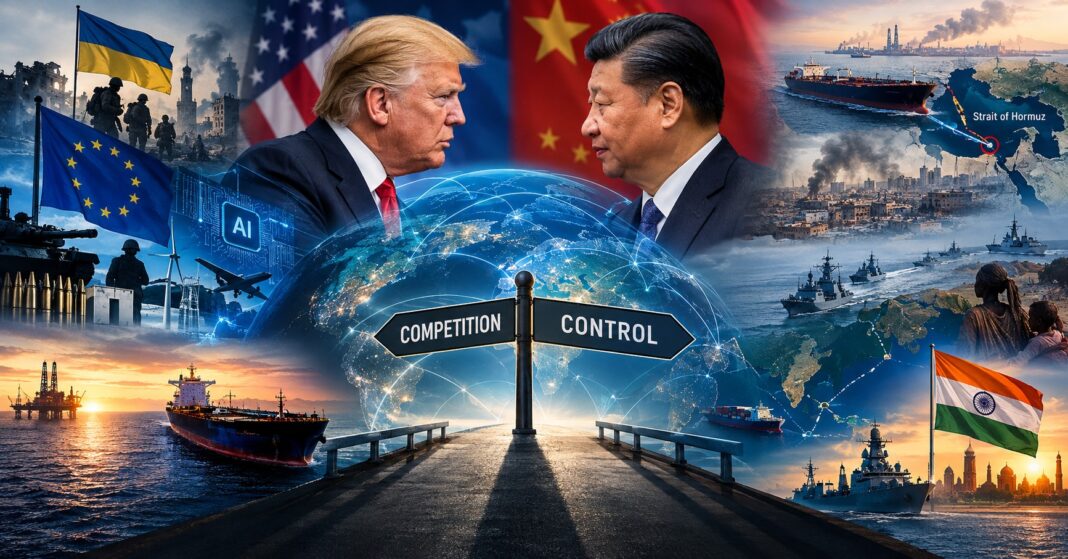
The recent summit between US President Donald Trump and Chinese President Xi Jinping illustrates this reality particularly clearly. Washington and Beijing agreed to reductions covering roughly $30 billion in reciprocal tariffs, further trade consultations and, perhaps most significantly, a bilateral communication channel dealing with artificial-intelligence incidents. The mechanism appears intended to provide notification and communication when serious AI-related incidents occur.
Chinese-language reporting is instructive because it demonstrates how differently the summit is being interpreted. Chinese and Chinese-language coverage emphasises stability, dialogue and the management of strategic competition, while independent assessments note that the summit generated substantial symbolism but comparatively modest breakthroughs on the most difficult structural disagreements involving technology, Taiwan and strategic influence.
This distinction matters. The United States and China are not ending their strategic competition; they are beginning to construct guardrails around it.
The artificial-intelligence channel may ultimately prove more significant than the tariff concessions. AI is rapidly becoming intertwined with military command systems, intelligence analysis, cyber operations, autonomous weapons and critical infrastructure. A serious AI incident could therefore generate escalation even when neither government intends it. Establishing communication mechanisms before such a crisis occurs represents a recognition by Washington and Beijing that technological competition now requires some of the crisis-management architecture once associated principally with nuclear weapons.
That is an important evolution in great-power politics.
Europe is preparing for a longer confrontation
The same mixture of diplomacy and deterrence is visible in Europe.
Washington is attempting to revive trilateral negotiations involving Russia and Ukraine, with the United Arab Emirates discussed as a possible venue. Yet military operations have continued simultaneously. Recent Russian strikes killed civilians in Kyiv and elsewhere, while Ukrainian drones continued targeting Russian military, logistics and energy infrastructure. Russia reported damage at the Novoshakhtinsk refinery, while Ukraine’s largest steel plant suspended production following repeated Russian strikes.
Russian- and Ukrainian-language reporting exposes the competing political narratives surrounding these developments. Moscow portrays continued fighting as a consequence of Ukrainian actions and Western support, while Kyiv argues that military and economic pressure is necessary precisely because Russia has little incentive to compromise without it. The first meeting between the German and Russian foreign ministers since 2022 provides another indication that diplomatic channels are being cautiously reopened even while their governments remain fundamentally divided.
Europe, meanwhile, is institutionalising its support for Ukraine. European Union governments have agreed terms for releasing approximately €6.6 billion through the European Peace Facility, including money connected with training, equipment procurement and reimbursement of previous military assistance.
This should not be interpreted merely as another Ukraine assistance package. Europe is gradually converting the war into industrial policy.
Defence procurement, ammunition production, drone technology, artificial intelligence, cybersecurity and military manufacturing are increasingly becoming part of Europe’s long-term economic and technological architecture. The consequences will outlast the Ukraine war itself.
For India, this transformation creates opportunities. Indian defence manufacturers, technology companies and component suppliers should increasingly view Europe not simply as a market but as a potential co-development ecosystem.
Hormuz has become a negotiating instrument
The most immediate danger to the global economy, however, remains the Middle East.
Iran has proposed a seven-day pathway toward reopening the Strait of Hormuz, while President Trump has publicly said he rejected Tehran’s latest proposal. Iranian officials nevertheless maintain that a definitive rejection has not yet been communicated through mediators.
The disagreement demonstrates how Hormuz has evolved from a maritime chokepoint into an instrument of geopolitical bargaining.
Saudi Arabia’s position is equally important. Foreign Minister Prince Faisal bin Farhan has publicly argued that the strait should return to its previous status without additional charges on maritime traffic.
The economic implications extend far beyond the Gulf. Insurance costs for tankers using Saudi Arabia’s principal Red Sea oil-export route have reportedly tripled in recent weeks.
This reveals the deeper strategic problem. Diversifying oil shipments away from Hormuz does not eliminate geopolitical exposure if the alternative route leads toward another unstable maritime corridor.
The Gulf, Red Sea and western Indian Ocean must therefore increasingly be understood as a single strategic system.
The Red Sea is no longer a peripheral theatre
Yemen reinforces this conclusion.
The Houthis have threatened American interests if Washington intervenes directly in support of Saudi Arabia or in Bab-el-Mandeb. These statements are political and military claims by a belligerent and should be treated accordingly, but they reveal the widening geographical conception of the conflict among Houthi decision-makers.
The implications for global shipping are substantial. Vessels attempting to reduce exposure to one threat can find themselves exposed to another as they move between the Red Sea, Gulf of Aden and western Indian Ocean.
India therefore has a direct strategic interest in treating the Arabian Sea, Gulf of Aden and Red Sea as a connected maritime-security space. Naval deployments, maritime-domain awareness, merchant-shipping protection and diplomatic engagement with Gulf and East African states are no longer separate policy compartments.
They are components of the same maritime strategy.
Africa’s crises are beginning to connect
The most dangerous emerging development in Africa is the renewed fighting in northern Ethiopia.
Tigrayan forces and allied armed groups have launched operations across Tigray, Afar and Amhara. Tigrayan forces have taken control of the airports at Mekelle, Axum and Shire, while fighting has also occurred around Abala and other strategically important areas. The African Union and European Union have called for immediate de-escalation.
French-language African reporting adds valuable ground-level context. Residents of Mekelle are reportedly stockpiling essential goods amid fears of renewed isolation, while internet disruption and transport interruptions are already affecting civilian life. Some federal casualty claims remain impossible to verify independently and should therefore not be treated as established battlefield facts.

The danger is not simply another Tigray war.
A wider confrontation could intersect with Ethiopia’s tensions with Eritrea, instability in Sudan, insecurity in Somalia and the strategic importance of Djibouti. Ethiopia is landlocked and overwhelmingly dependent upon corridors toward the Red Sea. Consequently, internal Ethiopian instability can eventually become a maritime-security issue.
Sudan presents another dimension of the same regional fragmentation. The Sudanese pound has lost almost half its value since the beginning of the northern summer in army-controlled areas, while the country’s effective economic partition has weakened public finances and intensified civilian hardship.
To the west, the Sahel continues deteriorating. Al-Qaeda-linked JNIM killed more than 100 Malian soldiers during the September attack on Dioura according to multiple security and diplomatic sources, while Sévaré airport has faced repeated attacks. French-language West African reporting similarly describes the Dioura assault as among the most serious attacks against Mali’s armed forces during the conflict.
The critical question is increasingly whether jihadist organisations can move from controlling or contesting rural territory toward systematically degrading the logistical viability of Sahelian states and extending sustained operations toward coastal West Africa.
Asia’s strategic competition remains unresolved
The apparent stabilisation of US–China relations should therefore not be confused with strategic relaxation across Asia.
Chinese maritime activity east of Taiwan has expanded during recent months, including coastguard operations in waters that historically received considerably less attention than the Taiwan Strait itself.
Meanwhile, North Korea recently launched two short-range ballistic missiles, while South Korean President Lee Jae Myung has advocated exploring sanctions relief in exchange for a freeze on further North Korean nuclear development.
These developments illustrate another emerging pattern: Asia is simultaneously experiencing stronger military deterrence and renewed experimentation with diplomatic risk reduction.
That is precisely the pattern visible between Washington and Beijing.
India’s opportunity lies in strategic optionality
India enters this environment with considerable advantages but also substantial vulnerabilities.
The most immediate vulnerability is energy. The rupee has been unusually sensitive to oil prices and developments around Hormuz, forcing the Reserve Bank of India to manage both currency volatility and banking-system liquidity.
But India’s position also creates opportunities.
The India–EU relationship is expanding beyond traditional trade diplomacy into semiconductors, artificial intelligence, quantum technology, high-performance computing, 6G and clean-energy supply chains. The third Trade and Technology Council meeting committed both sides to deeper cooperation in these areas, while negotiations are underway concerning India’s possible association with Horizon Europe.
A joint €15.2 million India–EU initiative on electric-vehicle battery recycling illustrates how geopolitical alignment can translate into industrial capability.
The deeper lesson is that strategic autonomy cannot mean equidistance from every major power. It must mean the capacity to maintain multiple relationships without becoming strategically dependent upon any single one.
India should therefore pursue simultaneous relationships with the United States, Europe, Russia, the Gulf, Israel, Africa, Japan and Southeast Asia while protecting its capacity to make independent decisions.
The objective is not neutrality. The objective is optionality.
The world ahead
Three broad scenarios now define the international environment.
The most plausible is controlled instability: wars continue, strategic competition deepens, energy markets remain volatile, but major powers repeatedly intervene to prevent regional confrontations from becoming systemic.
A second possibility is convergent escalation. A major incident involving Hormuz, Taiwan, NATO territory or the Red Sea could connect previously separate crises and generate cascading economic and military consequences.
The third is selective de-escalation. Washington and Beijing could institutionalise competitive coexistence; Iran and the United States could establish a maritime arrangement around Hormuz; and renewed diplomacy could produce limited progress in Ukraine. None would constitute global peace, but together they could reduce systemic risk.
The most dangerous possibility is strategic surprise: an event occurring outside the principal focus of international attention – perhaps in the Horn of Africa, the Sahel, the Korean Peninsula or maritime Asia – that suddenly alters calculations across several theatres.
This is why the emerging world cannot be understood through isolated crises.
Hormuz influences India’s currency. Yemen influences Red Sea shipping. Red Sea insecurity interacts with the Horn of Africa. Ethiopia’s stability influences access to maritime corridors. Ukraine is reshaping Europe’s defence industries. US–China competition is transforming technology governance. And the technological competition surrounding artificial intelligence is beginning to enter the architecture of great-power crisis management.
The international system is becoming simultaneously more fragmented and more interconnected.
For India, the answer cannot be withdrawal from this complexity. It must be deeper engagement combined with greater national resilience: diversified energy supplies, stronger maritime capabilities, domestic defence manufacturing, technological partnerships, resilient supply chains and diplomatic relationships capable of surviving disagreement.
The great geopolitical contest of the coming decade will not simply determine which country possesses the largest economy or military.
It will determine which nations possess the greatest capacity to absorb shocks, preserve strategic choices and influence multiple competing systems simultaneously.
India should aim to be one of those nations.