
Key Takeaways
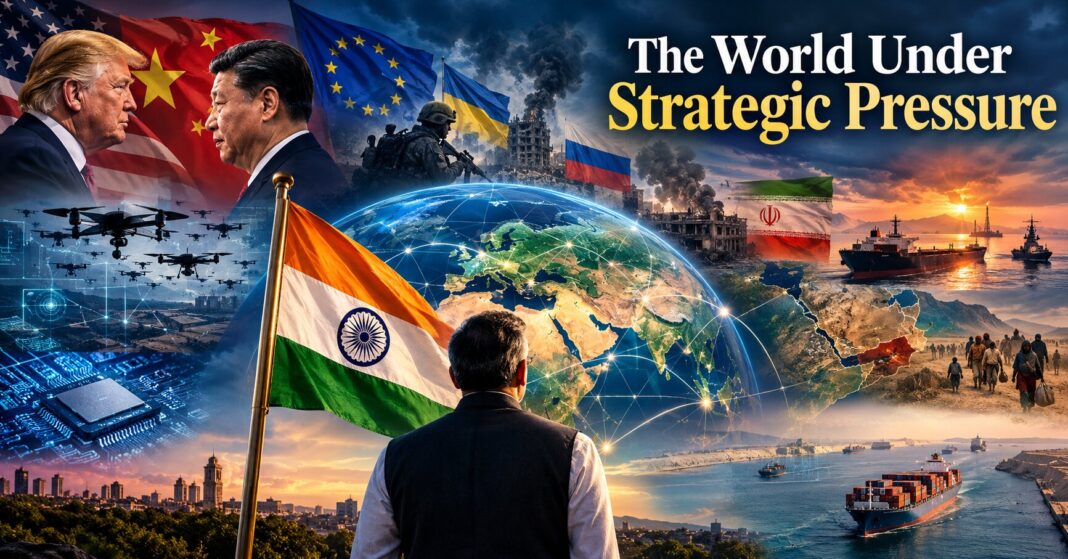
- The World is under increasing strategic pressure as major powers seek autonomy and influence.
- Technological advances like AI-enabled drones are reshaping warfare, turning Ukraine into a real‑time testing ground.
- Europe’s €6.6 billion commitment via the European Peace Facility signals a shift toward greater military self‑reliance.
The defining feature of the present international order is not that the world is dividing neatly into rival camps. It is that countries are becoming increasingly dependent upon one another at precisely the moment when trust between them is deteriorating. That distinction matters.
Washington and Beijing are trying to prevent their rivalry from becoming an uncontrolled confrontation. Europe is simultaneously preparing for a longer war in its neighbourhood and investing more heavily in its own defence-industrial capacity. Russia and Ukraine continue to attack the infrastructure that sustains the other’s war-making capability. The Middle East remains hostage to the uncertain trajectory of the Iran-US confrontation and the security of the Strait of Hormuz. Ethiopia is again sliding towards a potentially wider war. Sudan’s humanitarian crisis is spilling across borders. And, underneath all of this, technology is changing the economics of conflict faster than diplomacy is changing the rules governing it.
India sits at the intersection of these developments. That is why the question for New Delhi cannot simply be whether India is closer to America, Russia, Europe, Iran, Israel or the Gulf. The more important question is whether India can preserve strategic autonomy while extracting economic, technological and security advantages from a world in which every major power needs partners but trusts very few.
The evidence from the past 24 hours points in that direction.
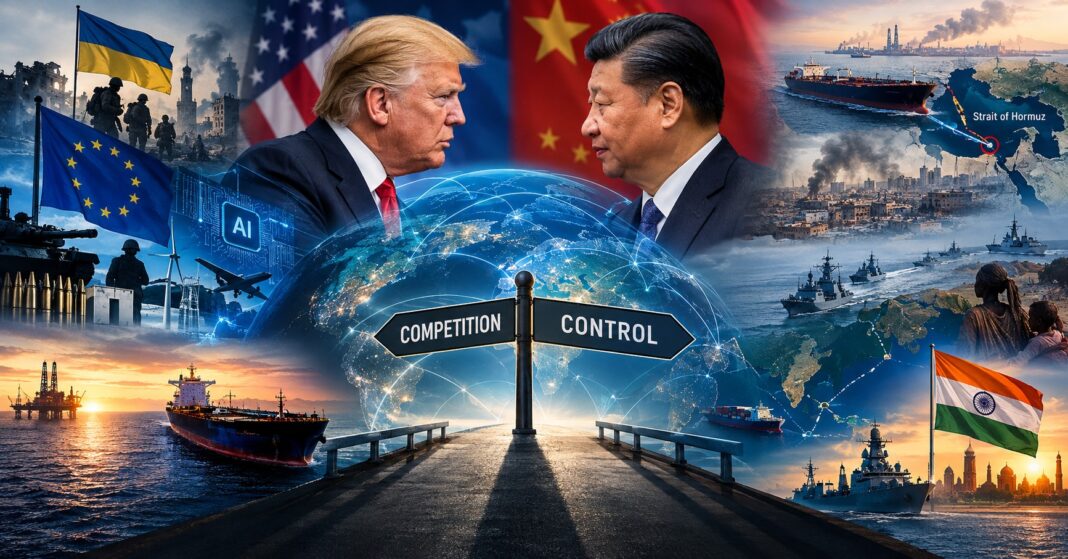
The meeting between US President Donald Trump and Chinese President Xi Jinping is perhaps the clearest example. The summit ended with considerable diplomatic ceremony but limited evidence of a breakthrough on the fundamental disputes between Washington and Beijing. Reuters reported that the two leaders concluded their meetings with little sign of major progress, despite the highly publicised effort to project a more stable relationship.
That should not be interpreted as failure. In great-power politics, preventing deterioration can itself be a strategic outcome.
The United States and China do not need to become friends. They need mechanisms that prevent competition over technology, trade, Taiwan and strategic influence from becoming a military confrontation. The summit therefore matters less for what it solved than for what it may prevent.
The danger, however, is that diplomatic stability at the top can coexist with intensified competition underneath it.
Artificial intelligence, semiconductors, critical minerals, supply chains, quantum technologies and advanced manufacturing are no longer purely economic subjects. They are instruments of national power. The world’s major powers increasingly view technological dependence as a national-security vulnerability.
That brings us to Europe.
Europe is discovering that economic prosperity without sufficient military capacity produces strategic vulnerability. The European Union has moved to release €6.6 billion linked to military assistance for Ukraine through the European Peace Facility. The package includes funding for joint procurement and military assistance mechanisms.
This is more significant than another financial package for Ukraine.
Europe is beginning to understand that the Ukraine war is also a European industrial war.
Russia has continued striking Ukrainian infrastructure, while Ukraine has intensified its ability to strike targets inside Russia. Global media reported that Russian attacks contributed to the shutdown of Ukraine’s largest steel plant, while Ukrainian strikes also hit Russian energy infrastructure.
Russia’s Perm oil refinery, one of the country’s largest, reportedly halted operations following a drone attack.
The war is therefore moving further into an uncomfortable new phase in which energy infrastructure, industrial capacity and logistics are legitimate strategic targets.
There is another development from Britain that may ultimately prove more consequential than any individual battlefield strike.
The UK Ministry of Defence has announced that up to 12 British companies will receive access to Ukrainian battlefield data to develop AI-enabled drone swarms. The database contains more than six million detections involving tanks, artillery, air-defence systems, infantry and aerial targets. The British programme is intended to develop autonomous and distributed systems capable of operating even when communications are degraded or satellite navigation is unavailable.
This is a major strategic signal.
Ukraine has become the laboratory in which the future of warfare is being tested in real time.
The transformation is moving from drones to networked drones, from networked drones to AI-assisted swarms, and potentially towards increasingly autonomous battlefield systems. The implications extend far beyond Ukraine.
India must study this development with urgency. The future battlefield will not necessarily be dominated by the country possessing the most expensive aircraft, tanks or missiles. It may increasingly favour the country capable of producing enormous numbers of relatively inexpensive autonomous systems, connecting them through resilient networks and replacing losses faster than the adversary can destroy them.
This is not an argument for abandoning conventional military capability. It is an argument for recognising that the economics of warfare are changing.
The same principle is visible in the Middle East.
Iran’s confrontation with the United States has transformed the Strait of Hormuz from a geographical chokepoint into a global economic pressure point. Tehran has proposed a seven-day framework under which the Strait could reopen, while sections of the media reported that the United States had rejected the proposal as presented. Iranian officials have simultaneously indicated that Tehran is unwilling to make nuclear concessions.
Oil markets have responded to every diplomatic signal.
Prices fell by around 2% on September 25 as markets interpreted US-Iran contacts as offering a possible path towards de-escalation, although the underlying security situation remained dangerous.
This is precisely why geopolitics can no longer be separated from economics.
The Iran crisis does not remain in Iran.
It reaches Saudi Arabia, the Gulf, Yemen, the Red Sea, the global shipping industry, European inflation, Asian energy costs and ultimately India’s current account.
It also intersects with the emerging security architecture around Saudi Arabia and the Red Sea.
If the Iran-US channel fails, the possibility exists that the centre of gravity of the conflict could shift further south – from Hormuz towards Yemen and the Bab-el-Mandeb. That would be strategically serious for India.
The Arabian Sea, Gulf of Aden and Red Sea are not separate maritime theatres from an Indian perspective. They are one extended commercial and security corridor.
An oil tanker delayed in the Gulf can affect an Indian refinery. A shipping disruption in the Red Sea can affect Indian exports to Europe. A rise in insurance premiums can affect freight costs. Instability around the Horn of Africa can affect maritime security. And a prolonged conflict can increase pressure on the Indian Navy to maintain a greater western Indian Ocean presence.
This is why the Horn of Africa deserves far more attention than it generally receives in Indian strategic discourse.
Ethiopia’s Tigray region has again descended into serious conflict. Local media reported telecommunications disruption in Tigray as fighting intensified, while earlier developments included the seizure of airports and clashes between regional forces and federal forces.
The danger is not merely another Ethiopian civil conflict.
Ethiopia’s geography connects the internal conflict to the Red Sea through its dependence on the Djibouti corridor. Any major deterioration involving Ethiopia, Eritrea or Tigray therefore has implications for one of the world’s most important maritime regions.
Sudan presents another dimension of the same problem.
The number of Sudanese fleeing into Chad has surged dramatically. On ground media reported that more than 400 people a day had crossed into Chad over the preceding week, approximately twenty times the earlier rate, as fighting and humanitarian conditions deteriorated.
This is not simply a humanitarian statistic.

Large-scale displacement can alter the security balance of neighbouring states. Refugee movements can be accompanied by arms trafficking, criminal networks, militia recruitment and cross-border ethnic mobilisation.
Sudan’s war is therefore becoming increasingly difficult to contain within Sudan.
The same logic applies to the Sahel.
The security environment stretching from Sudan and Chad towards Libya and the wider Sahel is becoming increasingly interconnected with migration, terrorism, energy infrastructure and European security.
This is the larger geopolitical pattern that is being missed when individual crises are examined separately.
The world is experiencing the convergence of theatres. Ukraine is connected to European defence-industrial policy. European defence is connected to NATO and transatlantic politics. US-China competition is connected to semiconductor supply chains. Semiconductor supply chains are connected to Taiwan. Taiwan is connected to global manufacturing. The Middle East is connected to energy. Energy is connected to inflation. Inflation is connected to currencies. Currencies are connected to India’s imports. And the Red Sea connects the Middle East directly to the Indian Ocean.
India therefore cannot afford a foreign policy that views Europe, West Asia, Africa and the Indo-Pacific as separate compartments.
The strategic map is becoming one system.
There is, however, an opportunity hidden inside this instability.
Europe increasingly wants resilient supply chains. The United States wants trusted technology partners. Japan and South Korea want secure technology and energy relationships. Gulf states want diversified strategic partnerships. African countries want infrastructure and investment without excessive geopolitical conditionality.
India can potentially occupy a valuable position within this emerging architecture.
The India-EU relationship is particularly important. The EU and India have been expanding cooperation through the Trade and Technology Council in semiconductors, artificial intelligence, quantum technologies, 6G, clean technologies and resilient value chains.
The European Union’s ambassador to India described the relationship on September 25 as one of the defining strategic relationships of the 21st century, with expanding cooperation in trade, defence, security, research and innovation.
This is not merely diplomatic language.
India and Europe increasingly have complementary strategic needs.
Europe possesses capital, advanced technology, research capacity and industrial expertise. India possesses scale, engineering talent, a large market, manufacturing potential and strategic connectivity across the Indo-Pacific.
The opportunity is to turn that complementarity into durable industrial capability.
India should therefore look beyond conventional trade negotiations and focus increasingly on technology security, defence manufacturing, critical minerals, semiconductor supply chains, energy resilience, maritime security and advanced research.
The greatest mistake India could make would be to assume that strategic autonomy means equidistance from all major powers.
It does not.
Strategic autonomy means possessing enough national capability and enough diversified relationships that no external power can dictate India’s strategic choices.
That distinction becomes critical as the world becomes more fragmented. There are several plausible scenarios emerging from the present situation.
The first is controlled instability. The US and China maintain dialogue; Russia and Ukraine continue fighting without a decisive breakthrough; Iran and the United States negotiate intermittently; and the Middle East remains dangerous but below the threshold of general regional war.
The second is systemic escalation. Hormuz remains disrupted, energy prices rise sharply, the Red Sea deteriorates, Ukraine intensifies strikes against Russian infrastructure and Ethiopia’s conflict widens. Under this scenario, apparently separate crises reinforce each other economically.
The third is selective de-escalation. Washington and Tehran reach an interim understanding, maritime flows improve and energy prices decline, while the Ukraine conflict remains unresolved. This would provide the global economy with some breathing space without creating a genuine geopolitical settlement.
The strategic surprise would be a fourth scenario: simultaneous diplomatic openings in Washington-Beijing, Washington-Tehran and Russia-Ukraine negotiations. Such a development would rapidly alter commodity markets, currencies and investment expectations.
But India should not build policy around the assumption that the most optimistic scenario will occur.
India should build resilience for the difficult scenarios and optionality for the favourable ones.
The next 24 to 72 hours therefore deserve close monitoring of five indicators.
First, whether US-Iran diplomacy produces an actual mechanism for reopening Hormuz rather than merely statements.
Second, whether Russia and Ukraine expand attacks against energy infrastructure.
Third, whether the Trump-Xi summit produces concrete implementation mechanisms rather than diplomatic symbolism.
Fourth, whether fighting in Ethiopia expands beyond Tigray.
And fifth, whether oil prices, shipping costs and the rupee begin reflecting a renewed deterioration in the Middle East.
The strategic reality is that India cannot control any of these developments. But India can control its preparedness.
It can build energy reserves. It can strengthen the Indian Ocean maritime architecture. It can diversify supply chains. It can expand domestic defence manufacturing. It can accelerate AI and autonomous systems. It can deepen technology partnerships with Europe, America, Japan and other trusted partners while retaining working relationships with Russia, Iran and the Gulf.
The world is not becoming simpler. It is becoming more interconnected precisely as its major powers become more distrustful. That is the paradox of the emerging international order.
The age ahead will not necessarily be defined by one dominant superpower or by a clean division between East and West. It may instead be defined by competing networks of technology, energy, trade, finance, military capability and diplomatic influence.
For India, this is not merely a challenge. It is an opportunity. But opportunity will belong to the country that understands that strategic autonomy without strategic capability is only a slogan.
India’s real task is therefore to build enough economic strength, technological capacity, military resilience and diplomatic reach to ensure that when the world’s great powers compete, India is not merely watching the contest.
India must become one of the powers shaping the environment in which that contest takes place.