

Key Takeaways
- The Indian defence modernisation budget allocates massive funds to domestic production, but true self‑reliance requires an indigenous datalink ecosystem.
- A secure military datalink creates a real‑time common operational picture, essential for network‑centric warfare.
- Reliance on foreign datalinks poses a strategic vulnerability; developing an indigenous datalink ensures control over encryption, software and upgrades.
Modern warfare is no longer simply about who has the fastest missile, the most advanced fighter aircraft or the largest number of tanks. The decisive advantage increasingly belongs to the military that can sense first, decide first and strike first. At the heart of this transformation is something that is often invisible to the public but absolutely critical on the battlefield: the military datalink.
A missile can have a sophisticated seeker, a fighter can carry an advanced radar and a warship can possess powerful sensors. When they securely exchange information in real time, their effectiveness dramatically rises. This is why India must treat indigenous military datalinks as a strategic capability—not merely another communications project.
India’s defence modernisation is taking place at an extraordinary scale. The Union Budget 2026–27 allocated ₹7.85 lakh crore to defence, with ₹1.39 lakh crore earmarked for procurement from domestic defence industries. Around 75% of the capital acquisition budget has been reserved for domestic industry. But true Atmanirbharta cannot stop at manufacturing missiles, aircraft, ships and drones. India must own the digital nervous system connecting these weapons.
A missile does not exist in isolation. Consider a modern air-defence environment. A satellite, ground-based radar, airborne early-warning aircraft, fighter aircraft or naval sensor may detect a threat. That information has to move rapidly through a command-and-control architecture, be authenticated, processed and then passed to the appropriate weapon system. The weapon may then require updates during an engagement. The faster and more securely this information moves, the greater the probability of a successful interception or strike.
This is the essence of network-centric warfare.
The danger of depending on foreign datalinks is therefore much greater than dependence on a foreign component. If the communications architecture is externally controlled, India potentially becomes dependent on another country for the information layer of its weapons systems.
That creates a strategic vulnerability.
Foreign-origin platforms may come with proprietary communications protocols, encryption architectures, software-defined radios and mission computers. Even where India possesses the physical platform, it may not possess complete control over the underlying software, encryption, waveform or upgrade pathway.
That is unacceptable for a country with India’s geopolitical environment.
India faces two nuclear-armed neighbours, a contested northern frontier, a strategically important Indian Ocean region and an increasingly complex unmanned warfare environment. The battlefield is also becoming saturated with drones, loitering munitions, electronic warfare systems, satellites and autonomous platforms.
The future battlefield will therefore look less like a collection of individual weapons and more like a single distributed combat system.
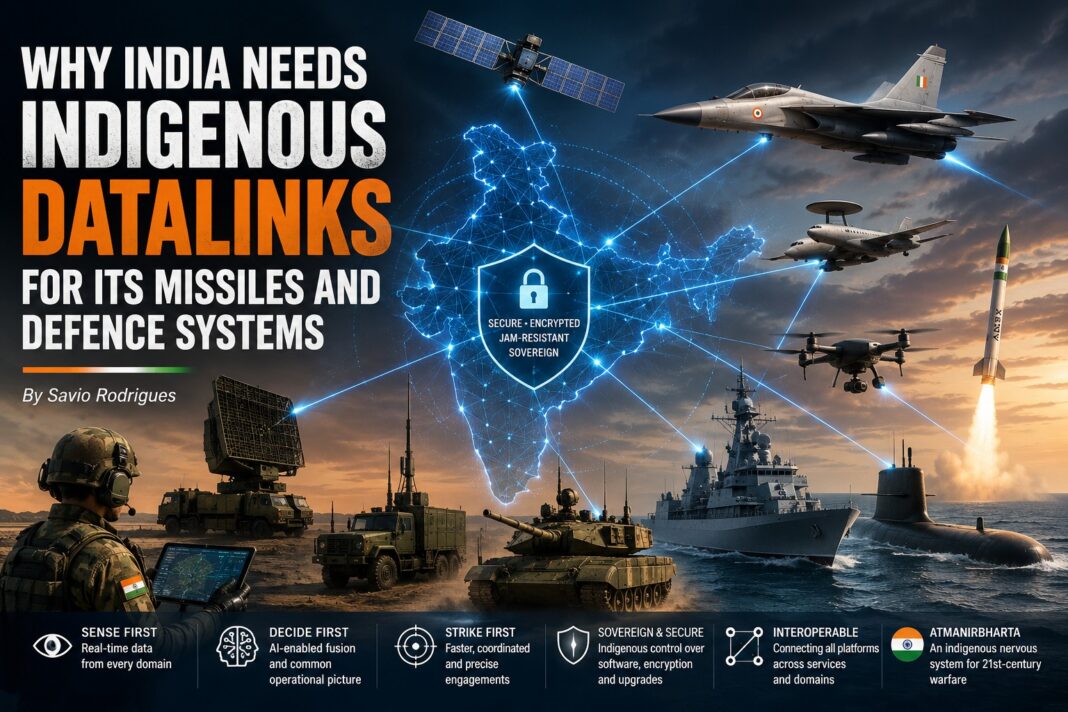
India needs a sovereign datalink architecture capable of connecting aircraft, missiles, ships, submarines, air-defence systems, drones, satellites, ground forces and command centres.
There is already an indigenous foundation on which to build. India’s defence establishment has worked on Software Defined Radio technologies, including efforts involving DRDO, the Weapons and Electronics Systems Engineering Establishment and Bharat Electronics. DRDO material has described indigenous SDR technology as particularly important for tactical communications and highlighted its potential for India’s Tactical Data Link requirements.
The strategic question is now whether India can take such technologies from individual programmes to a common national military datalink ecosystem.
The answer must be yes.
The United States provides an important lesson. Systems such as Link 16 have become fundamental to interoperability among aircraft, ships, air-defence systems and command structures. The value of such a network is not simply the radio itself. It is the ability to create a common operational picture and allow different platforms to function as part of a larger combat architecture.
India should develop its own equivalent – not necessarily by copying another country’s system, but by designing an architecture around India’s specific requirements.
That architecture should be secure, encrypted, jam-resistant, software-defined and capable of operating across all three services.
Most importantly, India should retain control over the source code, encryption architecture, waveform management, authentication mechanisms and upgrade cycle wherever strategically appropriate.
Why does this matter?
Because electronic warfare is becoming a central feature of modern conflict. An adversary does not necessarily need to destroy a weapon physically. It can attempt to jam, deceive, intercept or disrupt its communications.
A missile may be technologically brilliant but operationally compromised if its communications environment can be degraded.
An indigenous datalink would allow India to continuously modify waveforms, encryption, authentication and network behaviour as threats evolve. If an adversary discovers a vulnerability, India should not have to wait for a foreign OEM to approve a software update.
Sovereignty in defence increasingly means sovereignty over software.
This becomes even more important with the emergence of artificial intelligence.
AI-enabled warfare will depend on the rapid movement of enormous quantities of sensor data. A fighter aircraft may detect an object that a satellite has already observed. A naval radar may correlate it with information from another platform. An unmanned aerial vehicle may provide additional imagery. An AI-enabled command system could combine these inputs and recommend a course of action.

But AI is only as effective as the data available to it.
The military datalink will therefore become the bloodstream of India’s future AI-enabled military.
India’s defence budget already recognises the importance of communications infrastructure. The 2026–27 Budget includes ₹975 crore for an optical-fibre-cable-based network for the Defence Services. That investment is important, but fixed communications infrastructure alone is insufficient for a modern battlefield.
The network has to extend into the air, sea, land, space and increasingly into autonomous systems.
India must therefore think beyond “communications” and develop a National Defence Data Architecture.
Such an architecture could have different layers. A secure tactical layer could connect soldiers, vehicles and drones. An air layer could connect fighters, airborne early-warning platforms, ground radars and missiles. A naval layer could connect ships, submarines, maritime aircraft and unmanned systems. A strategic layer could connect these networks to satellites and national command structures.
They should not necessarily operate as one completely open network. Instead, they should be interoperable while maintaining appropriate security boundaries.
The opportunity for Indian industry is enormous.
India’s defence production has risen sharply. PRS analysis based on government data puts defence production at approximately ₹1.55 lakh crore in 2024-25, compared with roughly ₹75,000 crore in 2016-17. At the same time, the government is actively pushing indigenous design and manufacturing. DAP 2020 gives priority to Indian-IDDM procurement and increased indigenous-content requirements, while explicitly recognising the importance of indigenous software for systems such as fire-control, radar, encryption and communications.
The next logical step is to make indigenous datalinks a major national mission.
India should encourage DRDO, BEL, private defence companies, semiconductor companies, telecommunications firms, AI companies and universities to participate in creating an open but secure defence-network ecosystem.
The objective should not be one company producing one datalink for one platform.
The objective should be a family of interoperable Indian datalinks.
They should support aircraft today, but drones tomorrow. They should work with missiles today, but autonomous swarms tomorrow. They should support conventional warfare while being resilient in environments characterised by electronic warfare and cyber attacks.
India also needs to consider export potential.
If India wants to become a major defence exporter, it cannot permanently depend upon foreign communications architectures embedded inside its products. Countries buying Indian missiles, air-defence systems, drones or combat vehicles will increasingly want secure, sovereign and customisable communications.
An Indian datalink ecosystem could therefore become an exportable technology in its own right.
The broader strategic logic is simple.
India has invested enormous resources in developing missiles such as the Akash and Pralay families, combat aircraft, naval platforms, drones, radars and space assets. Recent policy moves have also opened the door for greater private-sector participation in missile manufacturing.
But the missile is only one part of the kill chain.
If India controls the weapon but not the data connecting the weapon to the wider battlefield, its sovereignty remains incomplete.
The next revolution in Indian defence manufacturing must therefore move from platform independence to network independence.
India should build its own datalinks, own its encryption, develop indigenous tactical radios, create sovereign communications protocols, integrate satellite communications, harden networks against electronic warfare and cyber attacks, and establish common standards across the armed forces.
The country that controls the battlefield’s information architecture will increasingly control the battlefield itself.
India has already demonstrated that it can build missiles, satellites, aircraft, ships and nuclear submarines. The next challenge is to ensure that these systems can see together, communicate together and fight together without asking another nation for permission.
That is the real meaning of Atmanirbharta in 21st-century warfare. India does not merely need indigenous weapons. India needs an indigenous nervous system for its weapons.