
Key Takeaways
- The shift from ownership to access is redefining how consumers engage with products, turning purchases into subscriptions.
- Software-as-a-Service and streaming platforms illustrate the rapid growth of the subscription economy across tech and media.
- Leasing and subscription models in the automobile and AI sectors show that even high‑value assets are moving toward access‑based usage.
For most of human history, ownership was the foundation of economic security. You bought a house and it was yours. You bought a car and it was yours.
You bought a book, a record, a piece of furniture or a tool and you possessed it. You could use it, lend it, sell it, gift it, preserve it or pass it on to your children. Ownership meant control.
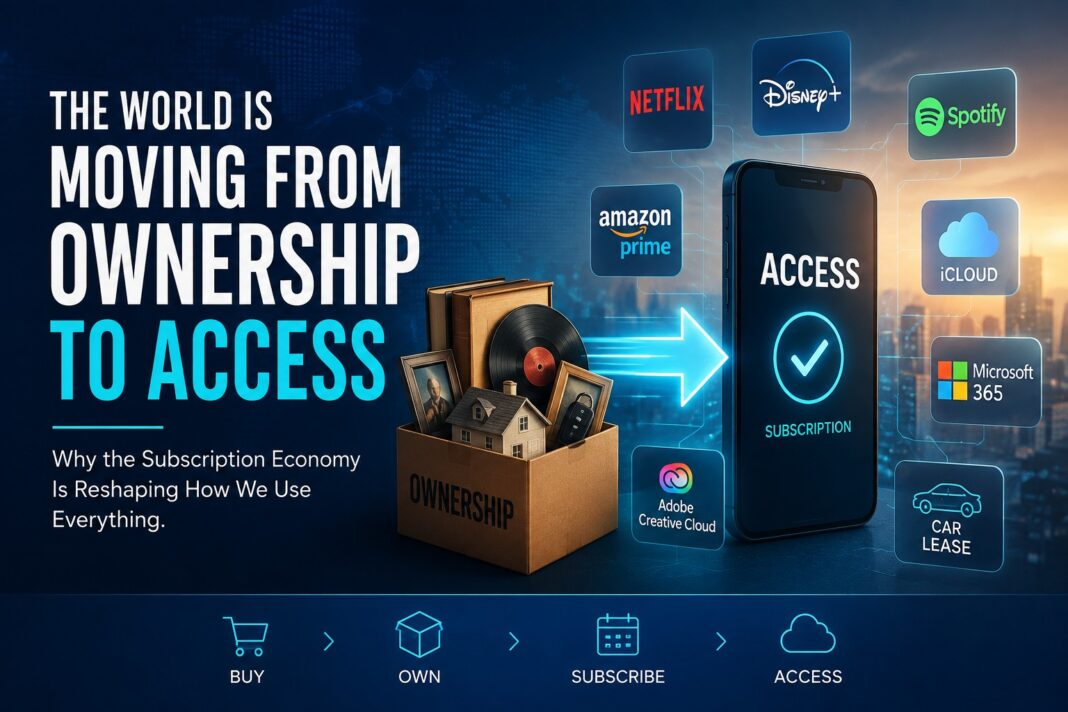
But the digital economy is quietly changing that relationship. The world is moving from ownership to access, from possession to subscription and increasingly from buying things to renting the right to use them. Consider something as ordinary as buying a digital book. When you buy a physical book, you own the physical object. The publisher cannot remotely remove it from your bookshelf. You can lend it to a friend, resell it or leave it to your children. When you buy an e-book, however, you are generally acquiring access under a licence whose terms are determined by the platform or publisher. Research into consumer perceptions of digital ownership has repeatedly highlighted this gap between what people believe they have purchased and the rights they actually possess. The uncomfortable reality is simple: you may think you bought a book, but what you really bought was permission to read it for as long as the company and its licensing arrangements allow. That small distinction represents a much larger transformation in the global economy.
The evidence is already visible. The subscription economy is expanding across sectors that were once dominated by outright purchases. Zuora’s 2025 Subscription Economy Index, which tracks more than 600 subscription businesses, found that companies in its index grew revenue 11% faster than the broader economy over the preceding two years. Its consumer research also found that 68% of respondents had subscribed to a new service for the first time during 2024. This is not simply the Netflix economy. It is a structural change in the way consumers interact with products and services. Software is perhaps the clearest example. There was a time when a customer bought software on a disc, installed it on a computer and could continue using that version indefinitely. Today, Software-as-a-Service has become the dominant commercial model for much of the technology industry. Global SaaS market estimates now place the industry in the hundreds of billions of dollars, with forecasts pointing towards a market worth more than a trillion dollars within the next decade. The consumer is no longer purchasing a piece of software. The consumer is paying for continuing access to software, updates, cloud infrastructure and services.
Entertainment has undergone an even more dramatic transformation. Deloitte’s 2025 Digital Media Trends found that 90% of U.S. consumers had at least one paid video-streaming service in their household, while the average household subscribed to four services. Among Gen Z and millennials, the average was five paid services. A generation that once built physical collections of music, films and television shows is instead building collections of subscriptions. The economic difference is profound. A DVD was an asset, however small. A streaming subscription is a recurring expense. A CD could be played decades after it was purchased. A streaming service can disappear from your account the moment you stop paying. Music has followed exactly the same trajectory. The record, cassette and CD gave consumers a physical object that could be owned indefinitely. Streaming transformed music into a utility. Millions of songs are now available instantly, but consumers increasingly own almost none of them. They pay for access.
The automobile industry offers another glimpse into this future. Cars have traditionally been among the most important assets owned by households, but leasing has demonstrated that even mobility can be converted from ownership into access. In the United States, roughly 24% of new vehicles were leased in 2025, according to Experian data. The shift is particularly striking in electric vehicles. More than half of new EV transactions were leases in late 2024, and the leasing share rose above 56% in the third quarter of 2025. The reasons are obvious. Electric-vehicle technology is changing rapidly, depreciation can be difficult to predict and consumers may not want to be locked into yesterday’s technology. Leasing allows them to use the latest vehicle without committing to ownership for a decade. The principle is increasingly becoming: why own an asset that depreciates rapidly when you can pay for the right to use the latest version?
Artificial intelligence could accelerate this transition even further. Consumers are increasingly accessing advanced AI capabilities through subscriptions rather than purchasing software outright. Businesses similarly pay for computing power, models, storage and applications as services. This is significant because AI is evolving at such a speed that today’s technology can become outdated remarkably quickly. Instead of buying a static product, consumers and businesses are purchasing continuing access to intelligence. The same philosophy is spreading across cloud computing, cybersecurity, digital storage and enterprise technology. The recurring-payment model is attractive to corporations because it transforms an uncertain one-time transaction into predictable recurring revenue. A company selling a $600 product receives $600. A company charging $50 a month potentially receives $600 every year for as long as the customer remains dependent on the service. The economic incentive for corporations is therefore enormous.
This is where the transformation becomes more than a question of consumer convenience. Ownership gives the consumer control. Subscription gives the provider a continuing relationship with the consumer. When you own a physical book, the publisher’s relationship with you largely ends at the point of sale. When you subscribe to a digital library, the relationship continues every month. When you purchase software outright, the transaction is largely complete. When you subscribe to SaaS, the company must retain you indefinitely. When you buy a CD, the manufacturer has little control over how you use it after the transaction. When you stream music, the platform controls the gateway through which you access the content.

There are obvious benefits to this model. Consumers can avoid large upfront costs. Businesses can access sophisticated technology without enormous capital expenditure. Shared assets can potentially be utilised more efficiently. Products can be upgraded continuously instead of becoming obsolete. A person who needs an expensive piece of equipment only occasionally may sensibly rent it rather than own it. A family that does not want the financial burden of maintaining a second car may prefer mobility services. A small company can use enterprise software that would once have been financially impossible to purchase. Access can therefore be more efficient than ownership.
But convenience can also create dependency. Imagine a future in which your books, films, music, software, photographs, artificial intelligence, vehicle, home appliances and professional tools are all tied to subscriptions. You may have access to more products than any previous generation, yet own fewer of them. The paradox is extraordinary: the consumer becomes richer in access but potentially poorer in ownership. And when ownership declines, control can decline with it.
The digital book illustrates the problem perfectly. If a physical book sits on your shelf, a company cannot remotely change the terms under which you read it. But a digital book exists inside a technological and legal ecosystem. Your ability to access it can depend on your account, the platform, compatible software and licensing arrangements. If the platform shuts down, changes its terms or loses the rights to distribute a particular title, your relationship with the content can change. The same principle applies to digital films, games, music and software. What looks like ownership can sometimes be a sophisticated form of rental.
This raises a much bigger question about wealth and power. For centuries, wealth accumulation meant acquiring assets. Families bought land, houses, businesses, gold, machinery and other things that could be passed from one generation to another. In the emerging access economy, however, the consumer may accumulate fewer assets while corporations accumulate ownership of the infrastructure through which those assets are accessed. The consumer rents the service while the platform owns the system. The individual pays the subscription while the corporation builds recurring revenue. The customer gets convenience while the company gets control of the relationship.
This does not mean ownership will disappear. People will continue to buy homes, land, businesses, jewellery, cars and physical goods. But the balance is changing. Younger consumers in particular are becoming comfortable with access-based consumption because they have grown up in an environment where music, entertainment, software, storage and communication are services rather than physical products. The psychological definition of ownership is changing alongside the economics.
The wealthy person of the future may therefore not necessarily be the person who owns the most objects. It may be the person who has access to the best systems: the best AI, the best healthcare, the best education, the best mobility, the best computing power and the best experiences. That could democratise access to things previously available only to those with substantial capital. But it could also create a society where ownership becomes increasingly concentrated among corporations and institutions while everyone else pays for access.
That is why the question we should be asking is not whether the world is moving towards renting. The evidence suggests that it already is. The more important question is who owns what the rest of us are renting. If corporations control the platforms, intellectual property, data, infrastructure and digital ecosystems through which billions of people access essential products and services, then ownership has not disappeared. It has simply moved upwards.
The old economy asked: what do you own? The new economy increasingly asks: what can you access? And the distinction matters. Because when you own something, you control it. When you rent it, someone else ultimately does. The digital book sitting inside your tablet may look like a book, but economically it can be something very different. You did not necessarily buy the book. You bought permission to read it. And that may be the defining metaphor of the 21st-century economy: a world in which we own fewer things, subscribe to more services and increasingly pay for permission to use what somebody else owns. The future may not be a world where nobody owns anything. It may be a world where a smaller number of institutions own more, while billions of people rent access to it. The question for society is therefore no longer simply how much we can access. It is how much control we are prepared to surrender in exchange for that access.