
Key Takeaways
- The Hexagon of Alliances proposes a six‑nation network to balance power across the Mediterranean and Indian Ocean.
- By integrating India and Israel with Greece, Cyprus, the UAE and Somaliland, the framework adds strategic depth beyond the Mecca Agreement.
- Institutional mechanisms—secretariat, working groups, and joint exercises—are essential for long‑term durability.
The emerging geopolitical contest in the Middle East and its expanding arc into South Asia will not be decided by missiles alone. It will be decided by alliances, geography, technology, economics, intelligence and, above all, strategic patience.
If the Mecca Agreement is emerging as a framework capable of consolidating a wider Sunni strategic axis, then the answer cannot simply be another military pact. The answer must be a network of networks—a counter‑alliance architecture ensuring that no single power or bloc can dominate the strategic spaces connecting the Mediterranean, Middle East, South Asia and the Indian Ocean.
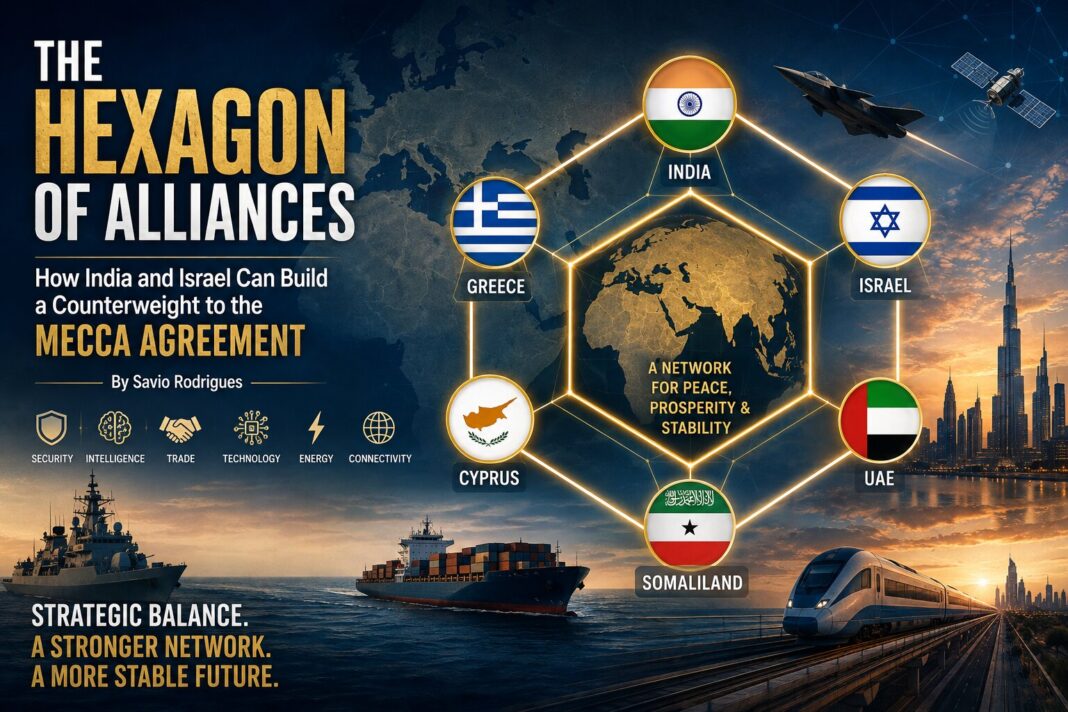
This is where the proposed Hexagon of Alliances becomes strategically important. Built around Israel, India, Greece and Cyprus, and extending towards partners such as the United Arab Emirates and Somaliland, such a framework could create a new strategic geometry. Its importance lies not merely in the countries involved, but in the geography they collectively occupy. Greece and Cyprus sit at the gateway between Europe and the Eastern Mediterranean. Israel provides technological, intelligence and defence capabilities. India brings scale, economic power and access to the Indian Ocean. The UAE brings financial muscle and a critical position in the Gulf. Somaliland, overlooking the Gulf of Aden near one of the world’s most consequential maritime chokepoints, offers another geographical dimension.
The objective should not be to create another NATO. It should be to create an interoperable strategic ecosystem. That ecosystem needs institutionalisation. Alliances built around political statements eventually disappear when governments change. Alliances built around institutions survive governments. A formal secretariat, permanent working groups and dedicated mechanisms for defence, maritime security, artificial intelligence, cyber security, energy, infrastructure, trade and cultural cooperation would give the Hexagon substance. Military interoperability should be accompanied by intelligence-sharing protocols, joint exercises and coordinated maritime-domain awareness. Universities, think tanks, technology companies and civil society should also become part of the architecture.
The real power of an alliance is not always what its armies can do. It is what its members can prevent their adversaries from doing.
The Eastern Mediterranean provides the first strategic theatre. Turkey’s expanding influence across the Mediterranean, the Caucasus and the wider Muslim world makes Greece and Cyprus natural partners for a broader balancing strategy. India has traditionally maintained good relations with Ankara, but New Delhi cannot ignore the consequences of Turkish strategic convergence with Pakistan and Azerbaijan. Turkey’s ambitions in the Mediterranean and its growing footprint towards Central Asia have implications far beyond Turkish borders.
Israel and India therefore have a shared interest in ensuring that the Eastern Mediterranean and South Caucasus do not become exclusive spheres of influence for Ankara.
The UAE adds another critical dimension. The India-Israel-UAE-United States grouping, popularly known as I2U2, was originally conceived around investment, food security, clean energy, technology and economic cooperation. But the changing strategic environment demands that economic partnerships be complemented by stronger security consultations. This does not necessarily mean transforming I2U2 into a military alliance. Rather, it should develop mechanisms for intelligence cooperation, counterterrorism, maritime security, cyber resilience and protection of critical infrastructure.
Economic interdependence without strategic resilience is an incomplete partnership.
For India, the South Caucasus is equally important. Armenia represents a particularly significant piece of this geopolitical puzzle. New Delhi has developed a growing defence relationship with Yerevan, while Israel has also emerged as an important defence partner of Armenia. Armenia may be militarily weaker than its larger neighbours, but strategic importance cannot be measured merely by military strength.
Geography gives Armenia significance. A genuinely independent Armenia creates a geographical and political obstacle to an uninterrupted Turkish-Azerbaijani strategic corridor stretching towards Central Asia. That matters to India because Turkey’s relationship with Pakistan, combined with Ankara’s ambitions in Central Asia and the Azerbaijani connection, creates a strategic configuration that New Delhi cannot afford to ignore.
Armenia’s Crossroads of Peace initiative and the emerging arrangements around regional connectivity demonstrate that Yerevan is attempting to survive in an extraordinarily difficult neighbourhood. India should welcome connectivity and peace, but peace cannot mean the disappearance of Armenian strategic autonomy.
India’s interest is not in choosing perpetual conflict for Armenia. It is in ensuring that Armenia retains meaningful choices. That distinction is crucial.
The same principle applies to Pakistan. Islamabad’s internal vulnerabilities are well known, but India must resist the temptation to view every Pakistani internal conflict purely through the prism of destabilisation. Instead, India’s leverage should come through diplomacy, international partnerships, economic engagement, information resilience and support for legitimate democratic and human-rights aspirations.
Balochistan is strategically important for another reason: Gwadar.

The China-Pakistan Economic Corridor was designed as one of the major pillars of China’s Belt and Road Initiative. Gwadar is not simply another port. It is part of Beijing’s effort to diversify trade and energy routes and reduce dependence on maritime pathways vulnerable to geopolitical disruption, particularly the Malacca Strait.
That makes Pakistan’s western coastline strategically significant well beyond Islamabad and Beijing.
For Washington, New Delhi and Jerusalem, the challenge is therefore not necessarily to physically disrupt CPEC. It is to develop alternative economic corridors, maritime partnerships and infrastructure networks that reduce the strategic value of China’s investments while increasing the choices available to regional states.
This is where the Hexagon could become more than a defence concept. It could become an economic counterweight.
India’s connectivity projects through Iran and Central Asia, its expanding maritime partnerships, its relationships with the Gulf states and its growing engagement with Africa can create alternative pathways linking the Indo-Pacific with Europe and Africa. Israel contributes technological capability. Greece and Cyprus provide European connectivity. The UAE supplies capital and logistics. Somaliland provides access to the Horn of Africa and the Gulf of Aden. Armenia connects the architecture to the Caucasus.
Suddenly, what appears to be a collection of bilateral relationships becomes a strategic map. And maps matter.
The mistake India must avoid is allowing its foreign policy to become reactive. New Delhi should not wait for alliances to emerge against it before constructing its own partnerships. India is now sufficiently powerful to shape strategic architecture rather than merely respond to it.
The objective should therefore be a layered alliance system: the Quad in the Indo-Pacific, I2U2 in West Asia, deeper India-Israel defence and technology cooperation, stronger India-Armenia engagement, partnerships with Greece and Cyprus, deeper UAE cooperation and an expanded Indian Ocean strategy.
The Hexagon can sit above these relationships as a strategic concept rather than attempting to replace them.
The world is moving from a unipolar moment towards competitive multipolarity. In such a world, countries that stand alone become vulnerable to pressure. Countries that build networks acquire strategic depth.
The Mecca Agreement, if it evolves into a durable strategic framework, should therefore not be confronted through rhetoric or panic. It should be answered with geography, economics, technology, diplomacy and alliances.
India’s greatest advantage is that it does not need to dominate every theatre. It only needs to ensure that no rival coalition dominates the theatres that matter to India’s national interest.
That is the essence of the Hexagon. Not encirclement. Not confrontation for confrontation’s sake. But strategic balance.
Because in the geopolitics of the twenty-first century, the strongest country may not be the one with the biggest army. It may be the country with the strongest network of friends.