


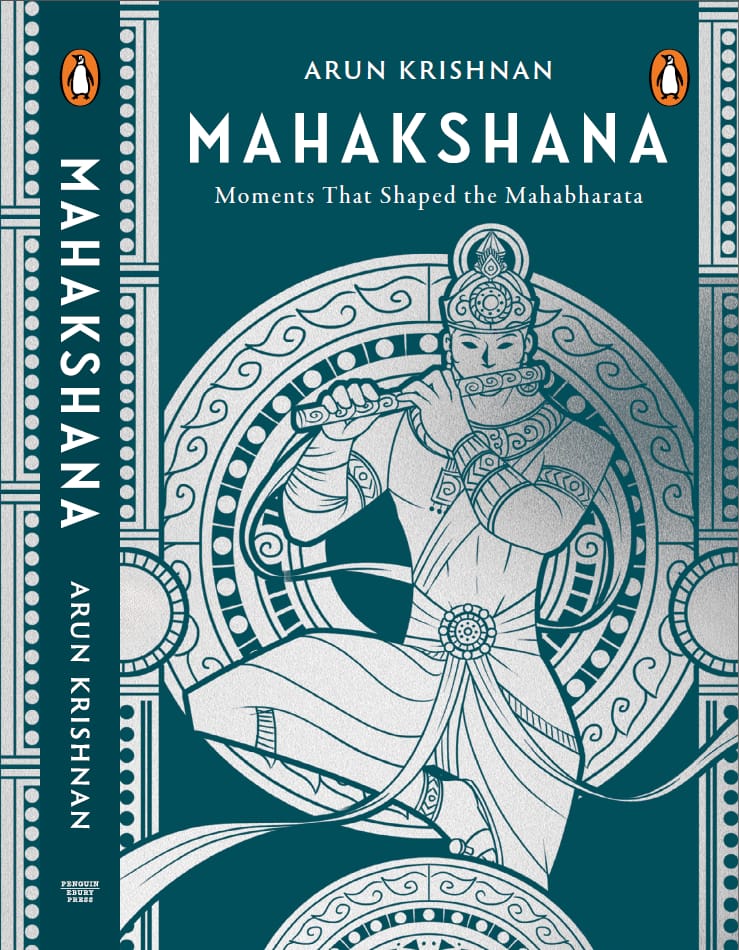

What happens in the instant before a choice becomes destiny?
In a time when every decision carries consequences and questions of ambition, power, loyalty, identity, and moral choice continue to shape our lives, bestselling author Dr. Arun Krishnan’s new book, ‘Mahakshana’ (Penguin India) offers a strikingly relevant retelling of the Mahabharata.
‘Mahakshana’ pauses at the defining moments when choices are made, emotions collide, and destinies change forever. Through these moments, the ancient epic becomes a reflection on the dilemmas that remain deeply familiar even today.
From Devavrata’s transformation into Bhishma and Amba’s turn towards vengeance, to Karna’s dilemma over the Shakti, Bhima’s wait to confront Kichaka, and Abhimanyu’s contemplation before entering the Chakravyuha, ‘Mahakshana’ explores the epic through moments of decision, consequence and irreversible change.
What makes ‘Mahakshana’ especially relevant to contemporary readers is its focus not merely on Gods, warriors and heroes, but on the human emotions that drive their decisions—desire, doubt, rage, love, ambition, loyalty and guilt. These are emotions that continue to influence relationships, leadership, conflict and choices in the world around us.
Sometimes, history is shaped in a single moment. ‘Mahakshana’ traces the story of the Mahabharata through these key moments.
Devavrata stands on the brink of becoming Bhishma. Amba’s humiliation hardens into vengeance. Dushasana steels himself for an act that will scar history. Bhima waits for the moment to strike Kichaka. Karna wrestles with the consequences of using the all-powerful Shakti on Ghatotkacha. Abhimanyu contemplates before entering into the Chakravyuha on the Kurukshetra battlefield.
These are not stories of Gods and heroes. They are stories of desire and doubt, rage and love, ambition and guilt—of ordinary human emotions colliding with extraordinary destinies.
In this extraordinary retelling of the Mahabharata, ‘Mahakshana’, Arun Krishnan steps inside the minds of the men and women who shaped Bharatavarsha, capturing them at the instant when choice becomes destiny.
Dr. Arun Krishnan is a passionate historian and storyteller, he is the author of the ‘Battle of Vathapi’ Trilogy, published by HarperCollins, and ‘Daughter of Two Rivers’, which has been longlisted for the IGF Archer-Amish Award and won the Special Jury Mention for the SL Byrappa Prize for Historical Fiction. A polyglot and history enthusiast, he draws on his diverse experiences to bring India’s past alive through his writing.
An engineer, and technologist with experience across IT, high-performance computing, bioinformatics, computational biology and HR analytics. He holds a doctorate from the US and an Executive MBA from ISB, Hyderabad.
To explore what ideas shaped this novel retelling of the Mahabharata, Sonakshi Datta of GoaChronicle posed a few questions to Dr. Arun Krishnan.
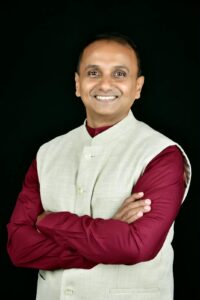
‘Mahakshana’ Author Dr. Arun Krishnan
What were the bases on which you chose the exact ‘defining moments’ of the Mahabharata where you have taken the right pauses to reflect on the decision-making process? What is that one moment and the thought processes related to it that struck a chord with you, and why?
There is of course, subjectivity in terms of identifying defining moments in the Mahabharata. No two individuals will probably agree 100 percent on all the moments. However, I believe that at least 80-90 percent of the moments that I have chosen as defining would pass muster. I have chosen those moments that either altered the turn of events and moved the story along or proved pivotal in the development of the character of individuals and which would later have an impact on how they acted.
There is no one moment, but, as an example, in ‘A Venomous Relationship’, I describe the relationship between the Kauravas and Pandavas, at a very young age, from Duryodhana’s point of view. After all, the Mahabharata owes a lot to the dislike and even hate that Duryodhana had for his cousins. Why and how did it develop? What was their childhood like? Why did Duryodhana harbor such hatred for his cousins? Could it even have some justification? These were the questions I tried to answer.

Obviously, in this case, the seeds for the hatred are sown at a very young age and the hatred on the part of Duryodhana is reflected in a trust deficit from the Pandavas and this is something that never gets bridged and only worsens through the story.
What are the dilemmas, showcased by these exact moments, that you believe remain relatable even today? What is one such dilemma that proved to be the most relatable with you? What do you think are the solutions to overcoming these dilemmas?
In our own lives, we make thousands of decisions, big and small. From decisions as trivial as, ‘What do I eat or wear today?’ to more weighty ones that affect our families and careers. Behind our decisions lies the weight of our experiences. Our past experiences have moulded and shaped our characters and they play an important part in the option that we choose among a host of competing options.
For me, personally, Vidura’s dilemma in helping to choose Pandu over Dhritarashtra comes closest. I am, for the most part, a fairly rational and logical person. That is how I am hardwired. Like Vidura. And just as Vidura knew that the rational decision was to go for Pandu (and which he eventually did), there was a small part of him that probably cautioned him against it because, in the end, it is mostly emotions that guide how people act. And a rational choice sometimes can have very adverse reactions in terms of the reactions it elicits from people.
I don’t think there are any perfect answers to these dilemmas and that’s the most fascinating bit. There are no right or wrong answers. Two different people might and often will, reach diametrically opposite conclusions when faced with the same scenario. Their natures are different. Their experiences are different and hence their choices are different. This is what makes life fascinating. It would be so boring if we were all alike, like automatons. But that’s also what makes relationships so daunting.
What are the facets of individual decision-making and actions in the Mahabharata that can easily be related with, by even modern-day human beings?
I firmly believe that human nature hasn’t changed over the hundreds and thousands of years. There is an evolutionary hardcoding that just cannot be erased. Humans have felt the same emotions for millennia – Love, lust, anger, hatred, greed, joy, gratitude, hope, pride, amusement, inspiration, awe – you name it, and all the emotions have been felt by our ancestors the same as us.
That being the case, and given how much our emotions dictate our decision making, every single scenario is replicable in this day and age. Take Shikhandi for instance. In the Mahabharata, he is supposed to be Amba-reborn. I have given it a slightly more rational interpretation but the idea is the same. A man trapped in a woman’s body initially. The cauldron of emotions such a person goes through would be very similar to what transgenders would feel in the modern age.
Or Draupadi’s revulsion at being just an object of lust for men. Which woman in the modern age hasn’t felt the same when they are catcalled by men or touched inappropriately in public spaces? Those emotions remain the same. Only the day and age has changed.
If you were to choose one individual out of the Mahabharata, who, as per your understanding, had the best decision-making abilities, who would that be, and why? What all are the lessons that one could learn through his/her choices made on the Kurukshetra battlefield, or even outside?
To me, there is only one person who fits the bill. Shri Krishna. His decisions are not a result of emotions or its opposite, cold logic. And this is where dharma enters the fray. Krishna’s decisions are underpinned by dharma and in the furtherance of dharma. There is a subtlety to it that more binary viewpoints can’t quite understand. Dharma is subtle but if every decision is underpinned by dharma, it will eventually lead to the right outcomes.
That is why, in the Indic/Hindu worldview, Artha (wealth) and Kama (desire) are legitimate pursuits on the path to Moksha (release from the cycle of births and deaths) but they have to be underpinned by Dharma. It is also why our most celebrated God / Avatar is Shri Rama, because of his strict adherence to what he saw as his Dharma. Dharma is also not singular. For example, I, as a man, have a dharma as a son, husband, father, a leader of my company, a friend etc. Sometimes the different dharmas are in conflict and it is the choice of the dharma that dictates the outcomes.
And the effect of every choice is our karma. Karma is inexorable. No one is exempt from it. Shri Krishna’s stated message is that He came to this world to rid the world of adharma and to establish dharma. Hence, His every action is in consonance with that stated goal.
What makes ‘Mahakshana’ a must-read for all?
I have tried to write it as I usually write historical fiction. To me, the Mahabharata is not ‘mythology’. It is Itihasa – history. The underlying story is human at its core. With all the attendant limitations. These were men and women, our ancestors, who lived their lives on this earth circumscribed by the same limitations that we face. These were also extraordinary humans. How did they make their decisions? How did they confront those daily conundrums that are so familiar to us?
I think the learning is what makes Mahabharata and by extension, ‘Mahakshana’ truly contemporary and a must-read for all.