


Key Takeaways
- Hindutva is not a rigid religious dogma or a political ‘ism’, but the essential state of being Hindu
- Hindutva is a civilizational essence and a universal way of life
- Hindutva is not a supremacist doctrine, but a philosophy that welcomes pluralism and inquiry
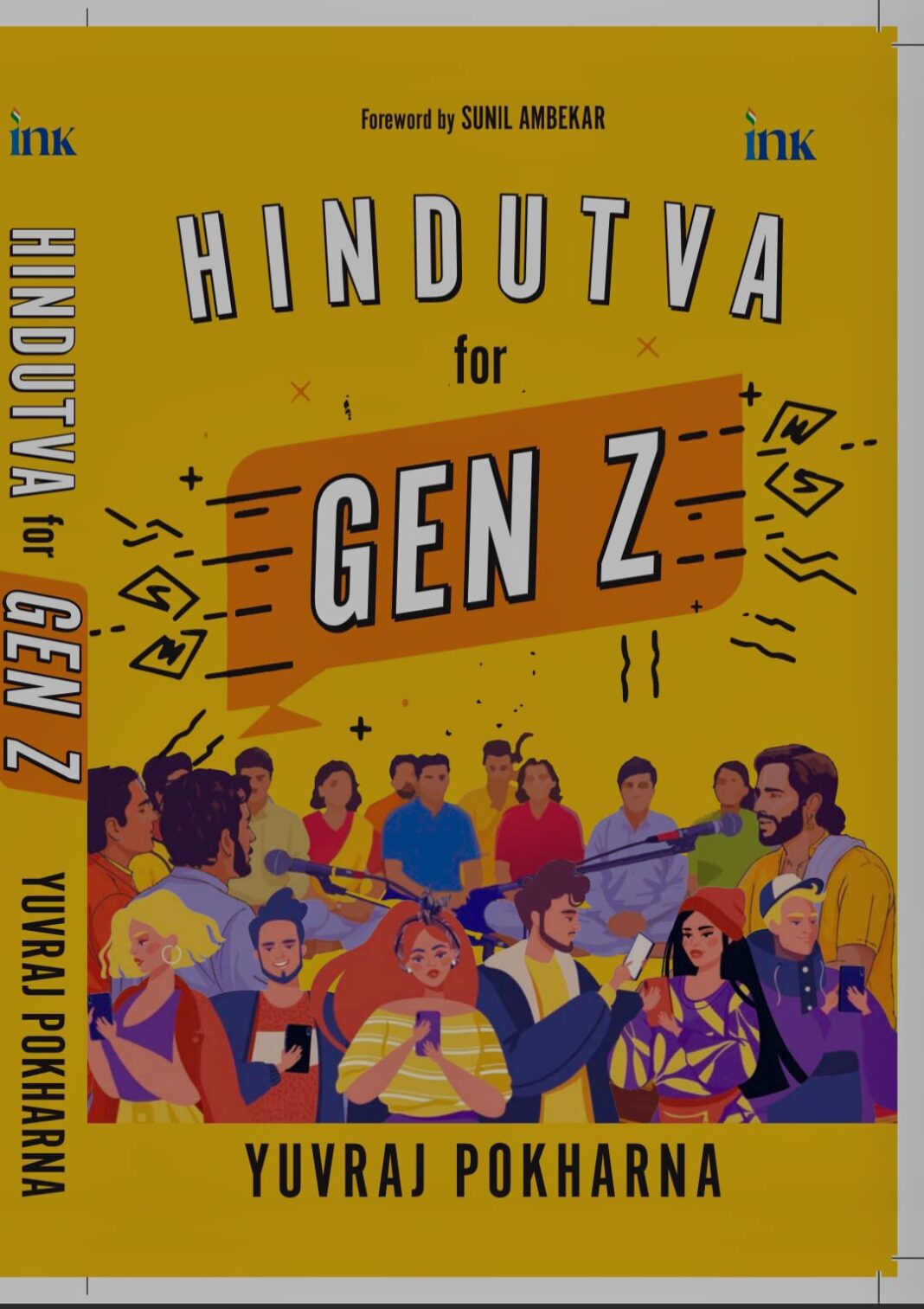
Globally launched by Sri Sri Ravi Shankar and written with the objective of helping Gen Z better understand the terminology of ‘Hindutva’, and the narratives and cultural conversations associated with it that are increasingly shaping public discourse across digital and mainstream media, ‘Hindutva for Gen Z’ by Yuvraj Pokharna aims to encourage informed thinking and independent decision-making by providing context around topics actively discussed in contemporary society.
Hindutva is not a rigid religious dogma or a political ‘ism’. It is the lived ‘state of being Hindu’- a civilizational essence and a universal way of life- Dharma.
Yuvraj Pokharna is a Surat-based author, activist, and media panelist. A prolific writer on Hindutva, Islamic Jihad, politics, and public policy, he brings to his writing, the urgency of an activist and the precision of a commentator.
Being the general advisor to Kirti Setu, Yuvraj is also a former educator and continues to drive socio-political dialogue at the intersection of tradition and modernity.
To delve deeper into the concepts and intellectual facets that have gone into the writing of ‘Hindutva for Gen Z’, Sonakshi Datta of GoaChronicle asked Yuvraj a few questions about his latest release.

‘Hindutva for Gen Z’ Author Yuvraj Pokharna
What, according to you, are the major topics related to Hindutva, that are a part of present public discourse? Why do you think these particular topics are raised frequently, and what aspects revolving around them do you reckon should be understood by those who are still uninformed, that is, your target readership?
The topics dominating the discourse right now are temple restoration and state taxation of Hindu places of worship, place-name reclamation, the caste system and its actual origins, Nehruvian secularism versus genuine pluralism, the global campaign against Hindu identity which I call ‘Hindumisia’, the Uniform Civil Code, and the fundamental question of what Hindutva actually means versus what it is consistently painted as.
These keep surfacing because they directly challenge a narrative that was locked in after 1947. A narrative that treated Hindu civilisational memory as something to be managed, diluted, or apologised for. Take temple control. It is not a minor administrative matter. It is the only faith in this country whose places of worship are taxed and administered by the government while every other faith enjoys full autonomy. That is not secularism. That is selective treatment dressed up as secularism. Name changes are another flashpoint. They are routinely framed as erasing history when they are actually correcting it. Prayagraj, Ayodhya, these are not new names. They are original names that were displaced by colonial and invader-era distortions. Restoring them is a decolonising act, not a divisive one.
Then there is caste, which is perhaps the most weaponised topic in this entire conversation. Very few people are told, and this is something the book addresses directly, that the rigid birth-based hierarchy we see today was significantly hardened by colonial census policies. The original Vedic varna system was fluid and merit-based. That distinction matters enormously and it is almost never part of the mainstream conversation.
What the uninformed reader, especially Gen Z, needs most is context. These are not random cultural skirmishes. They are battles over civilisational continuity. Once you understand the pattern, how certain frameworks were imposed from outside and how Hindu society was conditioned to view itself through those imported lenses, the noise starts making sense. My book breaks all of this down in short, standalone essays precisely so that a reader does not have to swallow an entire ideology in one sitting. Pick the chapter that provokes you. Start there.
What, as per your understanding, is the core deduction that could help the youth comprehend that Hindutva is not some ‘hardcore’, ‘fascist’, ‘radical’, form of Hinduism; unlike what is propagated prolifically in the current times?
The core deduction is straightforward. Hindutva is not an ism at all. It is the tatva, the essential state of being Hindu. It is swa-dharma, the natural expression of a civilisation that has existed and evolved across millennia. It is not a political ideology. It is certainly not a supremacist doctrine. The moment you understand that distinction, the fascist label falls apart on its own.
What the propaganda deliberately conceals is that this civilisation has always carried within it an extraordinary capacity for pluralism and inquiry. The Rig Veda says ‘Ekam sat vipra bahudha vadanti’. Truth is one, the wise call it by many names. That is not the declaration of a fascist civilisation. That is the foundational philosophy of one that welcomes diverse paths to the same truth. From Chanakya’s statecraft to Adi Shankaracharya’s philosophical debates, from the coexistence of Shaivism and Vaishnavism to the accommodation of the Charvaka atheist within the broader Hindu fold, Hindutva has never demanded uniformity. It has absorbed, argued, reformed, and evolved. Fascism, by definition, cannot do any of those things.
The fascist and radical labels are lazy colonial and post-colonial constructs designed specifically to delegitimise any assertion of Hindu civilisational confidence. When a Hindu says my temples deserve autonomy, that becomes communal. When a Hindu says my history deserves honest telling, that becomes dangerous. The labelling is not a response to what Hindutva is. It is a strategy to prevent people from finding out.
What I want young readers to take away is this. Hindutva does not ask you to hate anyone. It asks you to stop hating yourself and your inheritance. That is the real distinction, between a lived civilisational essence and a manufactured political slur. Once that is clear in a young person’s mind, the rest of the propaganda loses its grip entirely.
What are some of the myth-busting facts you have covered in your book that would help burst the bubble of ‘liberal’ propaganda, rampant among Indian youth?
Several, and I will take them one by one.

The most persistent myth is that the caste system as we know it today is an ancient Vedic invention. It is not. Colonial census operations played a massive role in rigidifying what was earlier a far more fluid varna arrangement. The British needed fixed, hereditary categories to administer a vast and complex society. So, they created them, or hardened what was already loosening. That is a documented historical pattern, not a nationalist talking point.
The idea that Hindu society has been uniquely and exceptionally oppressive is another myth the book examines. When you place it alongside how other civilisations across the world have historically treated questions of social hierarchy, the selective outrage becomes very apparent.
On temples, the constitutional asymmetry is impossible to defend once you lay it out plainly. Hindu temples alone are under state control and state taxation. Other religious institutions are not. That is not secularism. Secularism means equal treatment. What we have is selective treatment, and calling it secularism does not make it so.
The Hindu terror narrative is perhaps the most cynically manufactured of all. The book traces how it was constructed, how it was applied selectively, and how far more organised and documented radicalism was simultaneously downplayed or explained away by the same ecosystem that was loudest about Hindu terror.
Then there is the superstition stereotype. Ancient Indian contributions to mathematics, surgery, atomic theory, and strategic thought are laid out in the book with specificity. A civilisation that gave the world the concept of zero and documented surgical procedures thousands of years ago deserves better than the primitive label it is routinely handed.
And cutting across all of these is the most important myth of all: that Hindutva is anti-pluralism. It is rooted in civilisational confidence, not civilisational aggression. Confidence does not require the diminishment of others. These are not opinions. They are documented patterns that the current discourse deliberately keeps fragmented so that no one sees the full picture at once.
What, according to you, are the factors that have led to, and continue resulting in the same misinformation and anti-Hindu propaganda, that ensues distancing Hindus from their own Dharma and its true essence? What needs to be done to counter this force and help Hindus, especially the young ones, wake up in a ‘Hindu consciousness’?
The roots go back further than most people realise. Colonial scholarship systematically framed Hinduism as chaotic, primitive, and inferior. That framing was not incidental. It was functional. A civilisation made to feel ashamed of itself is far easier to govern and far easier to convert. The tragedy is that we carried that framing into independence and institutionalised it.
The post-independence political project deepened the wound. ‘Minorityism’ was packaged as secularism and accepted as progressive thought. What it actually created was a hierarchy where Hindu civilisational assertion became inherently suspect while every other identity assertion was celebrated as resistance. Academia followed. Media followed. And eventually global discourse followed, where today the same frameworks that were built to delegitimise Hindu confidence continue to operate largely unchallenged in international institutions and publications.
The result is cultural amnesia. An entire generation of young Indians who know more about imported ideologies than about the philosophical and institutional depth of their own tradition. Who can tell you about Marxist dialectics but cannot tell you what the Arthashastra argued. Who feel uncomfortable saying they are proud Hindus in a way they would never feel uncomfortable asserting any other identity.
To counter this, we need two things. First, clarity, not slogans. Young people need access to the actual intellectual lineage and historical record of this civilisation without the filter of guilt or caricature. The material exists. It simply has not been made accessible in a language and format that speaks to how this generation actually consumes information. That is precisely what this book attempts.
Second, confidence. Hindu consciousness is not about aggression. It is about recovering the default setting of this civilisation, the quiet, grounded understanding that it has the right to exist on its own terms without perpetual apology. Books, curricula, and public conversations that treat Hindu thought as a serious, living tradition rather than a museum piece or a political problem are the practical way forward. The decolonisation of the mind begins with honest information. Everything else follows from there.
What makes ‘Hindutva for Gen Z’ a must-read for all, even if they are older for the Gen Z category?
Because the questions this book deals with are not generational. They are civilisational. The confusion around Hindutva, the distortion of Indian history, the asymmetry in how secularism has actually been practised in this country, and the global campaign to delegitimise Hindu identity, none of these affect only young people. They affect every Indian who has inherited this civilisation and is trying to make sense of the noise around it.
Gen Z is simply the generation that has grown up entirely inside this distorted information environment. They have had the least exposure to corrective context and the most exposure to the propaganda. That is why the title addresses them specifically. But the 45-year-old professional, the retired schoolteacher, the parent trying to answer their child’s questions about why certain conversations are framed the way they are, they need this clarity just as much.
The format reflects that. The book is written as short, self-contained essays across diverse themes. Temple rights, caste, Kashmir, the name change movement, Wokeism, the RSS, cow veneration, ancient science. Each chapter is a complete argument in itself. You do not need to read it from cover to cover. You can pick the issue that provokes you most and start there. That was a deliberate editorial choice because I know how people actually read today, in bits, between commitments, on a commute, during a lunch break.
This is not a manifesto. It is not asking anyone to join a movement or adopt a position. It is an attempt to hand people the missing pieces so they can think for themselves. The title says for Gen Z but the crisis of cultural disconnection it addresses belongs to all of us who inherited this civilisation and want to pass it on with clarity rather than confusion.
That is who this book is for. Which, when you think about it, is most of us.