


Key Takeaways
- Reenita Malhotra Hora’s novel ‘Vermilion Harvest’ explores the complexities of Anglo-Indian identity in the face of colonial violence.
- The novel intertwines a cross-cultural love story between Aruna, an Anglo-Indian school teacher, and Ayaz, a young political firebrand drawn into the Rowlatt Satyagraha.
- The novel explores themes of colonial violence, gender identity, belonging, and the human cost of resistance.
April 13 remains etched in India’s collective memory as the day of the Jallianwala Bagh massacre—one of the most tragic and defining moments of the freedom struggle.
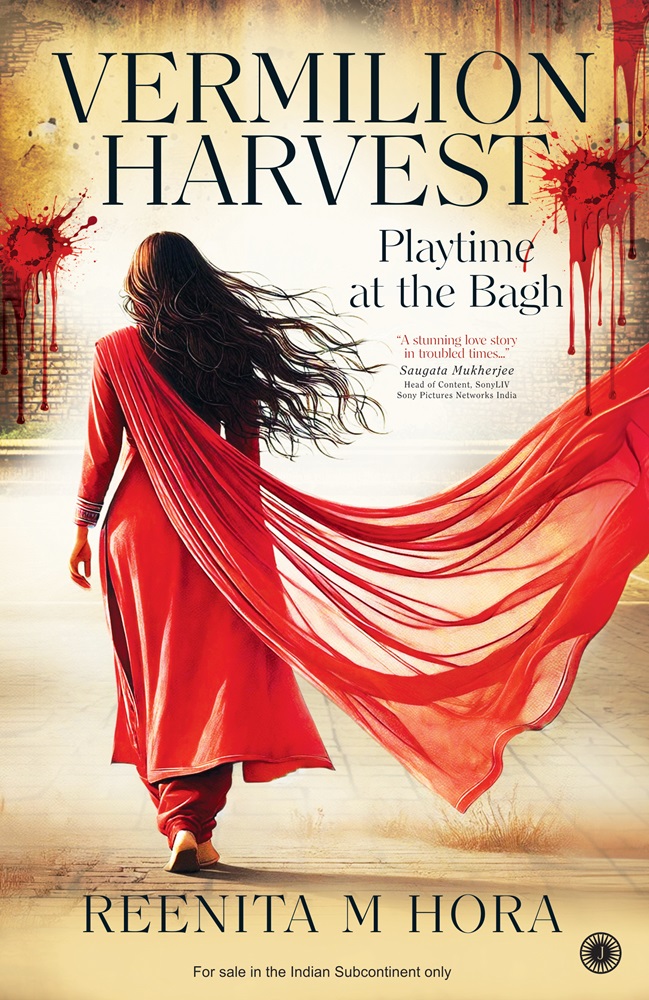
Reenita Malhotra Hora’s ‘Vermilion Harvest: Playtime at the Bagh’ revisits this haunting chapter through a deeply personal and evocative narrative. The novel intertwines a cross-cultural love story between Aruna, an Anglo-Indian school teacher, and Ayaz, a young political firebrand drawn into the Rowlatt Satyagraha.
As their lives unfold against the growing unrest in colonial Amritsar, the story builds toward the fateful events of April 13, 1919. Rich in historical detail and emotional depth, the book explores themes of identity, belonging, and the human cost of resistance.
Blending fact with fiction, ‘Vermilion Harvest’ goes beyond retelling history—it offers a powerful and intimate reimagining of India’s freedom struggle, and the lives irrevocably altered by it.
Aruna and Ayaz’s story mirrors a country caught between its yearning for freedom and the devastating price of resistance. Can love survive when history itself conspires to tear it apart?
Reenita Malhotra Hora is a Mumbai-born, California-based novelist and screenwriter whose stories spotlight the South Aian experience. Her award-winning historical love story Vermilion Harvest – Playtime at the Bagh, set against the 1919 Amritsar massacre, won the Overall Grand Prize at the Chanticleer International Book Awards.
Her YA rom-com ‘Operation Mom’ has also earned acclaim, with recognition from the Sundance Institute Development Slate, The Writers Lab, the Eric Hoffer Book Award, the Indie Reader Discovery Award, and more. LA Weekly hails her as a top indie writer redefining Indian culture and comedy for global audiences.
She is a former journalist for Bloomberg and RTHK, with work in The New York Times, CNN, and Bloomberg.
To learn more about Reenita’s latest release, Sonakshi Datta of GoaChronicle posed a few questions to her, related to the themes and topics her novel touches upon.
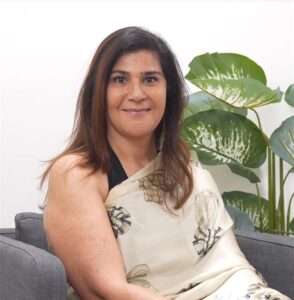
‘Vermillion Harvest’ Author Reenita Malhotra Hora
How did the thought of merging the facts of the Jallianwala Bagh Massacre with a love story cross your mind?
As a young boy, my maternal grandfather witnessed the aftermath of the Jallianwala Bagh massacre. Just days after it happened, he saw a pile of slippers stacked upon outside the entrance of the bagh. The image stayed with him his whole life, and through him, it stayed with me. This is not a textbook connection. It is blood memory. My mother was born in Amritsar. As a Punjabi, this tragedy was never abstract.
But the love story came from somewhere else entirely. I was a teenager when I played a character connected to this history in a school play, and around the same time I read Erich Segal’s LOVE STORY. That’s when I first understood that love stories were literary fiction and not romance. Something clicked. I knew I would one day want to write in that vein. Fast forward to TITANIC many years later: a love story set against a disaster. So, this is the pitch I always return to. TITANIC meets GANDHI. A real disaster. Real love. Real grief. Real pathos. The only honest way in.
Apart from the historical details of the massacre, what other themes of importance does your new story cover?
Colonial violence. Gender. Identity. Belonging. What it means to exist in the space between two worlds that both reject you. Aruna is Anglo-Indian, which meant she was outcast from both sides. Neither the Indians nor the British accepted her. This is exactly the lived experience of the Anglo-Indian community. On a micro level, Aruna’s story is a metaphor for the colonial violation happening on a macro level. Her mother was assaulted by a British officer. This is not backstory as much as it is the engine of her entire personal story.
VERMILION HARVEST does not fit the romance formula of a happily ever after. The most beautiful love stories are filled with pathos, because I honestly believe that love is a double-edged sword. Alongside its beauty, there is invariably deep pain. This duality is what I want readers to carry with them when they finish the book.
What aspects about the Jallianwala Bagh Massacre do you think remain unexplored by us? What such aspects have you covered in your latest release?
Firstly, fiction. There has never been a fictional story set against this massacre. That alone is extraordinary, given its scale and its consequences for the Indian independence movement. Secondly, the perspective of the marginalized. The Anglo-Indian. The outcast who just doesn’t appear in history books.

Thirdly, the very real tension building in Amritsar in the days and weeks before the massacre. It started with the Rowlatt Act, which essentially allowed the British to arrest people at will. Anti-sedition laws. The unity of Hindus, Muslims, and Sikhs at the Ram Navami festival that year. The galvanizing strength of local Congress leaders Saifuddin Kitchlew and Dr. Satyapal. How all of this unnerved the British colonizers and the Government of Punjab. And how the British weaponized the walled city of Amritsar to exercise control.
Outside India, very few people have even heard of the Jallianwala Bagh massacre. Indians learn about it in maybe two paragraphs of a school history book. And though official records cite 379 deaths and roughly 1,500 injuries, unofficial estimates go as high as 2,000. The truth is we will never know exactly.
I wanted to explore the texture of that day. Not so much the political record but the civilian experience. The confusion. The disbelief. The seconds before anyone understood what was happening. And more specifically, the point of view of a young girl. Who could not roam freely in Amritsar, who went to Jallianwala Bagh not as protester but as a human being attending a harvest festival. She lived through it to tell her tale but never came home.
Why did the love story around which your novel revolves, have to be an interfaith one?
In 1919 Punjab, Hindus, Muslims, and Sikhs shared neighborhoods, lives, and festivals. Reading the history backward from 1947 makes it easy to forget that. The interfaith angle is significant here. It raises the stakes for Aruna and Ayaz in ways that are very specific and very real.
She is Anglo-Indian, an outcast from both Indian and British society. Ayaz comes from a Nizari Ismaili Shia family, a deeply insular community with strong traditions around whom their children marry. There would never be a place for Aruna at that table. He is also a Muslim activist under constant British surveillance, labeled a troublemaker, a threat to the empire. Everything about their situation conspires against them, and yet they find each other, anyway. That is where the story lives.
We have seen plenty of Hindu-Muslim love stories in books and films. The Anglo-Indian and Muslim pairing is far more nuanced, and far less explored.
And this is not ancient history. Interfaith relationships remain deeply contested across South Asia today. The book is set in 1919, but the questions remain extremely current. That sets it apart sharply from American fiction, with its melting-pot assumptions. In South Asia, even today, there is resistance to that melt.
What makes ‘Vermillion Harvest’ a must-read for all?
I have been asking this question my whole life. Growing up in India, the assassinations of Mahatma Gandhi and prime ministers Indira and Rajiv Gandhi were not distant historical events. They were generational trauma. You absorbed them the way you absorb anything that happens to your family.
When I emigrated to the United States thirty-five years ago, I believed I had left that particular fear behind. Then came the attempt on Donald Trump’s life at a campaign rally in Pennsylvania, and I was right back at Jallianwala Bagh.
The parallels are not comfortable ones. General Dyer’s massacre was driven by the colonial regime’s divide-and-rule philosophy, which saw any unity among Hindus, Muslims, and Sikhs as a direct threat to the British Empire. The assassination attempt on Trump emerged from a different but equally toxic soil: extreme political polarization, a country that has forgotten how to share its humanity across the aisle. Different contexts, same devastating logic. Violence as control. Fear as the point.
History is said to be written by the victors. But General Dyer was no victor. The people he sought to suppress became martyrs, and their sacrifice fueled India’s independence. Gandhi and Martin Luther King Jr. championed non-violence their entire lives and both died by assassins’ bullets, one on Indian soil, one right here in America.
What exactly have we learned? That question is the engine of VERMILION HARVEST. Start with the color. Vermilion, or sindhur, adorns the hair parting of a married Hindu woman. It signals life, vitality, and commitment. The last time Ayaz sees Aruna, he applies vermilion to her hair, marking her as his bride in an unofficial act of Hindu marriage. Within hours, she is a widow. That same color runs through the blood spilled at Jallianwala Bagh on Baisakhi, 1919. Beauty and catastrophe, inseparable. The subtitle says the rest. Playtime at the Bagh refers to the innocent gatherings of a harvest festival that became, under General Dyer’s orders, a deadly game of bullets.
There is a paucity of colonial Indian fiction written by Indians, about Indians, from the inside. VERMILION HARVEST fills that gap. It places you inside a specific, turbulent, post-World War I Punjab, through the eyes of a woman that nobody’s history books follow.
The New York Times once wrote that historical fiction falls to ‘the women, the colonized, those on the other side of wars and walls, to make up for the burned or redacted documents and the experiences that were never recorded.’
That is exactly what this book does. The questions it raises about colonial violence, freedom of expression, and political terror are not questions from 1919. In India, in America, right now, the same cycles are turning. VERMILION HARVEST does not offer a comfortable answer. That is precisely why it needs to be read.