


Key Takeaways
- The Thucydides Trap describes the heightened risk of conflict when a rising power threatens to displace an established hegemon.
- The US-China rivalry is driven by economic competition, military build-up, and ideological differences.
- The potential consequences of the US-China rivalry include military conflict, economic instability, and a shift in global power dynamics.
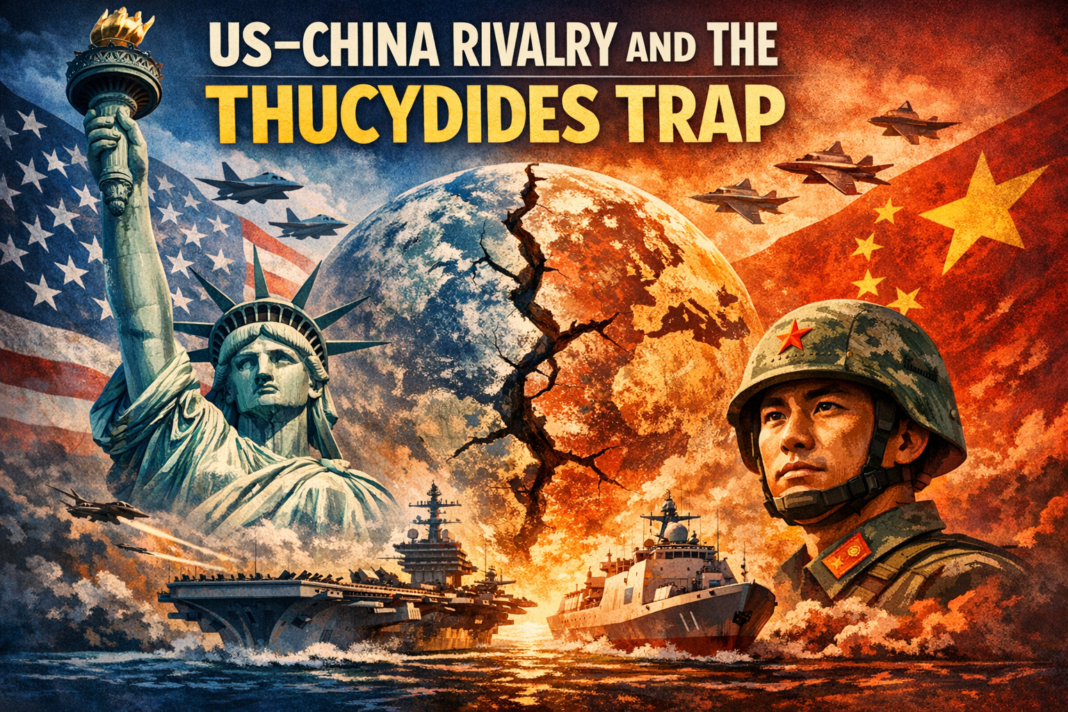
2,400 years ago, when Thucydides wrote that “it was the rise of Athens, and the fear that this inspired in Sparta, that made war inevitable,” he captured a structural dynamic that has haunted great‑power politics ever since. In our time, through his 2017 book “Destined for War”, Harvard scholar Graham Allison has popularised this pattern as the “Thucydides Trap”: the heightened risk of conflict when a rising power threatens to displace an established hegemon. The United States and China now embody the most consequential test of this idea in the 21st century. The crucial question is whether their rivalry must end in confrontation, or whether politics and prudence can override structural pressures.
In ancient Greece, Sparta faced a security dilemma due to the rapid growth of Athens, which unfolded in a world without nuclear weapons or dense economic interdependence. This dynamic is similar to the current US-China rivalry. Allison’s survey of 16 power transitions finds that 12 ended in major war. Critics argue that his taxonomy is selective and underplays agency, institutions and ideology. Still, the metaphor matters, because it shapes how Washington and Beijing interpret each other’s moves – often through a lens of worst‑case assumptions. The danger lies more in self‑fulfilling prophecies, than in an iron law of history.
For four decades after 1945, the international system was structurally bipolar, with the US and Soviet Union locked in global ideological, military and nuclear competition. That long Cold War habituated Washington to a containment playbook: alliance networks, export controls, proxy conflicts and economic pressure to exhaust a rival superpower. With the Soviet collapse in 1991, the US briefly enjoyed unipolar primacy and pursued a twin strategy toward China: deep economic engagement and a cautious hedge. Beijing’s entry into the World Trade Organization in 2001 accelerated its industrial ascent, while US firms offshored manufacturing to exploit China’s scale and low costs. Over time, however, American anxieties about deindustrialisation, technological theft and geopolitical revisionism mounted. Since around 2017, US policy has shifted toward overt strategic competition: tariffs, investment screening, semiconductor export controls, the CHIPS Act, “friend‑shoring” supply chains, and new security groupings like the Quad and AUKUS.
China’s trajectory has been different but equally strategic. Deng Xiaoping’s post‑1978 reforms, followed by Jiang Zemin and Hu Jintao, prioritised growth, stability and integration – summed up in Deng’s injunction to “hide your strength, bide your time.” while leveraging globalisation. Xi Jinping has consolidated this into a more centralised and security‑focused project of “national rejuvenation.” Domestically, he has tightened party control and launched anti‑corruption drives; externally, he has championed the Belt and Road Initiative, military modernisation and a more assertive posture in the Western Pacific. Economically, China has become the world’s largest trading nation in goods. This shift in global trade patterns underpins Beijing’s belief that it can no longer be contained in the way the Soviet Union was.
Both powers enjoy asymmetric strengths the other cannot easily match.
China leads in scale manufacturing and dense supply‑chain integration: its share of global goods trade has risen to around 12-13 percent, surpassing that of the US, and it now ranks among the top three trading partners for well over 100 countries. Through the Belt and Road Initiative it has financed and built ports, railways, power plants and digital networks from Pakistan and Central Asia to Africa and the Middle East, creating structural dependence that translates into geopolitical leverage. Its political system also allows long‑term industrial planning in areas like electric vehicles, renewable energy and high‑speed rail.

By contrast, the United States, retains decisive advantages in frontier innovation, alliances and finance. American firms and labs still dominate leading‑edge semiconductors, foundational artificial intelligence models, aerospace and biotech. Despite losing lustre, the US dollar still remains the primary reserve currency, and US control over global financial infrastructure and high‑end chipmaking tools gives Washington powerful sanction and chokepoint capabilities. Though with increasing disaffection, NATO in Europe and treaty allies like Japan, South Korea and Australia in Asia, still provide strategic depth that China cannot replicate.
Yet both face structural limits: China’s rapidly ageing population, high debt levels and persistent soft‑power deficit constrain its long‑term appeal, while the US struggles with polarised politics, fiscal pressures and a hollowed‑out manufacturing base.
Chinese President Xi Jinping’s psychology is central to the trajectory ahead. Shaped by persecution during the Cultural Revolution and a subsequent rise through the party hierarchy, Xi appears intensely focused on regime survival and ideological discipline. Chinese elites have studied the Soviet collapse closely and concluded that it stemmed from internal decay rather than external pressure. Xi’s answer has been to strengthen the party’s grip, deliver rising living standards, and ensure that neighbours are economically bound to China, so that they will resist US‑led containment. Concurrently, Xi’s nationalism and intolerance of dissent have produced harsher policies in Xinjiang and Hong Kong and a more muscular stance towards Taiwan and in the South China Sea. This combination of insecurity and ambition may increase both – prudence about all‑out war, and risk‑taking in the grey zone.
Seen from Washington, contemporary crises (its own misadventures) – Ukraine, Venezuela, Iran, competition for resources in Latin America and Africa – are all also theatres in a wider contest with China, for global power and influence. In the Gulf, US efforts to isolate Iran intersect with China’s need for secure energy supplies and its expanding trade and infrastructure presence. In Venezuela, and across Latin America and Africa, Washington worries that Chinese finance, infrastructure and resource deals erode its traditional primacy. While these conflicts have local roots, each episode reinforces Beijing’s reading that the US is sharpening tools – sanctions, technology denial, maritime and financial chokepoints – that could later be used to “choke” China strategically.
However, unlike in the US-Soviet Cold War, the US and China are deeply (if unevenly) intertwined. Two‑way trade in goods and services is now over 650 billion dollars annually, even after tariffs and partial “decoupling.” Both sides are trying to “de‑risk”: the US by reshoring or friend‑shoring critical supply chains; China by boosting domestic demand and diversifying markets through the Belt and Road Initiative and partnerships with the Global South. This produces a world of weaponised interdependence rather than clean separation; where market access, standards and choke technologies are leveraged as instruments of statecraft.
The Thucydides Trap is therefore a warning, not an inevitability. Structure matters: a status‑quo superpower and a rising one, each convinced that the other seeks to encircle or overturn it, operating amid nuclear weapons and fragile global networks, inhabit a system prone to crises. Yet outcomes will hinge on leadership choices, domestic resilience and the ability to build geopolitical guardrails – from crisis hotlines and military‑to‑military communication, to narrow deals on climate and financial stability. History suggests that great powers often stumble into conflict when narratives of inevitability go unchallenged. The task for Washington and Beijing is to prove that this time, structural rivalry need not end in tragedy.