



Key Takeaways
- The UAE is facing a natural reality: agriculture in desert conditions is extraordinarily difficult.
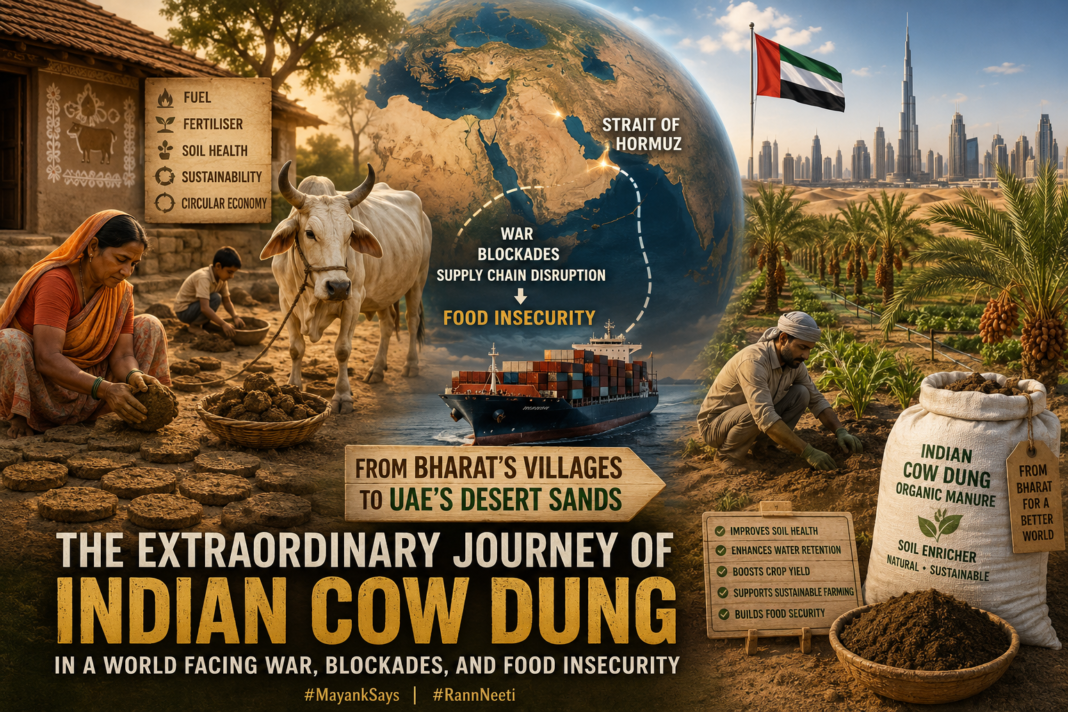
- Indian cow dung is being used to improve soil health in the UAE’s desert agriculture, addressing fertiliser shortages and food insecurity.
- Healthy soil is not merely dirt. It requires organic carbon, microbial life, moisture retention, and balanced nutrient cycles, which Indian cow dung naturally supports.
There was a time when the smell of freshly plastered cow-dung floors was inseparable from life in Bharat’s villages. For millions who grew up in rural homes, cow dung was never considered “waste.” It was part of life itself.
It dried in the sun as fuel cakes outside mud homes. It lined courtyard floors to keep them cool during punishing summers. It nourished fields before every sowing season. It powered chulhas, protected crops, repelled insects, and sustained families long before the modern world discovered fashionable phrases like “organic living,” “circular economy,” or “sustainability.”
Children ran barefoot across village courtyards coated with cow dung and mud. Farmers stored it carefully before the monsoon. Women shaped fuel cakes by hand while speaking of harvests, marriages, and changing seasons.
Nothing was wasted. Everything belonged to a cycle.
The cow nourished the land.
The land nourished the family.
The family protected the cow.
For centuries, this was not ideology. It was civilisation in practice.
Yet as Bharat urbanised and raced toward industrial modernity, many of these practices were quietly abandoned.
Chemical fertilisers replaced organic manure. Concrete replaced mud homes. Traditional wisdom gave way to imported agricultural models.
And gradually, many educated Indians themselves began to feel embarrassed by practices that had sustained their ancestors for generations.
Cow dung became the subject of ridicule. Something “backward.” Something incompatible with modernity.
But history has a curious way of humbling certainty.
Today, something remarkable is happening.
The same cow dung once mocked as primitive is now travelling thousands of kilometres across oceans to nourish the deserts of the UAE.
And in the middle of a world shaken by war, disrupted supply chains, and fears of food insecurity, this story suddenly appears far more important than anyone imagined.
The World Is Discovering the Fragility of Modern Agriculture
The ongoing conflict involving the United States, Israel, and Iran has transformed the strategic geography of West Asia. What began as a military confrontation has rapidly evolved into a global economic and supply-chain crisis.
At the centre of this unfolding turmoil lies one narrow maritime chokepoint: the Strait of Hormuz.
Nearly a fifth of the world’s oil and massive quantities of liquefied natural gas pass through this route. But what many people do not realise is that Hormuz is also critical for the global fertiliser supply chain.
As tensions escalated and shipping disruptions intensified, global fertiliser markets were shaken dramatically. Reports indicate that nearly one-third of global fertiliser trade passes through the Gulf region.
Nitrogen fertilisers such as:
- urea,
- ammonia,
- and other fertiliser feedstocks
depend heavily on Gulf energy infrastructure and natural gas supplies.
The consequences have been immediate.
Global urea prices have surged sharply since the conflict escalated. Shipping disruptions have affected ammonia and sulphur movement. Gas shortages have reduced fertiliser production in several countries.
Analysts now warn that the world may be entering a slow-moving food security crisis triggered not merely by war, but by disrupted access to fertiliser raw materials.
And suddenly, humanity is rediscovering something its industrial arrogance had forgotten:
soil cannot survive on geopolitics alone.
The Desert’s Silent Hunger
The UAE, despite its futuristic skylines and technological sophistication, faces a stubborn natural reality: agriculture in desert conditions is extraordinarily difficult.
Its soil lacks:
- organic richness,
- microbial biodiversity,
- and water retention capacity.
Without fertile soil, food security becomes a strategic vulnerability. This is why Gulf nations have increasingly invested in:
- sustainable agriculture,
- regenerative farming,
- water conservation,
- and desert soil restoration.
And unexpectedly, part of the answer is now coming from Bharat’s villages.
Over the past few years, India has witnessed growing exports of:
- processed cow dung,
- organic manure,
- vermicompost,
- bio-fertilisers,
- and natural soil enhancers.
Trade estimates suggest that between 2023 and 2024, nearly ₹400 crore worth of cow dung and dung-based products were exported from India to Gulf nations including the UAE, Saudi Arabia, and Kuwait.
For many urban Indians, the idea sounds almost surreal. How can something once dismissed as insignificant become part of international trade?
But modern agricultural science explains it very clearly.
Healthy soil is not merely dirt. Healthy soil is a living ecosystem.
It requires:
- organic carbon,
- microbial life,
- moisture retention,
- and balanced nutrient cycles.
Processed cow dung naturally supports many of these ecological needs.
In arid climates like the UAE, organic manure helps sandy soil retain water longer, an enormous advantage in regions where every drop of water carries strategic importance.
Reports suggest that UAE farms, especially date farms, are increasingly using organic soil enhancers imported from Bharat to improve soil fertility and sustainability.
And somewhere in this extraordinary journey lies a poetic irony: while the modern world struggles with fertiliser disruptions caused by war and maritime blockades, Bharat’s ancient rural practices are quietly offering a sustainable alternative.

When War Disrupts Chemistry, Nature Returns
The current Hormuz crisis has exposed a harsh reality about modern agriculture: industrial farming is deeply dependent on geopolitically vulnerable supply chains.
Modern chemical fertilisers rely heavily on:
- natural gas,
- ammonia,
- sulphur,
- phosphate movement,
- and uninterrupted maritime trade.
When war interrupts shipping lanes, agriculture suffers.
The ongoing disruptions around Hormuz have already:
- increased fertiliser prices globally,
- delayed shipments,
- strained food production systems,
- and triggered concerns about future crop yields.
In many ways, this conflict is forcing the world to confront a difficult truth: food security is inseparable from ecological resilience.
And that is precisely why traditional organic systems are regaining importance.
Cow dung may not fully replace industrial fertilisers overnight. But it represents something increasingly valuable: local resilience.
Unlike synthetic fertilisers dependent on global shipping routes, organic manure emerges from decentralised agricultural ecosystems. It does not require geopolitical stability to exist.
It requires sustainable rural systems.
That distinction suddenly matters in a world where chokepoints like Hormuz can disrupt entire global supply chains overnight.
The Forgotten Wisdom of Villages
Perhaps the most emotional part of this story is what it says about memory. For generations, Indian villages understood sustainability instinctively. The cow was not merely an animal. It was part of a complete ecological and economic cycle.
Milk nourished families. Dung fertilised fields. Dung cakes became cooking fuel. Agriculture, livestock, and livelihood remained interconnected.
Nothing existed in isolation.
Yet industrial modernity gradually dismissed such systems as outdated.
Chemical-heavy agriculture promised speed and scale. But over time, it also produced:
- declining soil fertility,
- groundwater contamination,
- ecological imbalance,
- and long-term sustainability concerns.
Now, climate anxiety and global supply disruptions are forcing humanity to rethink many assumptions. The modern world increasingly speaks the language of:
- regenerative agriculture,
- biodiversity,
- circular economies,
- and soil restoration.
Ironically, Bharat’s villages had been quietly practising many of these principles for centuries.
A Different Conversation About the Cow
For years, discussions around the cow in Bharat became trapped in noise:
- political confrontation,
- ideological conflict,
- television shouting matches,
- and social-media polarisation.
But the UAE soil story changes the conversation entirely. Now the discussion is no longer about slogans. It is about:
- sustainability,
- food security,
- ecology,
- and peaceful coexistence with nature.
This is where the vision articulated by Gauvansh Akhara acquires a deeper context.
The Akhara has attempted to move the discourse beyond symbolism and toward a broader civilisational understanding of the cow as:
- a symbol of ecological balance,
- sustainability,
- coexistence,
- compassion,
- and rural resilience.
Its campaign to project the cow as the “Ambassador of World Peace” often surprises people initially. But in a world where wars are disrupting fertiliser supplies, threatening food systems, and exposing the fragility of industrial agriculture, the symbolism suddenly feels less abstract.
What is peace if food systems collapse? What is progress if soil dies? What is development if agriculture becomes hostage to conflict zones and maritime chokepoints?
A creature associated historically with:
- nourishment,
- agriculture,
- sustainability,
- and non-exploitative living
naturally becomes a symbol of ecological peace.
The cow here is not merely a religious figure. It becomes a metaphor for sustainable civilisation.
Bringing the Story to Light
Importantly, this fascinating dimension entered wider public conversation through the efforts of Ratna Chaudhuri, who helped draw my attention to the extraordinary reality that Indian cow dung products were increasingly helping nourish lands beyond Bharat’s borders.
At a time when public discourse often reduces complex issues into shallow binaries, bringing this story forward helped reopen an important question: Can ancient traditions contain solutions for modern global crises?
Her observations encouraged me to look beyond stereotypes and rediscover the ecological intelligence embedded within Bharat’s rural systems.
And perhaps that is the larger lesson hidden inside this story.
Civilisations survive not merely because they possess power, but because they preserve wisdom.
Today, as wars disrupt fertiliser supply chains, as maritime chokepoints threaten food systems, and as industrial agriculture struggles with sustainability, the forgotten wisdom of Bharat’s villages is quietly re-entering the global conversation.
Not through conquest. Not through force. But through relevance.
And somewhere in the deserts of the UAE, nourished by the ancient ecological memory of Bharat, that forgotten wisdom is beginning to bloom once again.
#MayankSays
#RannNeet