


Key Takeaways
- Swami Vivekananda’s teachings inspired one person to learn about Sanatana Dharma and India’s civilisational depth.
- Vivekananda’s philosophy is a call for civilisational confidence and a reminder that spirituality is not confined to places of worship.
- Hinduism and spirituality are not mutually exclusive, and Vivekananda’s teachings can help you understand and appreciate the timeless Hindu philosophy.
Many people have asked me a question over the years: How can you have such deep admiration and respect for Sanatana Dharma while remaining firmly rooted in your own religious beliefs?
My answer is simple. The inspiration came from one extraordinary man whose life transcended religious boundaries and whose message continues to illuminate humanity more than a century after his passing—Swami Vivekananda.
My journey to understanding Sanatana Dharma began with the life and teachings of Swami Vivekananda. He presented Hindu philosophy not as something confined to rituals or religious identity, but as a vast and timeless framework for understanding humanity, spirituality, and the pursuit of truth.
I spent my younger years in Dubai, growing up in a multicultural environment where people of different nationalities, religions, and traditions lived and worked together. While I was proud of my Indian roots, my understanding of India’s civilisational depth was limited to what I saw during family visits and through cultural traditions at home.
It was only when I moved to India as an adult that I truly began to engage with the country’s intellectual, spiritual, and cultural heritage. Living in India exposed me to conversations, ideas, and philosophies that went far beyond the headlines and stereotypes. Among the many influences that shaped my understanding, none was more profound than the life and teachings of Swami Vivekananda.
Vivekananda became my gateway to understanding Sanatana Dharma. He presented Hindu philosophy not as something confined to rituals or religious identity, but as a vast and timeless framework for understanding humanity, spirituality, and the pursuit of truth. Through his writings and speeches, I discovered a civilisation that had spent thousands of years asking some of the deepest questions about existence, consciousness, duty, and the divine.
What impressed me most was that Vivekananda never demanded conformity. He encouraged inquiry. He invited people to seek truth fearlessly. As someone who remains deeply committed to my own religious beliefs, I found in Vivekananda’s teachings a refreshing confidence that respected faith while embracing dialogue. He demonstrated that one can be deeply rooted in one’s own tradition while appreciating the wisdom found in others.
That realisation transformed my perspective. My admiration for Sanatana Dharma did not emerge from politics or social trends. It emerged from a sincere desire to understand a civilisation through one of its greatest modern interpreters – Swami Vivekananda.
What struck me first about Vivekananda was his extraordinary confidence in India. At a time when India was under colonial rule and many Indians had begun to doubt their own heritage, Vivekananda stood before the world and declared that India had a spiritual mission for humanity.
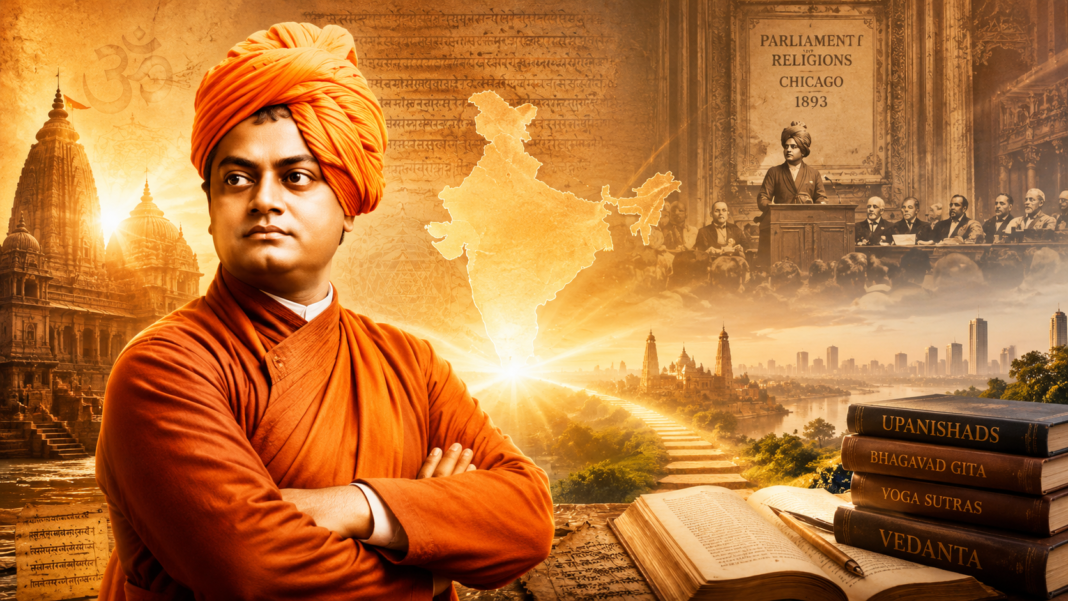
His famous address at the Parliament of Religions in Chicago in 1893 was not merely a speech. It was a civilisational awakening. He spoke not with arrogance but with conviction. He did not seek to prove the superiority of one faith over another. Instead, he presented the timeless Hindu philosophy that truth is universal and that different paths can lead to the same divine destination.
For someone like me, who believes deeply in his own faith, this message was transformative.
Vivekananda taught me that respecting another religion does not weaken one’s own beliefs. On the contrary, genuine faith gives us the confidence to appreciate the spiritual journeys of others. In a world increasingly divided by identity politics and religious polarisation, this lesson remains as relevant today as it was in 1893.
As I began reading more of his writings and speeches, I discovered that Sanatana Dharma was far more than rituals and customs. It was a vast ocean of philosophical inquiry.
Vivekananda introduced me to concepts that were both intellectually stimulating and spiritually profound. The idea that divinity exists within every human being. The belief that service to humanity is service to God. The understanding that spirituality is not confined to places of worship but must manifest itself in action, compassion, and character.
These teachings resonated deeply with me.
One of Vivekananda’s most powerful messages was his call for strength. He repeatedly emphasised that weakness is the greatest sin. He urged Indians to develop physical strength, mental courage, and spiritual confidence.
This was not merely a religious teaching. It was a philosophy for nation-building.
Vivekananda understood that a civilisation cannot thrive if its people lose confidence in themselves. He challenged Indians to stand tall, embrace their heritage, and contribute meaningfully to the world.
As a journalist and public commentator, I have often reflected on this message. India’s rise in the twenty-first century cannot be sustained solely through economic growth or military power. It must also be rooted in civilisational confidence. We must know who we are before we can determine where we want to go.
Vivekananda’s teachings encouraged me to study India’s civilisational foundations more deeply. Through him, I explored the Upanishads, Vedanta, and the broader philosophical traditions that form the backbone of Sanatana Dharma.
What fascinated me was the remarkable intellectual freedom embedded within these traditions. Questions were encouraged. Debate was welcomed. Truth was pursued through inquiry rather than imposed through coercion.
In many ways, Sanatana Dharma presented itself not merely as a religion but as a continuous search for truth.
This openness appealed greatly to me.
Another aspect of Vivekananda’s teachings that left a lasting impression was his emphasis on universal brotherhood.

Long before globalisation became a buzzword, Vivekananda envisioned a world where nations and religions would coexist through mutual respect. He believed that humanity’s future depended not on uniformity but on harmony.
This principle helped shape my understanding of interfaith relations.
I learned that appreciating Sanatana Dharma did not require abandoning my own faith. It required recognising the divine wisdom that exists across different traditions. It required humility – the humility to acknowledge that no single community possesses a monopoly on truth, compassion, or spiritual insight.
Vivekananda embodied this humility despite his towering intellect.
His patriotism was equally inspiring.
Unlike narrow forms of nationalism that seek division, Vivekananda’s nationalism was rooted in service. He wanted India to rise not for domination but for contribution. He envisioned an India that would share its spiritual heritage with the world while embracing modern science, education, and progress.
This balance between tradition and modernity remains one of the most important lessons I have learned from him.
Too often, societies fall into the trap of choosing between the past and the future. Vivekananda rejected this false choice. He believed India could honour its ancient wisdom while embracing innovation and change.
That message is particularly relevant today as India navigates the opportunities and challenges of the twenty-first century.
For me personally, Swami Vivekananda became a bridge.
He bridged faith and reason.
He bridged spirituality and action.
He bridged tradition and modernity.
Most importantly, he bridged communities that often view each other through suspicion rather than understanding.
Whenever I encounter individuals who question how I can admire Sanatana Dharma while remaining committed to my own religious beliefs, I return to Vivekananda’s teachings.
He taught me that truth has nothing to fear from dialogue.
He taught me that respect is not surrender.
He taught me that learning from another tradition enriches one’s own spiritual journey.
And he taught me that India’s greatest strength lies in its ability to accommodate diversity without losing its civilisational identity.
Today, my respect for Sanatana Dharma is not based on political considerations or social convenience. It is rooted in an intellectual and spiritual appreciation of a civilisation that has contributed immensely to humanity’s understanding of life, consciousness, and the divine.
For that journey of discovery, I remain deeply grateful to Swami Vivekananda.
His life demonstrated that true spirituality does not divide people into competing camps. It elevates them. It inspires them to seek truth, serve humanity, and build bridges of understanding.
In a world increasingly consumed by conflict and division, Swami Vivekananda’s message remains a beacon of hope.
And for me, it remains the reason why learning about Sanatana Dharma became not merely an exercise in curiosity, but a journey of profound respect, understanding, and inspiration.