

Key Takeaways
- Digital distraction in passenger transport is a moral issue that endangers human life and violates passenger dignity.
- Distracted driving can have grave consequences, including serious injury, permanent disability, and loss of life.
- Drivers have a professional responsibility to prioritize passenger safety and dignity over personal entertainment or gratification.
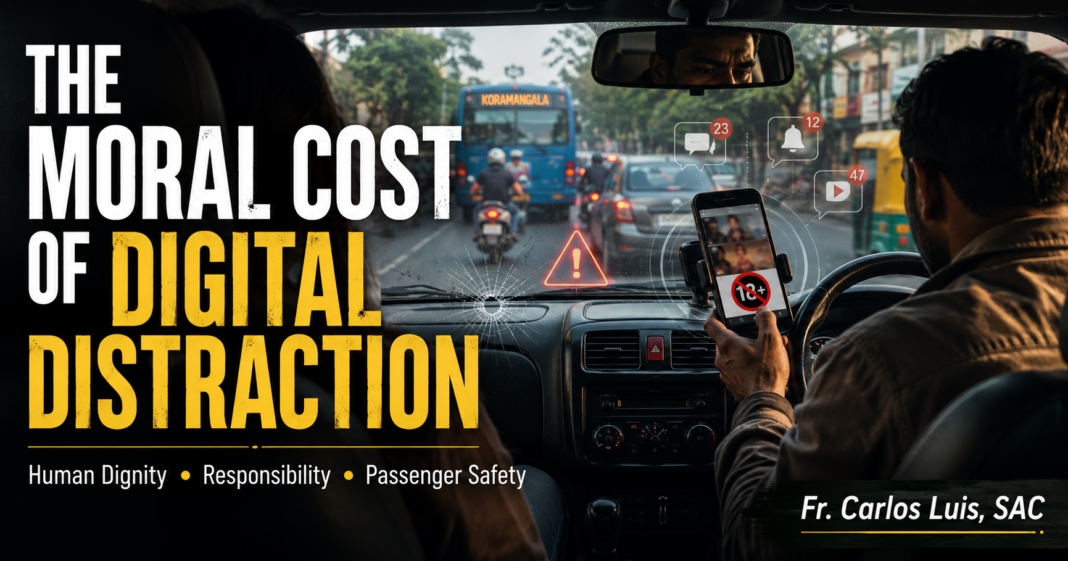
Trust is the foundation of every journey. When a passenger enters a vehicle, they entrust their safety to a stranger. However, many passengers have encountered drivers who distractedly talk on the phone, respond to messages, or scroll through social media while driving. Recently, on August 3, 2026, in Model Town, New Delhi, a driver was found viewing pornographic content while transporting passengers. This behavior is not only unprofessional but also a profound ethical failure that endangers human life and violates the dignity of passengers. Such behaviour is not merely unprofessional. It represents a profound ethical failure that endangers human life, violates the dignity of passengers, and raises serious questions about the moral responsibilities of those entrusted with public safety.
Personally, I have observed many times, especially in Bengaluru, drivers engaging in prolonged conversations with friends or family while driving. On several occasions, I have noticed drivers repeatedly glancing at their phones to check notifications or browse social media or watch explicit content. The experience immediately generated anxiety and discomfort. It was not simply because the driver was distracted, but because such behaviour fundamentally altered the atmosphere within the vehicle. The passenger is confined in an enclosed space, dependent upon the driver for safety and unable to leave until the journey ends. What should have been an ordinary ride became an unsettling experience marked by vulnerability and fear.
These examples differ in degree, but they reveal a common ethical problem: distraction. Driving demands sustained concentration, sound judgement, and constant awareness of changing road conditions, more so when Bengaluru offers modifications on an everyday basis. Every glance at a mobile phone, every unnecessary conversation that diverts attention, and every moment spent consuming digital entertainment diminishes the driver’s ability to respond to unexpected situations. Distracted driving is therefore not simply a lapse in concentration; it is an ethical failure because it knowingly places innocent lives at unnecessary risk.
Watching pornography while driving, however, introduces an even deeper moral concern. Pornography is not ethically neutral entertainment that merely becomes problematic when viewed behind the wheel. It represents a distortion of authentic human sexuality by reducing persons to objects of consumption and gratification. Numerous ethical, psychological, and theological studies have highlighted how habitual consumption of pornography contributes to the objectification of persons, weakens interpersonal relationships, fosters unrealistic perceptions of intimacy, and diminishes respect for human dignity. The moral problem therefore exists independently of whether one is driving, working, or alone in private.
When such material is viewed while transporting passengers, the ethical violation becomes even more serious. The driver not only chooses content that undermines respect for human dignity but simultaneously neglects the solemn responsibility of safeguarding another person’s life. One moral failure compounds another. The issue is therefore not pornography instead of distracted driving; rather, pornography while driving represents the convergence of personal moral disorder and professional negligence.
Professional ethics requires that individuals distinguish between personal freedom and public responsibility. A driver certainly possesses personal autonomy outside working hours, yet professional responsibilities impose moral limits on personal behaviour while providing a service. Every profession establishes expectations that preserve public trust. Airline pilots, surgeons, teachers, police officers, and commercial drivers are all expected to maintain standards of conduct appropriate to the responsibilities they bear. Ride-hailing drivers occupy a similar position of trust. Their first obligation is not entertainment, conversation, or personal gratification but the safety, comfort, and dignity of every passenger.
The moral gravity of distracted driving becomes even more apparent when examined through different ethical perspectives. The consequences of a driver’s actions extend far beyond the individual behind the wheel. Engaging with social media, watching reels, carrying on prolonged personal conversations, or consuming pornographic content while driving places numerous lives at risk for the sake of momentary personal gratification. The potential outcomes include serious injury, permanent disability, psychological trauma, and even loss of life. No fleeting diversion or personal entertainment can morally justify exposing others to such grave and preventable risks.

The issue is equally compelling when viewed from the perspective of duty and responsibility. The moment a driver accepts a passenger, an implicit covenant of trust is established. Passengers reasonably expect competence, vigilance, and responsible care throughout the journey. This obligation is not diminished by boredom, curiosity, fatigue, or the temptation of digital distractions. Allowing one’s attention to wander from the road constitutes a breach of professional responsibility and a betrayal of the confidence freely placed in the driver.
Attention must also be given to the formation of character rather than merely isolated actions. Professional excellence is not measured solely by technical driving skills but by the virtues that shape one’s conduct. Prudence, temperance, self-discipline, integrity, and responsibility are indispensable qualities for anyone entrusted with another person’s safety. A driver who habitually chooses personal entertainment over attentive driving reveals not only poor judgement but also deficiencies in moral character. Virtuous habits are cultivated through countless ordinary decisions, and every choice to remain focused on the road strengthens the character expected of a true professional.
The discussion acquires even greater depth when we know that every human person possesses an inherent dignity because each is created in the image and likeness of God. Pornography fundamentally contradicts this dignity by reducing persons to objects of gratification rather than recognising them as persons worthy of reverence, respect, and love. This moral disorder exists irrespective of the circumstances in which pornography is consumed. When it is viewed while transporting passengers, however, the offence becomes even more serious. It combines the objectification of the human person with reckless disregard for the lives entrusted to the driver’s care. Such conduct stands in direct opposition to the commandment to love one’s neighbour, which calls every individual to protect life, uphold human dignity, and seek the common good through responsible action.
The broader digital culture also deserves careful reflection. Smartphones have transformed communication, education, and entertainment, yet they have simultaneously fostered habits of constant connectivity and perpetual distraction. Many individuals now find it difficult to disconnect even for a brief period. Notifications, social media platforms, and endless streams of digital content compete relentlessly for attention. Ethical digital citizenship therefore demands more than technological competence; it requires the moral discipline to ensure that technology remains a servant of humanity rather than its master. The inability to set aside a mobile phone while entrusted with another person’s life reveals not simply poor judgement but a failure of self-mastery.
Responsibility does not rest solely with individual drivers. Ride-hailing companies also bear an important ethical obligation to cultivate a culture of professionalism and accountability. Platforms can strengthen safety by implementing safeguards that discourage unnecessary phone usage during active journeys while encouraging passengers to report behaviour that compromises their wellbeing.
Ultimately, this discussion extends far beyond one disturbing incident or the isolated failures of a few individuals. It invites a broader reflection on the kind of society we are becoming when entertainment consistently triumphs over responsibility and immediate gratification eclipses concern for others. Every journey places human lives in the driver’s hands. Professional competence begins with technical skill, but it reaches its fullest expression in ethical integrity. Keeping one’s eyes on the road is therefore not merely a legal obligation but a profound moral responsibility rooted in respect for human life, reverence for human dignity, and the conviction that no momentary pleasure is ever worth compromising another person’s safety.