
Key Takeaways
- US Representative Riley Moore’s criticism of India’s FCRA amendments has sparked an international debate regarding sovereign legislative rights.
- Indian NGOs received over ₹22,963 crore in foreign funding during the financial year ending March 31, 2025, primarily from the US.
- High-profile organizations like Compassion International and Believers Eastern Church have faced major regulatory actions due to compliance issues.
- The Indian government maintains that regulating external financial flows is necessary to protect national security and sovereignty.
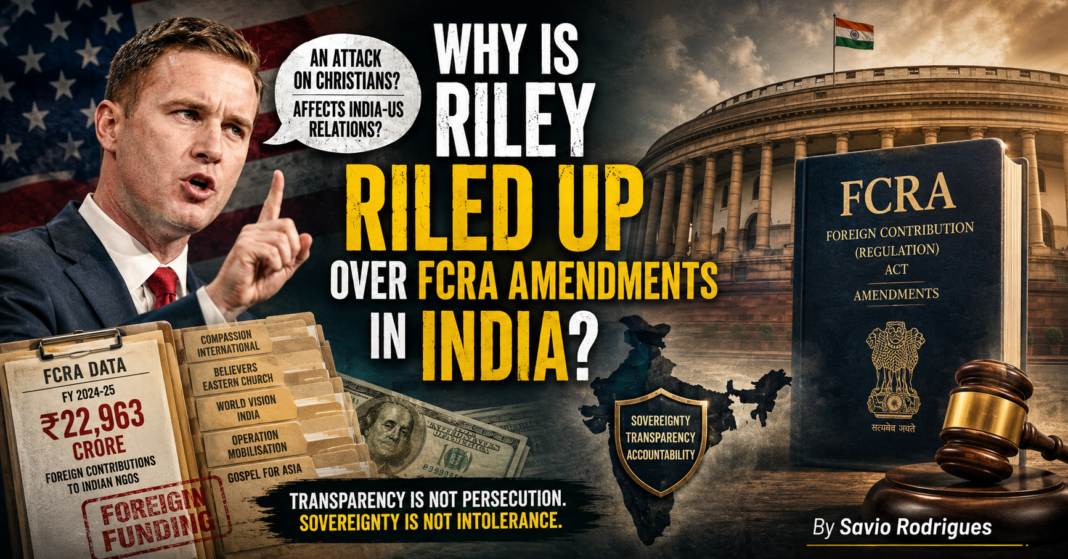
When U.S. Representative Riley Moore publicly criticised India’s proposed amendments to the Foreign Contribution (Regulation) Act (FCRA), describing them as an attack on Christians and even suggesting they could affect India-US relations, he elevated what is essentially a sovereign legislative matter into an international political debate.
As an Indian, I find myself asking a simple question: Why is Riley so riled up over India’s FCRA amendments?
India’s Parliament has every constitutional and sovereign right to determine how foreign money enters the country and how it is utilised. Every mature democracy regulates foreign influence. The United States has stringent laws governing foreign lobbying, sanctions, campaign finance and national security. India should be afforded the same sovereign right without external political pressure.
What makes Representative Moore’s intervention particularly interesting is that he represents West Virginia, a state with a significant Christian nonprofit and philanthropic ecosystem. Publicly available IRS filings compiled show thousands of nonprofits operating in the state, including hundreds of religious organisations, churches, ministries and charitable institutions. These organisations contribute to humanitarian, educational and religious work in the United States and abroad. Mentioning this ecosystem is not to imply that these organisations have acted unlawfully or funded activities in India, but to illustrate the scale of faith-based philanthropy associated with the state.
The timing of Representative Moore’s criticism also coincides with a renewed debate over foreign funding in India. During the financial year ending March 31, 2025, Indian NGOs received ₹22,963 crore in foreign contributions. The United States has historically been among the largest source countries for foreign donations received by Indian NGOs, underscoring why Parliament continues to examine the adequacy of the FCRA framework.
Over the years, while investigating foreign funding received by Indian NGOs, I had the opportunity to interact with intelligence sources closely monitoring overseas financial flows into India. According to intelligence sources, approximately 75% of the foreign funding reaching Christian NGOs in India originated from West Virginia. This assessment helped shape my understanding of the foreign funding ecosystem. It is precisely for this reason that U.S. Representative Riley Moore’s intervention immediately caught my attention and prompted me to examine it through a much broader geopolitical and strategic lens.
India’s concerns over foreign funding are not hypothetical. They have emerged from decades of regulatory experience.
One of the most widely discussed examples was Compassion International, which reportedly transferred approximately US$45 million annually into India through its child sponsorship programmes before restrictions under the FCRA eventually led to its exit from India in 2017. Indian authorities raised concerns regarding compliance and alleged links between funding and religious conversions, allegations the organisation denied. Regardless of where one stands on that dispute, the case demonstrated how foreign charitable funding can become a matter of national policy and diplomacy.
Another significant case involved Believers Eastern Church and organisations associated with K.P. Yohannan. In 2017, the Ministry of Home Affairs suspended the FCRA licences of the church and associated organisations.
In 2020, the Income Tax Department conducted searches at multiple premises linked to the church. Investigators examined foreign contributions and alleged financial routing irregularities, which the church denies as legal proceedings continue.
Similarly, organisations such as World Vision India, Church’s Auxiliary for Social Action (CASA), Evangelical Fellowship of India, and several affiliates linked to Gospel for Asia have, at different times, faced FCRA-related regulatory action, cancellation, suspension or non-renewal of registrations.
Operation Mobilisation (OM India) is under investigation by the Enforcement Directorate over alleged diversion of approximately ₹296 crore in foreign and domestic donations meant for the education and welfare of marginalised children. Separately, The Timothy Initiative (TTI) has been accused by the ED of allegedly funnelling over ₹92.55 crore into India through more than 1,000 foreign debit cards, bypassing FCRA and FEMA provisions. Both matters remain under investigation, and the allegations are yet to be adjudicated in court.
Historical FCRA data also illustrates the scale of foreign funding received by several Christian organisations. According to the Ministry of Home Affairs’ FCRA annual reports, World Vision India, Believers Church India, Gospel for Asia, Compassion East India, Operation Mobilisation India, and the Indian Society of the Church of Jesus Christ of Latter-day Saints were among the largest recipients of foreign contributions in earlier years.
Taken together, these examples illustrate why India views the FCRA not as legislation targeting a particular religion but as a law governing foreign financial influence.

Critics argue that tighter regulation affects civil society. Supporters argue that stronger regulation protects sovereignty. Both views deserve consideration.
However, the first responsibility of any elected government is to safeguard the interests of its own nation.
The FCRA is fundamentally a transparency law. It requires organisations receiving foreign money to disclose its source, account for its utilisation and remain compliant with Indian law. These are principles that would not appear unusual in most democratic countries.
Representative Moore is fully entitled to express his opinion. Equally, India is fully entitled to disagree.
What concerns me is not criticism itself but the suggestion that India’s sovereign legislative decisions should become a point of bilateral pressure.
India does not tell the United States how to regulate foreign lobbying, foreign political donations or overseas influence campaigns. It should expect the same respect when framing legislation governing foreign contributions within its own borders.
For me, the debate is therefore larger than Representative Riley Moore.
It is about whether India should have the confidence to regulate foreign funding without being accused of attacking democracy or religious freedom.
My answer is yes.
Transparency is not persecution. Accountability is not discrimination. Sovereignty is not intolerance.
The FCRA is ultimately about ensuring that foreign money entering India remains transparent, accountable and consistent with India’s constitutional framework. Parliament has every right to strengthen that framework whenever it believes circumstances require it.
That is why I believe the more important question is not whether India should amend the FCRA.
The more important question is this:
Why is Riley so riled up over India’s sovereign decision to do so?