


Key Takeaways
- FCRA is a national security safeguard that regulates foreign donations and ensures transparency in funding.
- FCRA protects India’s sovereignty and national security by preventing foreign influence.
- The implications of FCRA are far-reaching, including ensuring transparency in foreign funding and maintaining national security.
As I watch the political developments unfolding in India, I cannot help but ask a question that, in my opinion, deserves far more attention than it currently receives: Is the real battle in India about the Foreign Contribution (Regulation) Act (FCRA)?
Many people view the current unrest through the prism of domestic politics. I see another dimension. I see a pattern that reminds me of developments in Bangladesh and Nepal, where domestic political events unfolded against a backdrop of intense geopolitical competition.
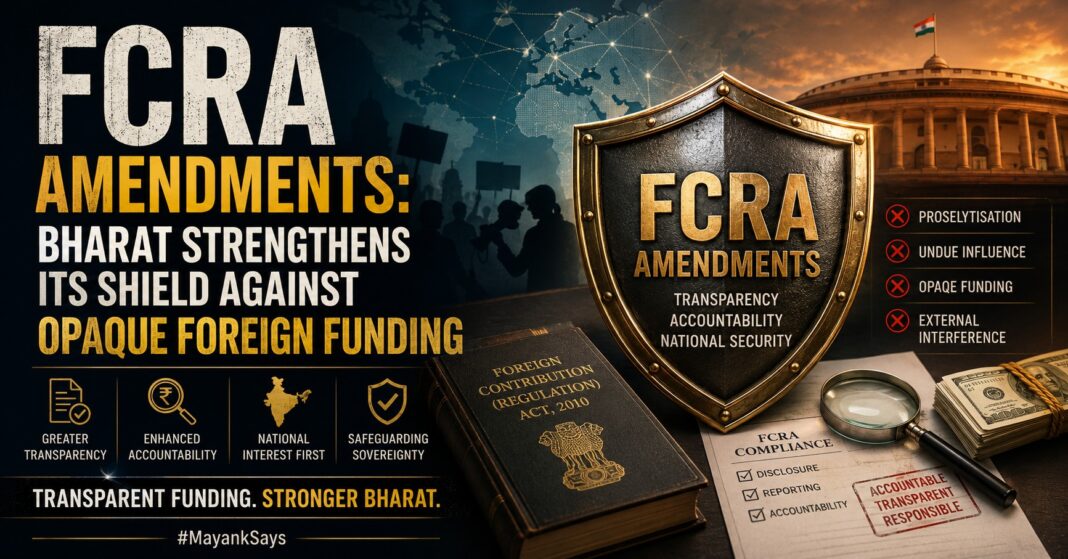
The FCRA is not merely a law regulating foreign donations. It is one of India’s most important national security safeguards. Its purpose is to ensure that foreign money entering India is transparent, accountable and does not compromise the country’s sovereignty or democratic institutions.
Every sovereign nation has the right to know who is funding organisations operating within its borders, for what purpose those funds are being used, and whether those funds are influencing public policy, elections, political mobilisation or national discourse. That is precisely why I believe FCRA has become strategically important.
Over the last several years, India has tightened FCRA compliance. Thousands of registrations have either expired, been cancelled or not renewed because organisations failed to comply with statutory requirements or regulatory standards. Supporters argue these actions strengthen transparency and protect India’s sovereignty. Critics argue they have constrained parts of civil society. Whatever one’s position, there is no denying that FCRA has become one of the most consequential policy issues relating to foreign influence in India.
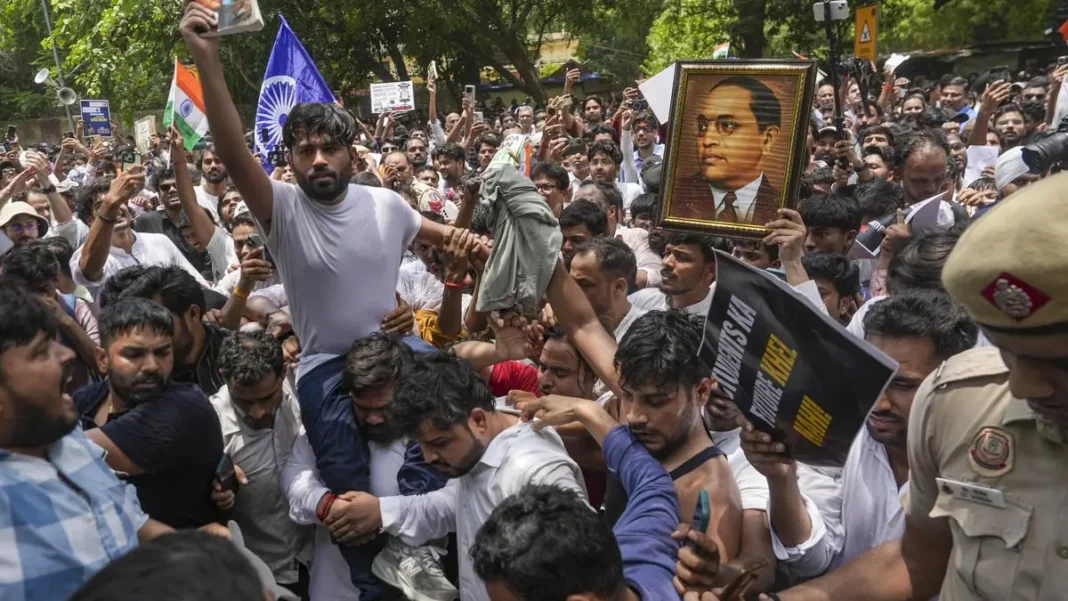
The ongoing protests in New Delhi reinforce why I believe FCRA deserves far greater attention than it is receiving. Every citizen has the constitutional right to peaceful protest, and no democracy can thrive without dissent. However, when protests escalate into confrontation, violence, attacks on police personnel, or organised attempts to paralyse the functioning of the national capital, it is equally legitimate to ask whether the issue extends beyond the stated grievances. My concern is not with students exercising their democratic rights, but with the possibility that genuine public sentiment can be amplified, redirected or exploited by larger political or geopolitical interests. This is where I see parallels with developments in Bangladesh and Nepal. In all three cases, domestic issues became the focal point of mobilisation, while broader questions about foreign influence, information campaigns and strategic geopolitical interests remained largely absent from public debate.
One reason I find this pattern compelling is the sequence of events in neighbouring countries. In Bangladesh, former Prime Minister Sheikh Hasina publicly alleged that a “white man” had proposed the creation of a Christian state carved from parts of Bangladesh, Myanmar and India’s Northeast. Those remarks remain politically contested. Shortly afterwards, Bangladesh descended into major political unrest that eventually resulted in her removal from power. I do not present these events as proof of causation. I present them because they form part of the pattern that has shaped my own assessment.
Nepal presents another example. For years, the country has been an arena of geopolitical competition involving India, China, Western governments and international organisations. Constitutional debates, political transitions, foreign-funded development programmes and diplomatic pressures have repeatedly fuelled domestic debates over external influence. Whether one agrees with those concerns or not, Nepal demonstrates how geopolitical competition can intersect with internal politics in ways that are often visible only in hindsight.

Bangladesh, Nepal, and India share common patterns. Domestic issues become catalysts for public mobilisation, international narratives amplify the political discourse, and foreign policy and sovereignty debates take a backseat. These similarities do not, by themselves, establish coordination. They are, however, the reason I believe the pattern deserves careful scrutiny rather than outright dismissal.
History has shown that major powers have often sought to advance their interests beyond their borders through diplomacy, economic leverage, development assistance, media engagement, intelligence activities and strategic partnerships. India would not be unique if it attracted such attention as it continues to rise as a major global power. That reality makes transparency in foreign funding all the more important.
This is why I believe FCRA sits at the centre of the larger debate. It is not merely about compliance paperwork or NGO regulation. It is about ensuring that foreign financial influence, where it exists, is transparent and accountable. A sovereign democracy has both the right and the responsibility to know who is funding organisations that participate in shaping public discourse.
The scale of foreign funding entering India’s non-governmental sector is substantial. Official Ministry of Home Affairs data shows that registered organisations received between approximately ₹16,000 crore and ₹20,000 crore annually in foreign contributions during recent years, depending on the reporting methodology. These funds flow into religious, educational, social, cultural and economic development programmes. There is nothing inherently improper about foreign funding that complies with Indian law. The question is one of transparency and accountability. Every sovereign nation has a legitimate interest in knowing who is funding organisations within its borders, for what purposes, and whether such funding has the potential to influence public policy, political mobilisation or national discourse. That is precisely why the FCRA has become such a strategically significant piece of legislation.
One reason FCRA remains politically significant is the Government’s increasing concern that foreign contributions should not be diverted for activities beyond their declared charitable purposes. The Ministry of Home Affairs has made it clear that NGOs found to be involved in induced or forceful religious conversions, proselytisation affecting social or religious harmony, or the diversion of foreign funds for undesirable activities face cancellation of their FCRA registration. In recent years, the government cancelled or declined to renew the FCRA registrations of organisations such as the Evangelical Fellowship of India, Church’s Auxiliary for Social Action (CASA), CNI Synodical Board of Social Service, Indo-Global Social Service Society (IGSSS) and the Voluntary Health Association of India over alleged violations of the Act. Earlier, Compassion International ceased its India funding operations after FCRA-related restrictions, while World Vision India has also faced regulatory scrutiny under the FCRA framework. In addition, the Government informed Parliament that complaints alleging inducement-based religious conversions had been received against several FCRA-registered organisations in Andhra Pradesh, including Harvest India, India Rural Evangelical Fellowship, Love-n-Care Ministries and Oikonomas Ministries, among others. These examples do not establish guilt in every case, nor should they be interpreted as proof that all foreign-funded NGOs misuse foreign contributions. They do, however, illustrate why successive governments have viewed transparency, accountability and strict enforcement of the FCRA as matters of national importance rather than mere regulatory compliance.
None of this diminishes the constitutional right to peaceful protest. Genuine grievances deserve to be heard and addressed. Nor do I suggest that every protest or every protester is motivated by anything other than sincere concern. My argument is different. I believe democratic societies must also remain alert to the possibility that genuine public movements can be amplified or exploited by larger geopolitical interests.
Some people may disagree with my conclusions. Some will view the developments in Bangladesh, Nepal and India as entirely separate events driven by domestic politics. Others, like me, see similarities that warrant deeper examination. Intelligence analysis often begins by identifying recurring patterns before drawing conclusions. This article reflects my assessment of the pattern I believe is emerging.
Whether history ultimately proves my assessment right or wrong remains to be seen. But I believe India should continue to strengthen transparency in foreign funding, rigorously enforce the FCRA, and remain vigilant against any attempt – whether domestic or external – to influence its democratic institutions in ways that undermine its sovereignty. For me, that is why FCRA is the real battlefield.