
Key Takeaways
- The strategic landscape of Syria is undergoing a profound transformation as Türkiye consolidates influence from the north and Israel seeks to preserve strategic freedom of action from the south.
- Türkiye’s expanding military footprint in Syria is a key factor in the emerging military contest, with the country involved in rebuilding Syria’s military infrastructure.
- Israel’s northern red line refers to the country’s doctrine of pre-emption through military denial, aimed at preventing potentially threatening capabilities from becoming established in Syria before they mature.
The strategic landscape of Syria is undergoing another profound transformation. More than a decade of civil war produced overlapping Russian, Iranian, Turkish, American and Israeli spheres of influence. But the post-Assad order is creating a substantially different equation: Türkiye is consolidating influence from the north while Israel is determined to preserve strategic freedom of action from the south.
The result is an emerging Türkiye–Syria–Israel strategic triangle whose consequences could extend far beyond Syria.
Türkiye’s Expanding Military Footprint
Türkiye is hardly a newcomer to Syria. Turkish forces have operated across northern Syria for years, establishing positions and influence stretching through Afrin, Azaz, al-Bab, Jarabulus and Idlib, as well as areas farther east along the Turkish-Syrian frontier.
Originally, Ankara’s objectives centred primarily on border security, countering Kurdish armed groups that Türkiye associates with the PKK, managing instability emanating from Syria and supporting Syrian opposition formations.
The strategic environment has subsequently changed.
Following the collapse of Bashar al-Assad’s government, Türkiye has developed close political and defence relations with the new Syrian authorities led by President Ahmed al-Sharaa. Turkish involvement therefore has the potential to evolve from maintaining a northern Syrian security belt into something much larger: helping reconstruct Syria’s conventional military capabilities.
Training, equipment, military infrastructure, radar coverage and eventually air-defence capabilities could fundamentally change the military balance inside Syria.
For Israel, this presents an entirely different challenge.
Abu al-Duhur: The Emerging Flashpoint
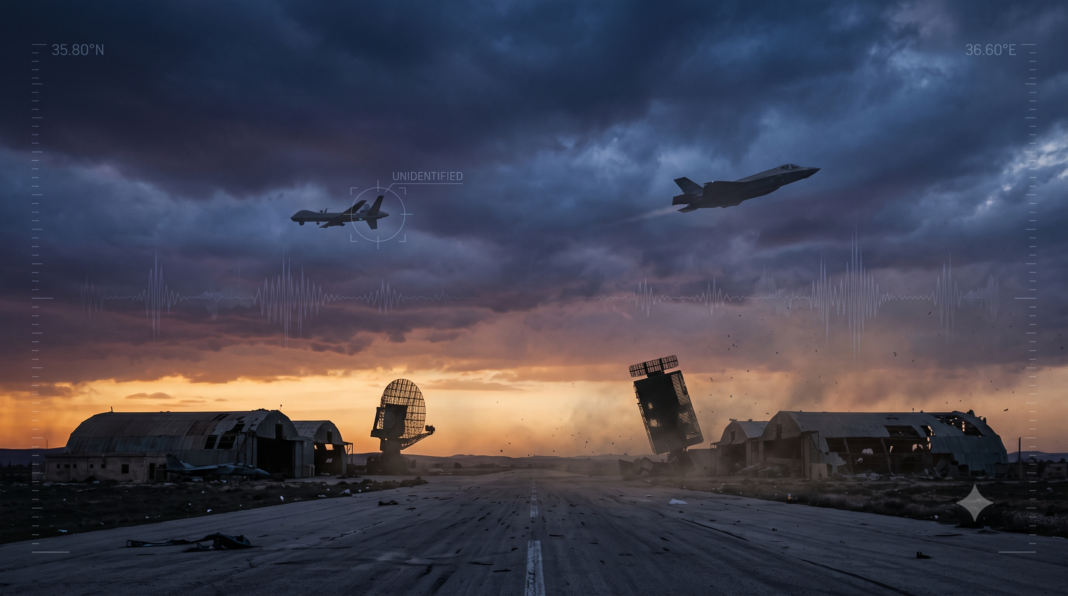
The most important symbol of this changing equation is Abu al-Duhur airbase in Idlib province.
On 18 August 2026, Israel struck the airbase after reports that a Turkish delegation had visited the facility. The attack damaged infrastructure at the base and immediately raised questions about Israel’s assessment of Türkiye’s intentions.
Israeli concerns centred on the possibility that Turkish forces or military capabilities could eventually be positioned there.
Türkiye and Syria have denied that a permanent Turkish military base was being established at Abu al-Duhur. Damascus has maintained that there was no plan for a permanent Turkish troop deployment.
That distinction is important. Abu al-Duhur should therefore not presently be described as a confirmed Turkish military base.
Nevertheless, its strategic significance cannot be dismissed.
Türkiye has reportedly been involved in assisting Syria’s efforts to rehabilitate military infrastructure. If airbases such as Abu al-Duhur eventually accommodate advanced radar, drones, aircraft or air-defence systems, Israel’s ability to operate freely across Syrian airspace could become progressively more complicated.
Israel’s strike therefore appears to have carried a message extending far beyond the runway:
Israel will attempt to prevent the emergence of military capabilities in Syria that could constrain its freedom of action or threaten its security.
Israel’s Northern Red Line
For years, Israel’s Syrian strategy concentrated primarily on preventing the transfer of advanced weapons to Hezbollah and disrupting Iran’s military entrenchment.
The Iranian dimension has now been substantially weakened.
But the strategic vacuum is not necessarily reassuring for Israel.
A Syria whose military institutions are rebuilt with substantial Turkish assistance could eventually possess stronger surveillance networks, drones, air defences and conventional military capabilities.
Türkiye is also a NATO member with a sophisticated defence industry. Turkish systems, including UAVs, electronic-warfare equipment, radars and modern precision weapons, would present an entirely different military challenge from the fragmented Syrian forces Israel confronted during much of the civil war.
Israel therefore appears determined to prevent potentially threatening capabilities from becoming established before they mature.
This is essentially a doctrine of pre-emption through military denial.
Israel Moves North, Türkiye Moves South
The geography explains the emerging strategic competition.
From the north, Türkiye possesses established military influence across the Afrin–Azaz–Idlib–al-Bab–Jarabulus belt.
From the south, Israel maintains an enhanced security posture around the Golan Heights, Mount Hermon/Jabal al-Shaykh and adjoining areas of southern Syria.
Between these two spheres lie Damascus, central Syria and the Syrian government’s attempts to rebuild its military institutions.
The strategic geometry can therefore be simplified:
Türkiye
↓
Northern Syrian military footprint
↓
Idlib / Abu al-Duhur
↓
Central Syria
↓
Damascus
↓
Southern Syria
↑
Israeli forward security posture
↑
Golan Heights / Mount Hermon
↑
Israel
The two countries are not currently fighting one another.
But their respective strategic spaces are becoming increasingly interconnected.
Why Air Defence Matters
Perhaps the most consequential issue is not the presence of Turkish soldiers but the potential reconstruction of Syrian air defence and surveillance capabilities.
Israel has enjoyed considerable operational freedom over Syrian airspace for years. That freedom enabled it to strike Iranian infrastructure, weapons shipments, missile facilities and Hezbollah-linked targets.
A functioning Syrian radar and air-defence network supported by Turkish technology could alter that equation.
Even if such systems were operated by Syrian personnel, their presence could make Israeli operations considerably more complicated.

This helps explain why Israeli planners are likely to view Turkish-supported Syrian military reconstruction through a much broader strategic lens.
The question is no longer simply: Where are Turkish troops located?
The more important question is: What military capabilities is Türkiye helping Syria acquire?
Washington’s Deconfliction Challenge
The danger of miscalculation has become sufficiently serious for the United States to pursue mechanisms designed to prevent an accidental confrontation among Israel, Türkiye and Syria.
This is significant.
Türkiye and Israel are both major American security partners, although their relationship has deteriorated sharply in recent years. A situation in which Israeli aircraft approach facilities containing Turkish personnel creates an obvious escalation risk.
An Israeli strike killing Turkish soldiers could produce political pressure on Ankara to retaliate. Turkish air-defence systems engaging Israeli aircraft could generate an equally dangerous cycle.
Thus, military deconfliction is becoming essential even without either country seeking war.
The 7 August Makkah Pact Changes the Equation
An additional development makes Türkiye’s expanding role in Syria even more consequential. On 7 August 2026, Türkiye, Saudi Arabia and Pakistan signed the Makkah Joint Defence Agreement at Al-Safa Palace in Makkah. The agreement establishes a collective-defence framework under which an armed attack against any one of the three states is to be treated as an attack against all three. It was signed by Turkish President Recep Tayyip Erdoğan, Saudi Crown Prince and Prime Minister Mohammed bin Salman and Pakistani Prime Minister Shehbaz Sharif.
The agreement goes beyond symbolism. Subsequent Turkish statements have outlined plans for high-level political and military coordination, joint exercises across land, sea, air and cyber domains, and cooperation in areas including unmanned systems, electronic warfare, artificial intelligence, defence production and technology transfer. The three governments describe the arrangement as defensive and insist that it is not directed against any particular country.
For the Syrian theatre, however, the timing is strategically significant. The Makkah Pact links Türkiye’s NATO-scale military establishment and rapidly expanding defence industry, Saudi Arabia’s financial and political weight, and Pakistan’s large military establishment and alleged nuclear-armed status within a new collective-security framework. It does not mean that the pact automatically applies to every Turkish military activity in Syria, nor does it establish that Saudi Arabia or Pakistan would support a Turkish confrontation with Israel. But it substantially enlarges the geopolitical context in which Ankara’s Syrian military presence must now be assessed.
The sequence is striking: the Makkah Joint Defence Agreement was signed on 7 August, and only eleven days later, on 18 August, Israel struck Abu al-Duhur amid concern about a possible Turkish military presence there. These are separate developments and should not be presented as evidence of a coordinated confrontation. Nevertheless, taken together they illustrate how quickly the regional security architecture is changing.
The emerging strategic equation can therefore no longer be viewed simply as Türkiye versus Israel inside Syria. Ankara is simultaneously strengthening its position in post-Assad Syria while embedding itself within a new trilateral defence architecture with Riyadh and Islamabad. Israel must consequently calculate not merely the tactical consequences of striking a Syrian installation associated with Turkish activity, but the wider diplomatic and strategic repercussions of an escalating confrontation with a Türkiye whose regional defence partnerships are becoming deeper and more institutionalised.
This makes deconfliction even more important. The Makkah Pact should not be exaggerated into an automatic “Islamic NATO,” but neither should its strategic signalling be underestimated. It represents another indication that regional powers are constructing security arrangements increasingly independent of the traditional American-led architecture.
Pakistan’s Makkah Pact Test: Rhetoric Meets Reality
There is, however, an uncomfortable question for Islamabad. If the 7 August Makkah Joint Defence Agreement genuinely means that an armed attack on one member is to be regarded as an attack on all three, Pakistan may soon have to explain what that commitment means in practice. The publicly disclosed agreement establishes the collective-defence principle but does not spell out an automatic military response. That ambiguity is already being tested by events.
Only two days after the pact was signed, the Iran-aligned Houthis claimed an attack on a Saudi oil refinery, while their wider campaign has again placed Saudi and Red Sea interests under pressure. If attacks on Saudi strategic assets continue, a pointed question follows: when does Pakistan’s promise of collective defence move from the conference table to the battlefield?
The irony becomes sharper when Syria is added to the equation. On 18 August, Israel struck Abu al-Duhur airbase in north-western Syria, saying it was acting to prevent a prospective Turkish troop deployment. Ankara denied that Turkish personnel were present, while Israel and Türkiye exchanged increasingly sharp warnings afterwards.
This creates a potentially awkward two-front credibility test for Islamabad. If Houthi missiles and drones threaten Saudi assets, will Pakistan confront the Houthis? If Israeli military action eventually strikes an installation actually hosting Turkish forces, would Pakistan confront Israel? Or will Islamabad discover that the sweeping language of collective defence is considerably easier to sign in Makkah than to implement against adversaries capable of imposing serious military and diplomatic costs?
That is the central credibility problem of the pact. Pakistan has longstanding defence ties with Saudi Arabia and increasingly close strategic relations with Türkiye, but there is a vast difference between providing training, exercises and political solidarity and entering an armed confrontation with the Houthis, or, more consequentially, with Israel. The agreement’s lack of publicly specified automatic military obligations gives Islamabad considerable room for manoeuvre.
For Pakistan, therefore, the Makkah Pact may prove less a demonstration of power than a test of strategic consistency. Collective defence sounds formidable in a communiqué. Its real value is measured when one partner comes under fire. Riyadh and Ankara may eventually ask the question that Islamabad would rather keep theoretical: if an attack on one is truly an attack on all, when exactly does Pakistan fight?
Syria Could Become the Arena of a Wider Rivalry
Syria’s geopolitical history demonstrates that strategic vacuums rarely remain empty.
For years, Russia and Iran were the principal external military powers supporting Damascus. Türkiye dominated sections of the north, while the United States maintained a presence in northeastern Syria.
The new order is different.
Iranian influence has been substantially diminished. Russia’s position is less dominant than during the Assad period. Türkiye has acquired unprecedented political leverage with the new authorities in Damascus.
Israel, meanwhile, is determined that the collapse of one strategic threat should not simply produce another.
Consequently, the contest emerging in Syria may increasingly revolve around two competing objectives:
Türkiye seeks a stable Syrian state closely integrated with Ankara’s political, economic and security architecture.
Israel seeks a Syrian military environment incapable of posing a significant threat to Israeli territory or restricting Israeli operational freedom.
Those objectives are not necessarily irreconcilable.
But neither are they automatically compatible.
The Lebanon Dimension
This developing Syrian equation also needs to be understood alongside Israel’s continuing operations against Hezbollah in Lebanon.
Israel’s strategic concern stretches across an interconnected northern theatre, from Lebanon through Syria to the Golan Heights.
Hezbollah remains primarily associated with the Iranian-led regional network, and available evidence does not justify categorising Hezbollah or every armed Islamist formation confronting Israel as Turkish-backed.
That distinction is essential.
Türkiye’s expanding role in Syria nevertheless creates a separate strategic problem for Israel. Ankara does maintain relationships with Syrian armed and political actors, and its influence over Syria’s evolving security architecture is considerable.
Therefore, individual armed formations must be examined separately before attributing Turkish sponsorship or control.
A New Strategic Fault Line
The significance of the 18 August 2026 strike on Abu al-Duhur may ultimately extend far beyond the physical damage inflicted on the airfield.
It demonstrated that Israel is prepared to use military force when it perceives potentially threatening capabilities emerging within Syria, even where those developments intersect with Turkish strategic interests.
The next phase will depend on several critical variables: whether Türkiye establishes additional military facilities, whether Syrian air-defence capabilities are rebuilt with Turkish assistance, whether Israel continues preventive strikes, and whether Washington can establish effective deconfliction arrangements.
The most dangerous scenario would not necessarily begin with a deliberate Israeli–Turkish confrontation.
It could begin with a miscalculation.
An Israeli aircraft enters Syrian airspace.
A Turkish-supported radar detects it.
An air-defence battery locks on.
A strike follows.
Turkish personnel become casualties.
What begins as another Israeli preventive operation could suddenly acquire an entirely different geopolitical dimension.
Syria is therefore entering another strategic phase.
The earlier contest was largely defined by Iranian expansion and Israeli containment.
The emerging one could increasingly be defined by Turkish consolidation and Israeli strategic denial.
And at the centre of this evolving geopolitical chessboard lies Syria, a country whose territory may once again become the arena in which the ambitions, security doctrines and red lines of regional powers collide.