


Key Takeaways
- Hamas has indicated conditional support for a 15-point roadmap for Gaza, which includes disarmament and a technocratic administration.
- The proposed technocratic administration aims to transfer governance from armed factions to civilian institutions, delivering essential services like electricity, water, and healthcare.
- The estimated cost of Gaza reconstruction is $71.4 billion over the next decade, according to the April 2026 Gaza Rapid Damage and Needs Assessment.
There is a dangerous temptation in diplomacy: to mistake tactical surrender for ideological transformation.
When an organisation that has spent years building an armed movement suddenly begins speaking the language of politics, technocracy, reconstruction and civilian governance, the international community naturally wants to believe that something historic has happened. After all, peace requires political courage, and Gaza desperately needs an exit from war.
But there is a question that cannot be avoided: Has Hamas changed – or has Hamas simply adapted?
The distinction is not academic. It could determine whether Gaza enters a period of genuine peace or merely a pause before the next war.
In August 2026, U.S. envoy Jared Kushner, former British prime minister Tony Blair and Board of Peace Director-General Nickolay Mladenov met Hamas political leaders in Cairo, including Khalil al-Hayya, to discuss implementation of a 15-point roadmap for Gaza. The proposal envisages Hamas disarming, Israeli forces gradually withdrawing, humanitarian assistance expanding and governance transferring to a Palestinian technocratic administration. Hamas has indicated conditional support for the roadmap and, according to reports, agreed in principle to the process of demilitarisation.
That is significant. But significant does not mean sufficient.
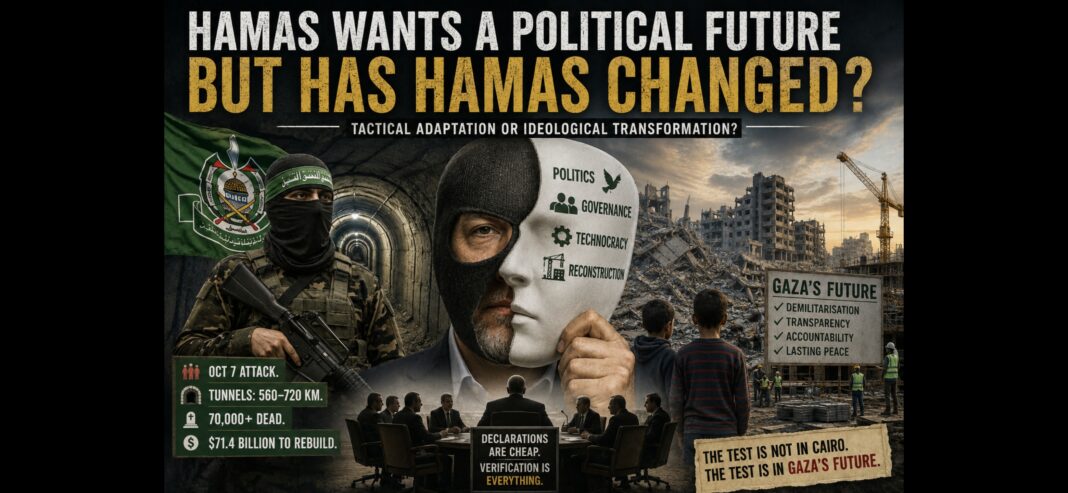
Hamas has been under extraordinary military pressure. The October 7, 2023 attack killed about 1,200 people in Israel and resulted in hundreds of hostages being taken. The war that followed has devastated Gaza. Current estimates cited by the Council on Foreign Relations put Palestinian deaths at more than 70,000, although casualty figures remain politically contested and difficult to independently verify in wartime. The physical destruction is staggering.
The April 2026 Gaza Rapid Damage and Needs Assessment by the United Nations, European Union and World Bank estimated $71.4 billion would be required for recovery and reconstruction over the next decade. Physical infrastructure damage alone was estimated at $35.2 billion, while economic and social losses amounted to another $22.7 billion. The assessment estimated that $26.3 billion would be needed in the first 18 months simply to restore essential services, critical infrastructure and economic activity.
This is not merely a reconstruction project. It is the rebuilding of an entire society. And that is precisely why the question of Hamas cannot be reduced to whether it will hand over its rifles.
The organisation built an enormous military infrastructure beneath Gaza. Estimates in early 2024 placed the tunnel network at approximately 560 to 720 kilometres – an extraordinary underground system for a territory only about 40 kilometres long. Those tunnels were not simply escape routes. They supported command posts, weapons storage, movement of fighters and military operations.
Destroying such an infrastructure is difficult. Preventing it from being rebuilt may be even harder. This is where Hamas’s political transition deserves scrutiny.
A military organisation under overwhelming pressure has a rational incentive to preserve its political structure even if its military structure is dismantled. The political apparatus can preserve personnel, relationships, influence, social networks, financial channels and organisational identity.
The gun can disappear. The organisation does not necessarily have to. That is why Hamas’s proposed transformation should not automatically be interpreted as an ideological conversion to liberal democracy, political pluralism or permanent peace.
There is a difference between accepting political reality and embracing political reconciliation.
The first can happen overnight. The second takes years.
Consider the sheer scale of the challenge facing Gaza. More than 43,000 people had sustained life-changing injuries, according to the World Health Organization data cited by the UN in May 2026. Most of Gaza’s population has been displaced at various points during the conflict, while basic health, housing, education and sanitation systems have been devastated.
A population living amid such destruction needs stability. Hamas needs political relevance. Those two facts can temporarily point in the same direction without meaning that Hamas has fundamentally changed. And this is where the international community must be exceptionally careful.
The proposed technocratic administration could be a positive development if it genuinely removes governance from armed factions. Gaza needs civilian institutions that can deliver electricity, water, healthcare, education, policing, employment and reconstruction without being controlled by Hamas or another militia.
But technocracy must not become Hamas by another name.
If former Hamas officials, loyalists or institutional networks retain effective control over ministries, municipal structures, security arrangements or reconstruction contracts, then the international community could unintentionally rebuild the organisational foundations of the very movement it is attempting to demilitarise. That would be a historic mistake.
There is another danger. The $71.4 billion reconstruction requirement creates an enormous economic prize. Billions of dollars will eventually flow into Gaza if a credible peace framework emerges. Cement, steel, telecommunications, housing, roads, hospitals, schools, ports, water infrastructure and electricity networks will have to be rebuilt.

Every one of those sectors will create influence. Who controls reconstruction controls patronage. Who controls patronage can control politics. And who controls politics can eventually rebuild power.
Therefore, international reconstruction must be tied directly to verifiable demilitarisation, transparent financial systems and independent auditing. Reconstruction money must build Gaza – not rebuild the machinery of war.
This is why the sequence matters.
Hamas cannot simply say: We are now political. It must demonstrate what being political actually means.
Does it accept political competition? Does it accept that another Palestinian political organisation can govern Gaza ? Does it accept that Palestinians who disagree with Hamas can organise freely?Does it accept that weapons belong to legitimate state security structures rather than political factions? Does it abandon recruitment and military training? Does it dismantle weapons manufacturing? Does it surrender control of tunnels? Does it permit independent verification? Does it accept that reconstruction will be controlled by civilian institutions rather than factional networks?
These are the real tests. Declarations are cheap. Verification is expensive. And history should teach the international community not to confuse the two.
There is also an uncomfortable reality for Israel. A sustainable Gaza settlement cannot be built exclusively around military control. If Gaza remains permanently devastated, politically isolated and economically hopeless, the conditions that nourish extremism will remain.
Security for Israel and a future for Palestinians are not contradictory objectives. They are interconnected. Israel needs a Gaza that cannot attack it.Palestinians need a Gaza in which their children do not grow up believing that armed struggle is their only political future.
The international community therefore has to demand two transformations simultaneously: Hamas must genuinely abandon its military infrastructure, while Gaza must receive a credible political and economic future.
One without the other will fail. If Hamas disarms but Gaza remains politically hopeless, another militant organisation could eventually fill the vacuum. If Gaza is rebuilt while Hamas retains an independent military capability, the reconstruction could ultimately finance another conflict.
The answer is neither permanent war nor unconditional legitimacy. It is conditional legitimacy based on measurable transformation.
Hamas should be allowed to prove that it has changed. But it should not be allowed to declare that it has changed and expect the world to believe it. That distinction matters because the consequences of getting this wrong will be enormous.
The October 7 attack demonstrated the destructive potential of Hamas’s military strategy. The subsequent war demonstrated the catastrophic price paid by Gaza’s civilian population. Now the proposed peace framework offers an opportunity to break the cycle.
But peace cannot simply mean that Hamas stops fighting today. Peace means creating a political system in which Hamas – or any other armed faction – has no incentive, capacity or justification to return to war tomorrow.
That requires dismantling the weapons. It requires dismantling the tunnels. It requires dismantling the command structures. It requires dismantling the financing. It requires dismantling the culture of armed political monopoly. And ultimately, it requires a political transformation that can be measured not by what Hamas promises in Cairo, but by what Gaza looks like five years from now.
The world should welcome Hamas coming to the negotiating table. But the negotiating table is not the finish line. It is the beginning of the test.
Hamas may be discovering politics because it has discovered the limits of war. That is not necessarily hypocrisy; organisations adapt when circumstances change. But adaptation is not transformation.
And the world must not give Hamas political legitimacy merely because military pressure has forced it to change its tactics.
The objective should not be to make Hamas a political organisation. The objective should be to make Gaza a place where no armed organisation needs to become powerful enough to hold its future hostage again.
That is the difference between ending a war and ending the conditions that create the next one.